
SSP Integration vs. Traditional Ad Management
Compare SSP integration and traditional ad management—speed, automation, transparency, scalability—and how SSPs boost publisher revenue and reduce fraud.

SSP Integration vs. Traditional Ad Management
SSP integration and traditional ad management are two very different approaches to selling ad space. SSPs (Supply-Side Platforms) use automated, real-time auctions to sell inventory in milliseconds, connecting publishers to a global pool of advertisers. In contrast, traditional methods rely on manual negotiations, fixed pricing, and slower processes, often leaving revenue opportunities untapped.
Key differences include:
- Speed: SSPs complete transactions in 100–200 milliseconds, while traditional methods can take days or weeks.
- Revenue Potential: SSPs increase competition among buyers, maximising revenue. Traditional systems use sequential "waterfall" models that can miss higher bids.
- Automation: SSPs automate tasks like pricing and reporting, reducing manual workload. Traditional methods demand significant human input.
- Transparency: SSPs provide detailed, real-time analytics, while traditional methods often lack visibility into buyer activity and pricing.
Quick Comparison
| Feature | SSP Integration | Traditional Ad Management |
|---|---|---|
| Transaction Speed | 100–200 milliseconds | Days to weeks |
| Revenue Model | Real-time bidding, dynamic pricing | Fixed pricing, waterfall model |
| Automation | High, API-driven | Low, manual processes |
| Data Transparency | Real-time analytics, detailed reports | Fragmented, delayed reporting |
| Scalability | Connects to global demand sources | Limited by manual capacity |
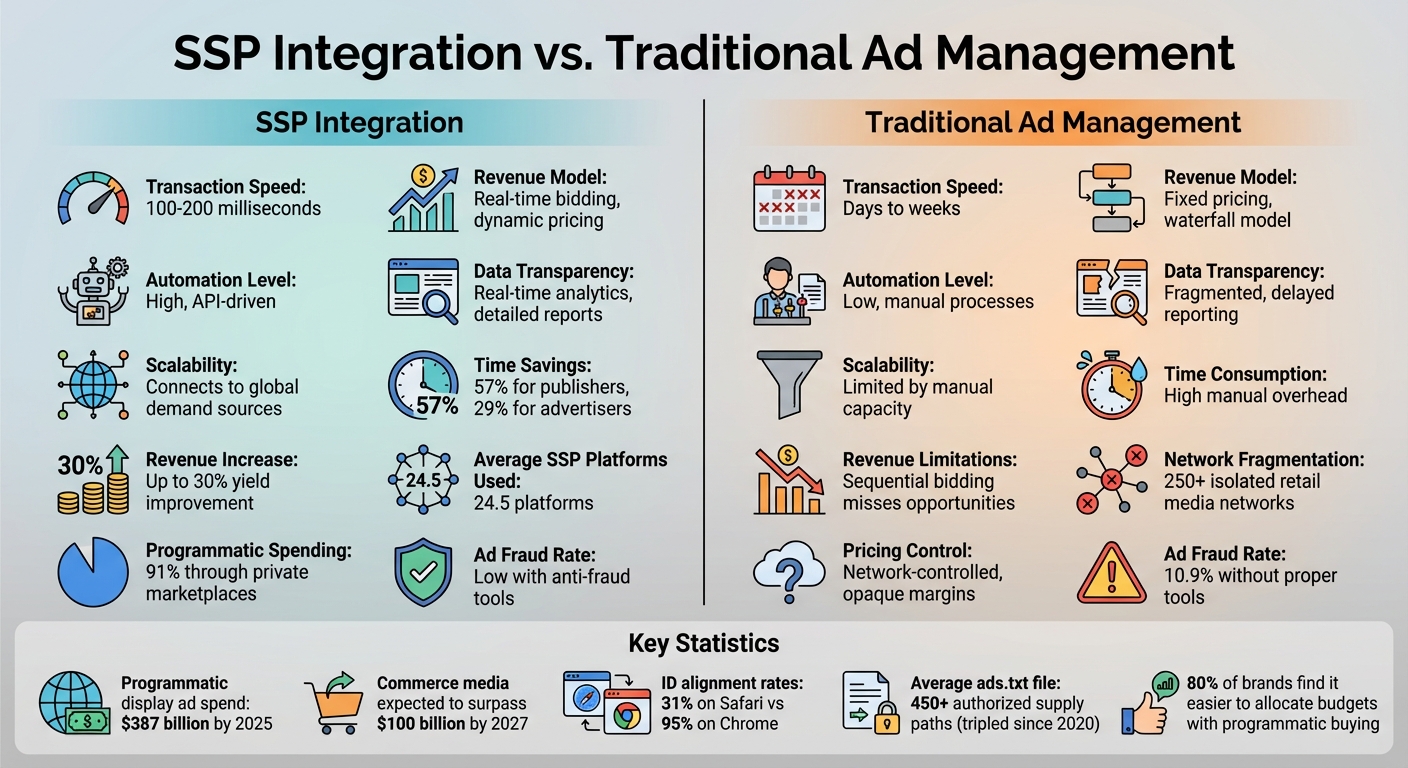
SSP Integration vs Traditional Ad Management: Key Differences Comparison
How SSP Integration Works vs. Traditional Ad Management
SSP Integration Workflow
SSP (Supply-Side Platform) integration operates through real-time bidding (RTB), handling everything in milliseconds. The moment a page loads, an ad request is triggered, carrying details like device type, location, and browsing behaviour. This request is instantly sent out to multiple demand-side platforms (DSPs) and ad exchanges within the programmatic ecosystem.
Before the auction begins, the SSP enhances the request using first-party data and identity signals. Then, it runs an automated auction where all demand sources compete simultaneously. Algorithms evaluate bids based on the publisher's rules - like minimum price thresholds and brand safety measures - and select the best bid in milliseconds. Tiberiu, CBDO & Co-Founder at Sevio, highlights this transformation:
"When I started in ad tech, SSPs were mostly just a bridge connecting publishers and buyers. But today it's different. Now, in that tiny moment, SSPs check if impressions are real and valuable; filter out bad or suspicious traffic; make sure the environment is safe; choose the best impressions for buyers".
This process, often called header bidding, ensures that every impression gets exposed to global demand without needing manual input. Instead of relying on sales teams to negotiate individual deals, software handles millions of transactions daily.
By comparison, traditional methods are far slower and less flexible.
Traditional Ad Management Workflow
Traditional ad management is rooted in manual processes. Sales teams negotiate campaign terms - like pricing, duration, placement, and targeting - well in advance, creating insertion orders (IOs) to formalise deals.
Inventory is typically sold using a "waterfall" model. In this setup, demand sources are ranked in a fixed order based on historical performance. When an impression becomes available, it is offered to the first demand partner in the list. If that partner doesn’t fill the impression, it moves to the next partner, and so on. This sequential approach means that high-value buyers at the bottom of the list might never even see the opportunity if an earlier partner secures the impression for less.
This method can take days or weeks to execute, with limited flexibility to adjust pricing or targeting based on real-time market trends. Reporting is often fragmented, making it hard to pinpoint which placements work best or why some inventory goes unsold.
sbb-itb-c231c83
Efficiency and Operations Compared
Automation and Time Savings
SSP integration processes transactions in just 100 to 200 milliseconds, completing real-time auctions before a webpage even finishes loading. Compare this to traditional ad management, where campaigns often take days or even weeks to finalise due to manual tasks like insertion orders, email exchanges, and price negotiations.
For publishers, programmatic guaranteed workflows through SSPs mean saving 57% more time compared to manual reservations. On the other side, advertisers and agencies save 29% of their time when switching to programmatic methods. Automation eliminates repetitive tasks, such as manually entering line items, drastically reducing the workload. As Manoj Donga, an AdTech expert, explains:
"If the integration requires you to manually create 1,000 line items, your AdOps team will quit. You need an SSP that pushes the configuration via API... to minimise the setup time".
SSPs also take automation further by using AI and machine learning to adjust floor prices and optimise yield in real time. Unlike traditional ad networks, which often focus on achieving a 100% fill rate, SSPs prioritise yield management, potentially increasing revenue by up to 30%.
This level of efficiency stands in stark contrast to traditional methods, where fragmented data and manual processes slow everything down.
Consistency Across Networks
Once automation saves time, the next challenge is ensuring consistency in data management. Traditional methods often rely on multiple platforms and manual reporting, which leads to fragmented data, delays in decision-making, and difficulty identifying top-performing placements.
SSPs address these issues by offering a centralised dashboard. This allows publishers to manage various inventory types - display, video, mobile, and CTV - all from a single interface. Instead of dealing with fragmented reporting, publishers gain access to real-time analytics, providing instant insights into metrics like fill rates, eCPMs, and demand partner performance. This streamlined approach reduces operational complexity and overhead.
To illustrate the growing complexity, the average ads.txt file now includes over 450 authorised supply paths, a figure that has tripled since 2020. SSPs simplify this by automating data management, ensuring consistency and minimising errors that often occur with manual updates across disparate systems.
Comparison Table: Efficiency and Operations
| Aspect | Traditional Ad Management | SSP Integration |
|---|---|---|
| Campaign Creation | Manual entry of line items and IOs; time-consuming | API-driven; automated via Programmatic Guaranteed |
| Transaction Speed | Days to weeks | 100–200 milliseconds |
| Operational Demands | High manual overhead | Low; automated auctions and yield optimisation |
| Data Consistency | Fragmented across different buyers and networks | Unified real-time analytics in one dashboard |
| Pricing Model | Fixed or sequential (waterfall) pricing | Real-time competition with dynamic floor prices |
| Scalability | Limited by manual sales capacity | Highly scalable across global demand sources |
Scalability and Revenue Potential
Demand Aggregation and Fill Rates
SSP integration isn't just about efficiency - it’s a game-changer for scalability and revenue growth. Traditional ad management often hits a ceiling due to manual processes and limited exposure to ad networks. SSPs break through these barriers by linking inventory to thousands of buyers across multiple Demand-Side Platforms (DSPs) and ad exchanges all at once.
To put this into perspective, programmatic display advertising reached a staggering $387 billion in ad spend by 2025, far outpacing the $61 billion spent on retail media. By leveraging SSPs, retail media networks can tap into these vast national brand budgets, which are primarily funnelled through DSPs, rather than being restricted to smaller shopper marketing allocations. Eric Brackmann from Koddi highlights this shift:
"Programmatic activation offers a way out of fragmentation... connecting commerce inventory to demand-side platforms (DSPs) where advertisers already transact".
This expanded exposure to buyers directly impacts fill rates and revenue. SSPs create real-time competition for ad space, driving up fill rates and yield. Publishers now work with an average of 24.5 SSP platforms to maximise market reach, and 91% of programmatic display spending flows through private marketplaces and programmatic direct deals. The trend is clear: 80% of brands and agencies find it easier to allocate budgets to commerce media when programmatic buying is available.
With scalability covered, let’s dive into how Adflux CMS enhances revenue optimisation.
Revenue Optimisation with Adflux CMS

For in-store digital screens, Adflux CMS integrates SSP programmatic capabilities to automate ad sales through real-time bidding (RTB) auctions. This opens up inventory to programmatic marketplaces, eliminating manual processes and expanding access to a broader pool of buyers.
Adflux CMS’s hardware-agnostic design allows retailers to scale their screen networks across multiple locations and formats without being tied to specific vendors. The platform works seamlessly with existing digital signage systems or as a standalone solution, offering immediate access to programmatic demand. Any unsold inventory is automatically routed to programmatic marketplaces, ensuring high fill rates with minimal effort.
One standout feature is its dynamic floor pricing, which adjusts based on factors like geography, device type, and real-time market demand. This ensures inventory captures its true market value, rather than being limited by static pricing models. Additionally, by integrating first-party audience data into bid requests, Adflux CMS increases bid competition and secures higher payouts.
Control, Transparency, and Measurement
Transparency and Brand Safety
Traditional ad management has long been criticised for its lack of clarity. Ad networks typically control pricing, take undisclosed cuts, and offer limited insight into who is buying your inventory and at what cost. SSP integration flips this dynamic by giving publishers direct control over pricing, access to buyers, and the quality of ads displayed.
With SSPs, publishers gain access to bid-level transparency, allowing them to manage ad quality proactively and understand why certain bids succeed or fail. This level of detail is something traditional networks can't match, as they typically provide only high-level, post-campaign summaries. As AdTech expert Kate Novatska explains:
"SSPs are optimised for control and competition. They require more setup but unlock better pricing mechanics".
SSPs also excel in brand safety. They allow pre-bid filtering to block malware and low-quality creatives before they appear, unlike traditional methods that rely on reactive measures and fixed agreements. The results are striking: campaigns without anti-fraud mechanisms experience ad fraud rates of 10.9% - 15 times higher than campaigns that use such technology. Moreover, the use of transparency tools has reduced spending on made-for-advertising (MFA) sites from 15% to 6.2%.
For retail media networks managing in-store screens, SSPs bring additional clarity to fee structures. Publishers can audit the "take rate" - the portion of ad spend consumed by fees - while traditional networks often obscure these margins. Standards like ads.txt and sellers.json reinforce this transparency, creating a clear trail of financial flows and eliminating the hidden costs often associated with traditional deals.
This enhanced transparency paves the way for more effective performance measurement.
Unified Reporting and Analytics
Beyond pricing control, SSPs streamline reporting by standardising metrics across platforms. Traditional ad management often results in fragmented data, with each retail media network using its own technology and measurement criteria. This forces advertisers to juggle multiple dashboards and reconcile inconsistent metrics manually. With over 250 retail media networks globally operating as isolated "walled gardens", comparing performance across platforms becomes a logistical nightmare.
SSP integration solves this issue with unified reporting. Instead of dealing with siloed systems, SSPs aggregate data from various demand sources into a single interface using standardised frameworks. This setup provides real-time analytics on metrics like fill rates, eCPMs, and auction dynamics, eliminating the delays associated with post-campaign summaries. Publishers also benefit from programmatic guaranteed deals, which are far more efficient than traditional manual reservations.
SSPs offer a deeper level of measurement. While traditional methods focus on basic metrics like impressions and clicks, SSPs provide impression-level reporting. Publishers can see exactly where ads ran, which buyer won the bid, and the clearing price for every impression. For retail media, this enables closed-loop reporting that connects ad exposure to purchase data, offering a clear view of campaign effectiveness.
Britany Scott from AI Digital captures this shift succinctly:
"The agencies winning today aren't those with the most SSP relationships. They're the ones who've fundamentally rethought what quality supply means in an era of signal degradation".
With ID alignment rates dropping to 31% on Safari compared to 95% on Chrome, SSP analytics play a crucial role in verifying signal integrity and preserving the value of inventory.
Comparison Table: Control and Transparency
| Feature | Traditional Ad Management | SSP Integration |
|---|---|---|
| Pricing Control | Network sets prices; opaque margins | Publisher sets floor prices and detailed rules |
| Buyer Visibility | Limited visibility of buyers | Buyers are largely visible and controllable |
| Data Access | Aggregated, inconsistent reports | Real-time log-level data and unified analytics |
| Reporting Speed | Often delayed, post-campaign | Real-time automated analytics |
| Brand Safety | Reactive vetting, fixed terms | Pre-bid filtering and AI fraud detection |
| Fee Transparency | Hidden margins | Auditable fees via sellers.json standards |
| Measurement Depth | Basic impressions and clicks | Impression-level data; closed-loop reporting |
| Revenue Impact | Limited by manual processes | Enhanced through real-time optimisation |
What Is a Supply-Side Platform (SSP)? How Publishers Sell Ads at Scale
Conclusion
The advantages of SSP integration - efficiency, scalability, and transparency - make it a compelling choice for retail media networks. This shift isn’t just about adopting new technology; it’s about reimagining how these networks function and grow. Traditional ad management, with its manual processes, unclear pricing, and disjointed reporting, falls short when compared to the streamlined automation and revenue optimisation that SSPs bring. For instance, publishers leveraging programmatic guaranteed workflows save considerable time over manual reservations, while benefiting from the growing programmatic display ad spend, which is expected to hit US$387 billion.
For Australian retailers, this efficiency translates directly into increased profitability. SSP integration replaces outdated manual systems with automated workflows and unified analytics, ensuring every ad impression is maximised. Campaigns lacking proper verification tools are far more vulnerable to ad fraud than optimised ones.
Platforms like Adflux CMS take this a step further by automating critical tasks such as content creation, partner management, campaign execution, and media sales. This ensures retailers retain control over pricing and brand safety while accessing the substantial budgets flowing through DSPs.
"A commerce SSP isn't just a technology choice - it's a growth strategy. As commerce media matures, SSPs will be the backbone of scalable monetisation, unified measurement, and advertiser trust".
With global commerce media expected to surpass US$100 billion by 2027, retailers embracing SSP integration today will be well-placed to capitalise on this growth. They can scale effectively without adding unnecessary complexity or increasing headcount. SSP integration offers a clear path to sustainable growth and greater transparency in retail media.
FAQs
Do I need header bidding to use an SSP?
No, header bidding isn't a requirement for using an SSP (Supply Side Platform). An SSP is a tool that helps publishers maximise their ad inventory by connecting with various demand sources, managing pricing strategies, and setting rules for ad placements. While header bidding can boost revenue by allowing multiple demand sources to bid simultaneously, SSPs can still operate effectively on their own, helping publishers improve ad sales and overall yield without relying on header bidding.
What data is needed for SSP integration to work effectively?
To make SSP integration work effectively, you’ll need a variety of data points. Start with impression metrics like ad requests and fill rates, alongside bid data from different buyers. Understanding your audience through user demographics - such as device types and locations - adds another layer of insight.
On the technical side, metrics like latency, timeout rates, and bid response times are critical for smooth operations. Don’t forget to factor in ad inventory availability, historical revenue trends, and content categories. These elements are key for fine-tuning price floors and strategies to ensure the SSP serves ads that are relevant while driving the highest possible revenue.
How do SSPs reduce ad fraud and improve brand safety?
SSPs play a key role in combating ad fraud and protecting brand integrity by employing sophisticated fraud detection and quality control measures. They utilise tools such as real-time fraud detection, pre-bid IP blocklists, and brand safety filters to ensure that ads appear in the right contexts. These systems work to identify and block suspicious activity, preserve brand reputation, and uphold the quality of ad inventory.
Adflux Editorial
Retail media, programmatic DOOH, and digital signage insights for Australian retailers.
Ready to build your retail media network?
Talk to the Adflux team about how the platform can work for your screens.