
How to Set Up Programmatic SSP for Retail Media Networks
Step-by-step guide to set up a programmatic SSP for retail media: system checks, data governance, API integration, pricing, inventory and performance monitoring.

How to Set Up Programmatic SSP for Retail Media Networks
Setting up a programmatic Supply-Side Platform (SSP) for retail media networks helps retailers maximise ad revenue by automating the sale of digital ad space. SSPs connect your inventory to advertisers via real-time auctions, ensuring optimal pricing and efficiency. Here's how to get started:
- System Readiness: Ensure your infrastructure supports OpenRTB protocols, handles real-time bidding, and integrates with technologies like Adflux CMS.
- Data Governance: Comply with privacy laws like GDPR and CCPA, and implement safeguards such as allowlists and blocklists.
- SSP Selection: Choose an SSP with features like real-time inventory management, commerce-specific targeting, and privacy-by-design capabilities.
- Integration: Use APIs to connect SSPs to your CMS, configure bid requests, and map inventory for seamless auctions.
- Inventory Management: Apply dynamic pricing strategies, segment inventory by placement type, and use analytics to optimise ad performance.
- Monitoring: Regularly track metrics like fill rates, eCPMs, and win rates to improve outcomes and address issues quickly.
Retail media networks adopting programmatic SSPs have seen significant improvements, including higher fill rates and increased eCPMs. Platforms like Adflux CMS simplify this process by centralising campaign management, automating updates, and improving ad targeting. With commerce media expected to exceed $100 billion globally by 2027, programmatic advertising offers a powerful way for retailers to unlock new revenue streams while maintaining control over their ad inventory.
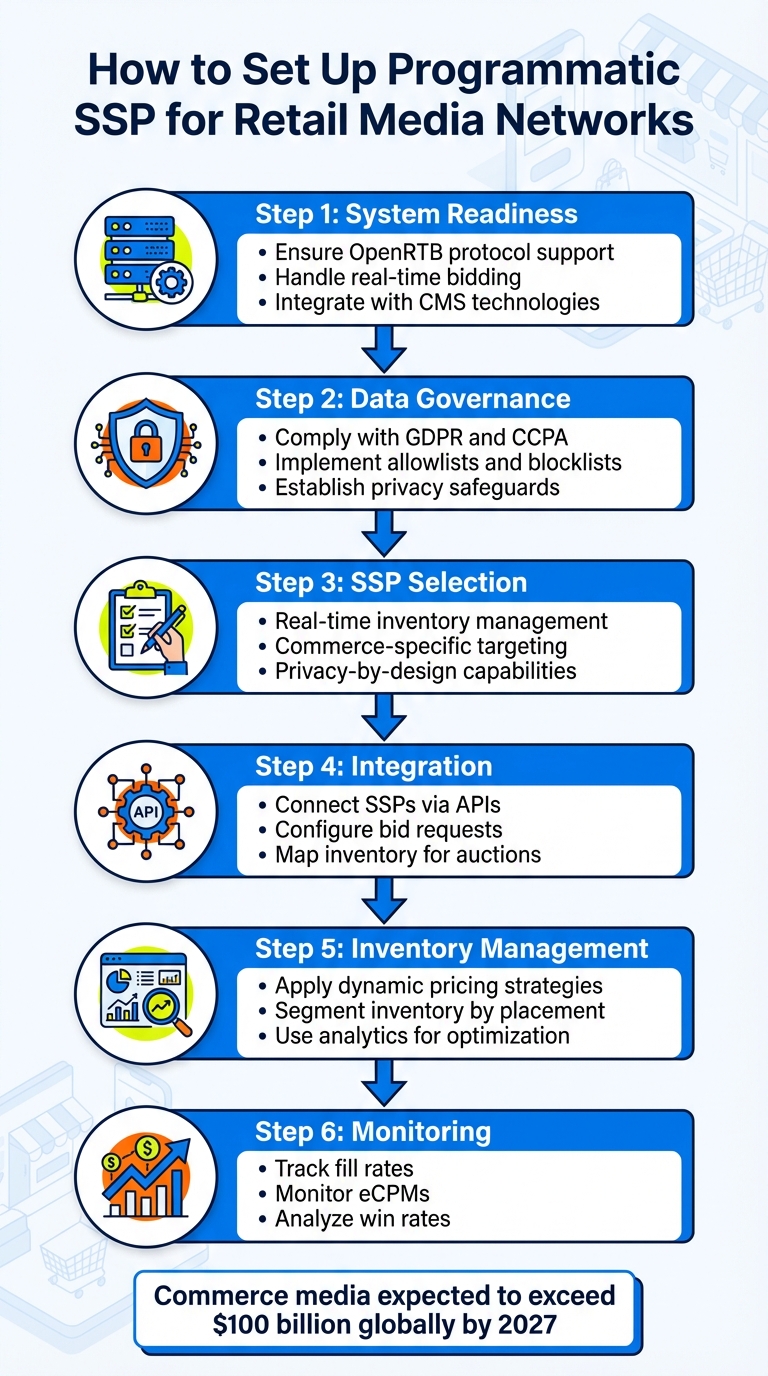
6-Step Process to Set Up Programmatic SSP for Retail Media Networks
Ad Tech Simplified: What is a Supply-Side Platform (SSP)?
sbb-itb-c231c83
Checking Your System Requirements
Before diving into programmatic marketplaces, it’s crucial to ensure your retail media setup can handle the fast-paced nature of real-time auctions. These auctions happen in milliseconds, meaning your system needs to respond quickly and support various ad formats across your digital screens.
Review Your Current Infrastructure
Start by checking if your systems are compatible with OpenRTB 2.5/2.6 protocols to ensure smooth communication with Demand-Side Platforms (DSPs). Your infrastructure should include:
- A scalable cloud environment to handle heavy traffic.
- Hardware capable of supporting the ad formats you plan to use.
- A robust integration layer to manage bid requests, interpret responses, and align data with SSP formats.
"SSP integration is the process of connecting a publisher's advertising inventory or an AdTech platform to a supply-side platform. As a result, ad impressions can be sold programmatically to multiple buyers in real time."
– Tamuna Basaria, Head of Sales and Business Development, Geomotiv
In September 2025, Adtrac expanded its retail media orchestration platform to support multiple SSPs. After testing with a major enterprise client earlier that year, the platform now enables retailers to connect with SSPs like Perion (formerly Hivestack), OneTech SSP1, Moving Walls, PlaceExchange, and, later in 2025, Vistar and Adform. This allows unbooked in-store ad inventory to be distributed programmatically while maintaining pricing control.
Once your infrastructure is ready, the next step is to focus on data governance and CMS integration.
Understand Your Data Governance Requirements
Australian retailers must comply with local data protection laws while considering global frameworks like GDPR and CCPA. Determine whether your technology partners act as data processors or controllers to ensure data handling aligns with your policies. Pay special attention to how IP addresses are used during real-time bidding. These should only be processed for operational purposes, like detecting invalid traffic, and must not be used for unauthorised targeting.
To protect your brand, implement safety measures such as allowlists, blocklists, and category exclusions. These steps will help ensure your ads don’t appear alongside inappropriate content.
Once data governance is in place, confirm that your CMS is fully compatible with programmatic requirements.
Verify Adflux CMS Compatibility
To maximise revenue, your Adflux CMS must meet specific integration needs. It should support real-time bid request generation, handle various media formats (like HD images, videos, and live web URLs), and offer remote health checks to monitor screen playback. Adflux CMS is tailored for in-store digital signage, automating updates like pricing, images, and availability based on live data. It also includes a self-service partner portal.
"Adflux CMS simplifies this process by offering a centralised platform where retailers can oversee all their digital signage campaigns... whether you're managing a handful of screens in a single store or a vast network spanning the entire country."
– Adflux
Make sure ad-related code loads asynchronously to prevent ad requests from delaying content rendering. Set up a sandbox environment to test bid requests and secure all necessary SSP specifications - such as endpoint URLs, API keys, and authentication details - to avoid delays during implementation.
Choosing and Setting Up Your SSP Technology
Selecting the right SSP technology can help boost revenue while simplifying connections with DSPs.
Required SSP Features
Your SSP should be compatible with OpenRTB 2.5 or 2.6 protocols to ensure smooth communication with DSPs like DV360 or The Trade Desk. Beyond basic compatibility, focus on features like real-time inventory management that dynamically adjusts pricing based on factors like demand, time of day, or audience activity. Precision targeting - using geolocation, demographics, and context - ensures ads remain relevant and non-intrusive.
Retail media SSPs differ from traditional ones by prioritising commerce-specific relevance. Instead of just filling ad slots, they match sponsored products to shopper behaviour and product categories. Closed-loop attribution is another must-have, offering direct, measurable links to sales and conversion data.
"When retail media networks maximize relevance and open up more supply - ideally flexibly versus fixed – this boosts product sales."
– Keith Bryan, Founder/CEO, Colosseum Strategy
Privacy features are crucial, especially in Australia, where data protection laws demand compliance with frameworks like GDPR and CCPA. Look for platforms with "Privacy by Design" capabilities, which use anonymous user IDs instead of personally identifiable information. With programmatic display expected to hit $387 billion globally by 2025 - compared to $61 billion for retail media - the opportunity to attract national brand budgets is immense.
These capabilities can be seamlessly integrated through Adflux CMS.
How Adflux CMS Supports SSP Integration
Adflux CMS enhances SSP integration by connecting your in-store digital inventory to external programmatic marketplaces via its digital signage API. This API ensures ads are displayed only for in-stock products. It also manages multiple sales channels, including direct bookings, self-service partner portals, and programmatic inventory, giving you full control over pricing and availability.
A centralised dashboard simplifies campaign management across all locations, automating updates based on real-time data like pricing changes and product availability. Remote health checks monitor screen playback and connectivity, ensuring programmatic ads are delivered effectively across retail locations. This automation reduces manual effort while maintaining both brand safety and operational consistency.
Configuration Steps
To get started, configure your SSP settings in Adflux CMS:
- Create a unique connection name and set it to "Active."
- Assign an AdOps or BizDev Manager for reporting purposes.
- Set financial parameters, including billing details, base commission percentage, and NET payment terms (15–90 days).
Set a QPS limit to avoid HTTP 429 errors during peak traffic. Configure supply chain settings by entering your business domain and selecting the seller type to ensure Sellers.json transparency.
Apply inventory filters to eliminate underperforming requests and enforce rules to block unsuitable ad types. Enable ad size augmentation to automatically add related dimensions to outgoing RTB requests, which can improve fill rates. Use Adflux’s screen grouping feature to organise displays by region or store type, making programmatic bidding more targeted and allowing for bulk updates. Lastly, set minimum price floors to protect premium retail ad space.
Connecting SSP to Your Retail Media Infrastructure
Once the SSP configuration is complete, the next step is to connect your SSP with the Adflux CMS. This involves API authentication, endpoint mapping, and validating bid requests to ensure smooth integration.
API Access and Connection Setup
To begin, create a dedicated API user account (e.g., dev_[customer]@relevant-digital.com) for technical support purposes. Gather the required credentials from your SSP, which typically include an API user email and password. For more advanced setups, additional security parameters like a consumer key and secret may also be necessary.
The connection relies on key-based authentication. This involves exchanging a permanent User Key for temporary access tokens, which usually expire within 24 hours. To optimise the connection, define both Base and data centre URLs, which help minimise latency when linking endpoints. Additionally, confirm access to your assigned 'namespace' to manage retail media data and settings effectively.
Whenever possible, prioritise API connections over CSV imports. APIs provide more up-to-date data and greater detail in reporting. Typically, maintaining an API connection involves around five calls per day for synchronising data.
Once the API connection is established, you can proceed to map bid requests for seamless auction integration.
Configure Bid Requests and Auctions
Mapping your retail data to the SSP requires aligning it with the OpenRTB 2.5/2.6 format. Use a modular adapter to accommodate custom fields and validation rules. Including real-time inventory signals - such as stock availability, product metadata, and first-party shopper data - within bid requests can significantly enhance demand quality and relevance.
For auctions, parallel auctions are the preferred method as they minimise latency and maximise yield. However, hybrid or waterfall setups may still be necessary for older systems. To maintain monetisation continuity, programmatic auctions must run within milliseconds. Set strict timeout limits for SSP connections to avoid delays caused by slow responses. Additionally, define a Queries Per Second (QPS) limit for each data centre to prevent errors such as "HTTP error 429: Too many requests" and to stay compliant with platform agreements.
"In practice, SSP integrations usually fail not because of missing code, but because technical, commercial, and compliance requirements are addressed in isolation."
– Tamuna Basaria, Head of Sales and Business Development, Geomotiv
A practical example comes from April 2025, when Geomotiv built a custom SSP for a mid-market omnichannel retailer in the USA. The solution replaced manual IO setups and used Go for the back-end and Redis for real-time caching. Managing 5 million ad impressions daily, the platform centralised auction logic and integrated inventory across product listings and search results. This reduced ad response times from 120ms to 45ms. Within three months, the retailer saw a 20% boost in fill rates for high-demand placements and an 18% increase in eCPMs.
The following table summarises the integration process:
Integration Workflow Summary
| Integration Step | Adflux CMS / Platform Tool | Expected Result |
|---|---|---|
| 1. Credential Setup | User Settings > User Key / API Key | Secure access keys generated for authentication. |
| 2. Connection Config | Configuration > Integrations > + New SSP | SSP type and data parameters defined. |
| 3. Auth Exchange | API Header / Token Service | Time-limited access token received for a secure session. |
| 4. Endpoint Linking | Platform Settings > Marketplaces | Connection established between CMS and SSP endpoint URLs. |
| 5. Data Mapping | Admin > Missing SSP Traffic | SSP IDs mapped to internal site/placement IDs. |
| 6. Verification | Reports / Live Logs | Real-time data flow and bid request functionality confirmed. |
To ensure accurate mapping and reporting, assign unique IDs to each placement. Use Adflux's playback reports and live logs to verify ad rendering and tracking across your network.
Managing Inventory and Ad Placements
Once your SSP is connected to Adflux CMS, the next step is to organise your inventory effectively. The goal? To boost revenue and attract more advertisers. By segmenting your inventory, applying dynamic pricing, and ensuring compliance, you can maximise your returns.
Set Up Pricing Strategies
Dynamic pricing is key to balancing fill rates and CPMs. By setting real-time price floors, you can adjust to market demand, audience value, and placement type. For instance, CPMs for in-store checkout screens typically range from $30 to $50, aisle displays fall between $10 and $20, and on-site display or video inventory averages $10 to $40.
Take the example of Blitz, which implemented dynamic flooring technology in late 2023. They saw a 7% revenue jump in November and another 6.5% increase in December. Similarly, Arkadium expanded dynamic flooring to cover 80% of their impressions in 2024, resulting in a 34% lift in session RPM, a 37.8% eCPM boost, and an improved fill rate from 83% to 87%.
"Dynamic price floors aren't about complex algorithms. They're about adapting to what your inventory is actually worth in real-time."
– Justin Wohl, Ad Operations Expert, Aditude
For the best results, align your price floors across all SSPs and Google Ad Manager Unified Pricing Rules (UPRs). Inconsistent pricing can lead to bidders winning inventory without proper competition. Fine-tune your pricing strategy by segmenting inventory based on factors like device type, geographic location, browser, and time of day. And if you’re manually adjusting floors, make small changes (e.g., $0.03 increments) to avoid sudden dips in fill rates while the system adjusts.
Use AI-Powered Analytics
While pricing strategies focus on revenue, analytics help refine ad placement for better performance.
Adflux CMS offers AI-powered tools to optimise ad placements and improve overall yield. By leveraging first-party data, you can create audience segments based on purchase history, browsing habits, and demographics. This makes each ad impression more valuable and attracts higher bids from demand-side platforms.
For example, in 2024, Happy Hippo used first-party data to achieve impressive results: they cut customer acquisition costs by 70%, increased conversion rates by 200%, and reached a 5.1x ROAS. Additionally, Adflux's automated system uses real-time data to distribute ad content to the most effective screens.
Segmenting inventory into three main streams - On-site (sponsored products, display, video), Off-site (CTV, social media, DOOH), and In-store (digital screens at entrances, checkouts, and aisles) - can help you tap into diverse ad placements. You can also distinguish between endemic advertisers (brands sold within your store) and non-endemic advertisers (such as financial services or automotive brands) to broaden your market reach. This segmentation allows for tailored monetisation strategies, improving fill rates while maintaining control.
Analytics also play a crucial role in maintaining brand safety and ensuring compliance.
Ensure Brand Safety and Compliance
Brand safety measures are essential for protecting your retail media network's reputation and maintaining advertiser trust. Private marketplace (PMP) controls, like allowlists and blocklists, ensure ads only appear in approved environments.
In February 2026, Coles 360 set a precedent as the first Australian retail media network to participate in the IAB Australia Retail Media Certification Programme audit. Spearheaded by General Manager Tiffany Chen, this initiative involved an independent review of measurement practices to meet IAB Europe's standards.
"Measurement plays an increasingly critical role in retail media... This certification is an important step towards creating industry-wide standardisation and strengthening accountability."
– Tiffany Chen, General Manager, Coles 360
To ensure compliance with regulations like GDPR and CCPA, implement the IAB Transparency and Consent Framework (TCF). This helps manage privacy controls while using IP addresses in programmatic auctions to detect and block invalid traffic (IVT/SIVT) and deduplicate bids. Additionally, setting floor prices in your SSP can prevent undercutting high-margin direct sales. Use strategies like waterfall prioritisation or "deal placeholders" to prioritise direct-sold campaigns.
Monitoring and Improving SSP Performance
Once your SSP is live, keeping an eye on the right metrics helps you spot both opportunities and problems early. Beyond managing your inventory, regular performance checks are the backbone of long-term success.
Set Up Performance Monitoring
Real-time tracking is essential to catch technical issues before they start eating into your revenue. Adflux CMS analytics tools can help you measure:
- Auction win rates and inventory fill rates across all demand sources.
- eCPM performance: Low win rates might mean your floor prices are too high, while high error rates often point to technical integration issues.
- Bidstream integrity: Make sure bid requests reaching demand partners are legitimate. Watch for signal tampering, auction duplication, and fraud rates.
- Outcome-based KPIs: Metrics like ROAS, conversion rates, and total sales link your ad performance directly to business outcomes.
Ask your SSP partners how they verify video placement signals and what share of your inventory passes fraud filters. This is especially important now, as ID alignment rates have dropped to 31% on Safari, compared to 95% on Chrome.
Run A/B Tests
A/B testing is your go-to strategy for figuring out what actually works. Focus on one variable at a time - like ad format, floor price, or inventory segment - and run tests until you have enough data to make decisions (e.g., 100–200 clicks or 20+ conversions).
For pricing experiments, test different floor prices and auction strategies, such as header bidding versus waterfall, to maximise revenue. Dedicate about 10% of your budget to these tests over a period of two weeks before scaling. If you’re testing major changes - like switching from Target CPA to Target ROAS bidding - monitor results for at least seven days or 50 conversions before drawing any conclusions.
"Treat AI like a skilled employee: provide clear objectives, set guardrails, review results regularly, but don't micromanage every decision."
– Mike Masiello, Gourmet Ads
If you’re using multiple SSPs, try different setups across regions or inventory segments. This can help reduce platform risk and pinpoint demand sources that yield better results.
Improve Performance Over Time
Once you’ve completed your initial tests, regular reviews are key to keeping your performance on track. Check metrics like CPM growth, fill rate improvements, and budget utilisation monthly to assess profitability and scaling potential. With 91% of programmatic display spending now flowing through private marketplaces and direct deals (growing at 13% annually), prioritising quality over quantity is more critical than ever.
Conduct regular audits of your supply paths to eliminate inefficiencies. The average ads.txt file now includes over 450 authorised supply paths, a threefold increase since 2020. Cutting down on intermediary hops helps preserve both your budget and signal quality.
Finally, balance your demand sources. Endemic advertisers (those selling directly on your platform) often generate 70% of revenue, while programmatic SSPs capture the remaining 30% from display and non-endemic sources. By balancing direct bookings, self-service campaigns, and programmatic demand - and maintaining control over pricing through your orchestration layer - you can maximise revenue and streamline operations.
Summary
Setting up a programmatic SSP for your retail media network doesn’t have to be complicated. Start by confirming that your infrastructure supports real-time bidding. Then, follow the steps to integrate, configure, and manage your SSP effectively. This includes connecting your SSP via API integrations, fine-tuning your auction logic, and using smart pricing strategies alongside strong brand safety measures to manage inventory.
Platforms like Adflux CMS make the process even easier. It offers a centralised system that handles everything from inventory aggregation to automated campaign distribution. With Adflux, you can unify your digital and in-store inventory, opening it to programmatic marketplaces while monitoring performance from a single dashboard. API integrations ensure that digital signs only promote products currently in stock, while advanced audience targeting uses first-party data without requiring manual segmentation. This centralised approach also simplifies performance tracking across your entire network.
Commerce media is expected to surpass $100 billion globally by 2027, with up to 80% of brands shifting their budgets to programmatic channels. Retailers often see profit margins between 50% and 70% from ad revenue.
To optimise your strategy, prioritise automation and standardisation to cut down on operational costs. Features like screen grouping allow you to update content across entire regions simultaneously. Implementing header bidding can drive competition for impressions, while adopting industry standards like OpenRTB ensures compatibility with global demand sources. Keep an eye on metrics like win rates, eCPM, and fill rates to quickly identify and address any issues.
FAQs
What’s the quickest way to check if my systems are OpenRTB-ready?
To determine if your systems are prepared for OpenRTB, start by confirming that your platform can handle communications based on the OpenRTB protocol. This includes mapping your internal data structures to the OpenRTB format and managing both requests and responses effectively. Make sure your infrastructure is equipped to support standard API calls and properly process responses. Additionally, consulting detailed integration guides can provide clarity and help simplify the setup process.
How do I keep shopper data private while still improving bid prices?
To safeguard shopper data while refining bid prices, prioritise privacy-first strategies and adhere to data regulations. Instead of relying on personally identifiable information (PII), focus on using aggregated or anonymised data. This method enables precise targeting without infringing on privacy.
By taking this approach, you not only ensure compliance with regulations but also foster trust with your audience. Plus, it helps improve ad performance by leveraging insights that are both relevant and privacy-compliant, allowing you to optimise bid prices effectively.
Which metrics should I monitor daily after the SSP goes live?
Once your SSP (Supply-Side Platform) is live, keeping a close eye on specific metrics is crucial to ensure everything runs smoothly and generates revenue effectively. Here's what to focus on every day:
- Inventory performance and fill rates: Check how well your available ad space is being utilised. High fill rates mean more of your inventory is being sold.
- Floor CPM (Cost Per Mille): Keep an eye on your minimum pricing to make sure it aligns with your revenue objectives.
- Bid activity and competition: Study bidding trends to understand demand and adjust strategies if needed.
- Ad impressions and CTR (Click-Through Rate): These metrics reveal how well your ads are engaging users and driving clicks.
- Revenue metrics: Review your daily earnings and average CPM to track overall performance.
Consistent tracking of these metrics allows you to fine-tune your approach, ensuring optimal performance and better ad revenue.
Adflux Editorial
Retail media, programmatic DOOH, and digital signage insights for Australian retailers.
Ready to build your retail media network?
Talk to the Adflux team about how the platform can work for your screens.