
How Real-Time Bidding Works in Retail Media
Explains how RTB powers retail media auctions, how SSPs, DSPs and exchanges work, plus privacy and optimisation.

How Real-Time Bidding Works in Retail Media
Real-time bidding (RTB) is an automated system that allows advertisers to bid on digital ad space in milliseconds, targeting individual users rather than bulk website sections. This process has reshaped retail media by enabling impression-level auctions, dynamic pricing, and precise targeting. Key components include:
- Supply-Side Platforms (SSPs): Manage and price ad inventory for publishers, ensuring quality and privacy compliance.
- Demand-Side Platforms (DSPs): Allow advertisers to evaluate bid requests and optimise campaigns using AI-driven predictions.
- Ad Exchanges: Facilitate auctions, validate bids, and select winners under strict time constraints.
RTB benefits retail media operators by increasing competition (bid density), boosting revenue, and automating ad transactions. It also ensures ads are delivered efficiently across online and in-store platforms. However, success depends on robust data handling, privacy compliance, and optimised auction strategies.
Key Stats:
- RTB processes occur in under 100 milliseconds.
- By 2024, programmatic advertising accounted for 80% of US digital ad spending.
- Retail media is projected to reach $62.35 billion in the US by 2025, making up 18% of digital ad spending.
RTB is transforming how retail media operates, offering a faster, more targeted, and efficient approach to ad space monetisation.
Real Time Bidding in Retail Media with Macy’s Michael Krans and Pentaleap’s Andreas Reiffen
sbb-itb-c231c83
Core Components of Real-Time Bidding Systems
At the heart of automated ad buying in retail media are three key technologies: Supply-Side Platforms (SSPs), Demand-Side Platforms (DSPs), and Ad Exchanges. These systems work together to facilitate lightning-fast transactions every time a shopper loads a page or app.
Supply-Side Platforms (SSPs)
SSPs act as the backbone of the sell-side, helping retailers organise and price their ad inventory before distributing it to potential buyers. When a shopper views a product page, for instance, the SSP creates a BidRequest JSON object. This object contains details like placement information, device data, contextual signals, and privacy consent.
But SSPs do more than just generate bid requests. They play a critical role in maintaining quality by filtering out invalid traffic, rejecting requests without proper user IDs, and blocking unauthorised buyers or low-quality ads. They also optimise revenue using dynamic price floors, which set the minimum price for an impression based on historical trends and user data.
"An SSP isn't just a pipe. It's where a publisher turns inventory into a product".
Retail media platforms like Adflux CMS take this a step further by integrating SSP functionality directly into their content management systems. This allows retailers to monetise both in-store digital screens and online inventory via real-time auctions, managing content scheduling and programmatic revenue from one platform.
Once the SSP packages the inventory, the DSP steps in to evaluate its worth.
Demand-Side Platforms (DSPs)
DSPs are the tools advertisers use to assess bid requests and decide how much to bid based on their targeting and campaign goals. Here’s how it works:
- A listener captures incoming requests.
- Targeting filters weed out irrelevant users (e.g., due to incorrect ad sizes or frequency caps).
- Models predict the value of each impression.
- Bid shading optimises the bid amount.
- A pacing service ensures the campaign stays on budget.
In under two milliseconds, the DSP matches a user ID with internal audience segments - such as "Auto Intender" or "High Income" - to ensure precise targeting. Using AI and machine learning, the system calculates the likelihood of a click (pCTR) or conversion (pCVR). The bid amount is then determined by multiplying this probability by the advertiser’s target value.
For example, in December 2024, bath and body care brand Happy Hippo used Shopify Audiences integrated with DSP targeting to refine their programmatic ad spend. By tapping into customer data to find similar audiences, they saw impressive results: a 70% lower cost to acquire new customers, a 200% rise in conversion rate, a 5.1x return on ad spend, an 86% increase in new customers, and a 51% drop in CPM.
Once DSPs submit their bids, the ad exchange takes over to manage the auction.
Ad Exchanges and Auction Systems
Ad exchanges serve as the marketplace where SSPs and DSPs meet to trade ad inventory. They ensure smooth communication between systems, often using the OpenRTB protocol for standardisation.
When an SSP sends a bid request to an exchange, it broadcasts the request to multiple DSPs. The exchange collects the bids, validates them (checking for correct creative sizes and security compliance), ranks them by price, and selects the winner based on auction rules.
Most exchanges have moved to first-price auctions, where the winning bidder pays the exact amount they bid, unlike the older second-price model where the winner paid just above the second-highest bid. Exchanges operate under strict time constraints, typically dropping any bids that arrive after the 100-millisecond mark.
To put this into perspective, around 178 trillion automated auctions occur annually across the U.S. and Europe, with exchanges processing tens of billions each day. Beyond running auctions, exchanges handle financial reconciliation, matching winning bids with tracking pixels to ensure accurate billing.
The Real-Time Bidding Process: 5 Steps
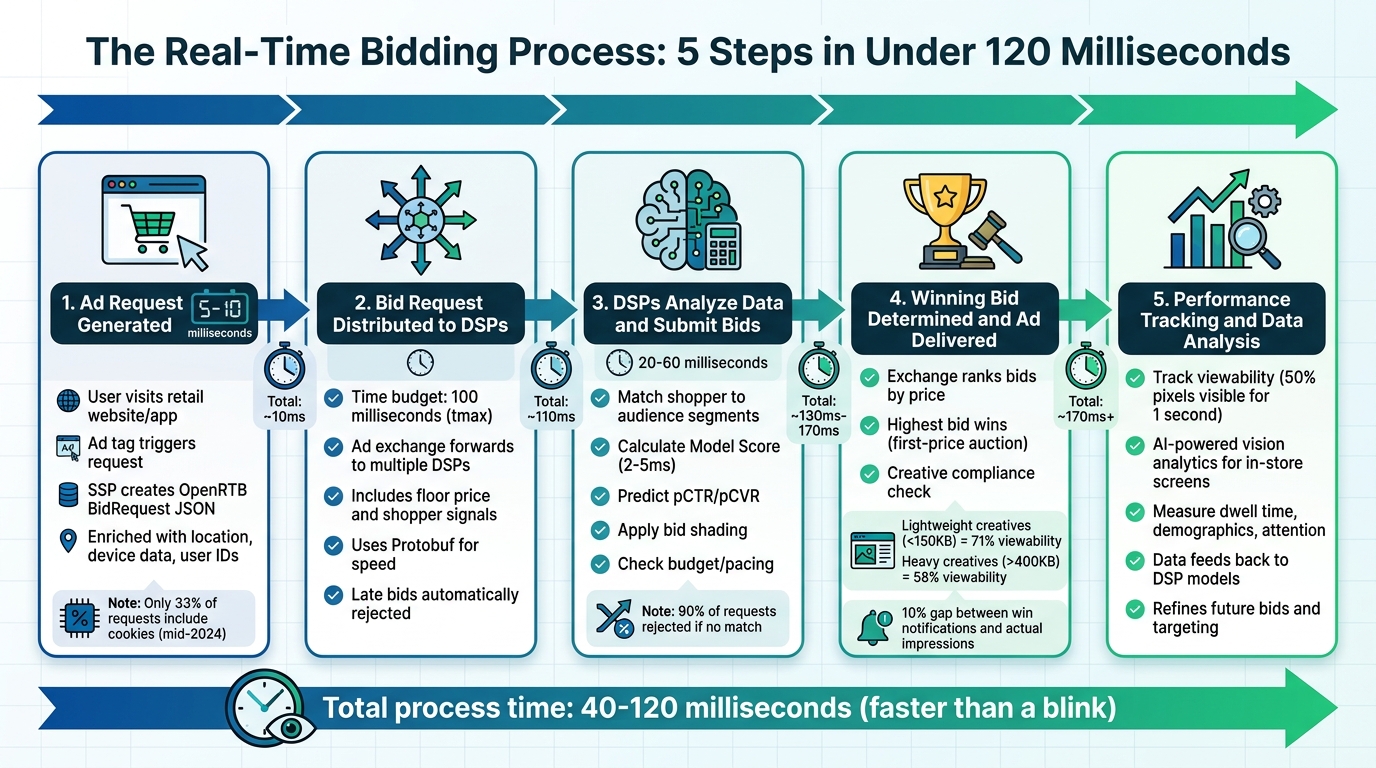
Real-Time Bidding Process: 5 Steps in Under 120 Milliseconds
The entire process - from when a page loads to when an ad appears - happens in just 40 to 120 milliseconds. That’s faster than the blink of an eye.
Step 1: Ad Request Generated
When someone visits a retail website or opens a mobile app, the browser triggers an ad request using an ad tag embedded in the page header. The publisher's ad server then packages this request, often as an OpenRTB BidRequest JSON object. At this stage, the supply-side platform (SSP) enriches the request with extra details, such as location data derived from an IP lookup, all within about 5–10 milliseconds.
This bid request includes a mix of user IDs, device details, ad inventory size, location, and compliance signals. With privacy regulations tightening, only 33% of bid requests now include cookies as of mid-2024. To adapt, the industry increasingly relies on first-party data and hashed emails for server-side ID matching. Privacy strings are also included to ensure user consent is communicated throughout the chain. Once enriched, the request is sent to the ad exchange for further processing.
Step 2: Bid Request Distributed to DSPs
After enrichment, the ad exchange forwards the request to multiple demand-side platforms (DSPs). Each request includes a latency budget (tmax), which is the maximum time allowed for bids to be submitted - usually set at 100 milliseconds. Late bids are automatically ignored. The request also contains the publisher's floor price (minimum bid) along with shopper behaviour signals and contextual data.
For speed, binary formats like Protobuf are often used to transmit these requests.
Step 3: DSPs Analyse Data and Submit Bids
DSPs have just 20–60 milliseconds to evaluate the request. They match the shopper to audience segments using internal data, filter out irrelevant inventory, and predict the likelihood of a click (pCTR) or conversion (pCVR) based on historical data. Calculating this "Model Score" typically takes 2–5 milliseconds. The bid amount is then calculated by multiplying this probability by the advertiser's target goal.
In first-price auctions, DSPs use techniques like bid shading to avoid overpaying while maintaining a competitive edge. Before submitting a bid, the DSP checks its budget and pacing strategy to ensure spending is spread evenly throughout the day. Interestingly, DSPs often reject up to 90% of bid requests outright if the shopper doesn't match the target profile. If no bid is submitted, a quick HTTP 204 "No Content" response is sent to minimise bandwidth use.
Step 4: Winning Bid Determined and Ad Delivered
The ad exchange collects all valid bids and ranks them by price. The highest bid wins, provided it meets or exceeds the publisher's floor price. If two bids are tied, the one received first takes precedence.
Before finalising the winner, the exchange checks the creative for compliance and file size. Lightweight creatives (under 150KB) perform better, as they load faster and improve viewability. For example, reducing a creative's size from over 400KB to under 150KB can boost viewability rates from 58% to 71%.
"If an auction takes too long, the user might scroll past the ad unit before the creative even arrives, or worse, the webpage load time will lag." - Samir ElKamouny, Founder, Fetch and Funnel
There’s often a 10% gap between "win" notifications and actual ad impressions due to factors like network delays or users leaving the page before the ad loads. A "win" notification (nurl) is sent immediately for logging, while the billing signal (burl) activates only when the ad successfully renders in the shopper’s browser.
Step 5: Performance Tracking and Data Analysis
Once the ad is delivered, viewability is tracked by checking if at least 50% of its pixels remain visible for one continuous second. This data confirms delivery and provides advertisers with performance insights.
For in-store digital screens, viewability tracking becomes more advanced. Tools like Adflux CMS use AI-powered vision analytics to measure audience engagement, collecting data on metrics such as dwell time, demographics, and attention levels. These insights ensure advertisers know their ads reached the intended audience, whether online or in physical locations.
The data gathered during this step feeds back into the DSP’s predictive models, helping refine future bids and improve targeting accuracy over time. This feedback loop keeps the real-time bidding process running more efficiently as campaigns progress.
Connecting RTB with Ad Inventory Management Systems
Integrating real-time bidding (RTB) with ad inventory management streamlines ad delivery and maximises efficiency. Retailers need a unified system to link RTB demand with their physical ad inventory.
Adflux CMS acts as the central hub, overseeing content management and programmatic monetisation from a single platform. Equipped with a built-in supply-side platform (SSP), Adflux CMS connects retail networks to over 35 global demand-side platforms (DSPs), including The Trade Desk, Google DV360, and Xandr. When an ad slot becomes available, the SSP initiates an RTB auction across all connected DSPs in under 50 milliseconds. The winning ad is then delivered to the appropriate screen or audio zone, aligning perfectly with the campaign's targeting criteria. This setup ensures rapid and precise ad delivery across various retail locations.
Ad placement is managed through a slot-based engine that schedules ads based on advertiser categories, priority levels, or inventory status. Unlike older waterfall models, where demand sources are processed one at a time, true RTB allows all buyers to bid simultaneously. This approach often results in CPM increases of 30–80%.
To maintain brand safety, multiple safeguards are in place. Private marketplace (PMP) activation limits access to approved buyers, while advertiser and category whitelisting blocks unsuitable brands. Creative approval workflows ensure all content is reviewed before going live, and a real-time "kill-switch" at the CMS level enables instant ad removal if necessary. Additionally, the platform provides full proof-of-play reporting, verified at both the screen and campaign levels, giving advertisers confidence that their ads were displayed as intended.
Inventory allocation is further enhanced by dynamic floor pricing and yield management. These strategies balance direct-sold campaigns with programmatic demand by adjusting minimum bid thresholds in real time. Physical inventory adapts to real-time demand, ensuring pricing remains efficient. API integrations with point-of-sale (POS) systems and inventory databases allow dynamic content to reflect current product availability. Meanwhile, content tagging enables promotions to target specific events, seasons, or times of day without requiring manual updates.
Advantages and Implementation Approaches for Retail Media Operators
Main Advantages of RTB
Retail media operators can gain a lot from integrating Real-Time Bidding (RTB) into their strategies. One of the biggest perks is increased bid density, which happens when multiple demand sources compete for the same impression. This competition drives up clearing prices, boosting revenue without needing additional traffic. RTB also enables impression-level valuation, allowing operators to price each impression based on live data.
Another key benefit is automation. RTB transforms what used to be time-consuming manual negotiations into lightning-fast processes that take less than 100 milliseconds. This efficiency aligns with the growing retail media market, which is projected to hit around $62.35 billion by 2025, making up nearly 18% of U.S. digital ad spending. With 80% of media buyers now prioritising programmatic tools for retail media purchases, operators adopting RTB can better meet these demands while staying competitive.
Auction Optimisation Techniques
To maximise the advantages of RTB, operators can fine-tune their auction strategies. One effective method is dynamic floor pricing, which helps maintain inventory value while keeping fill rates steady. Hard floors reject bids below a set minimum, but soft floors allow slightly lower bids during low-demand periods, ensuring no revenue opportunities are missed.
Another critical factor is match rate monitoring. If the user match rate between the publisher and demand-side platform (DSP) drops below 60%, both bid density and revenue take a hit.
Creative optimisation is equally important. For instance, using lightweight creatives (under 150KB) can significantly improve viewability rates - from 58% to 71% - compared to larger files. Encouraging advertisers to reduce creative file sizes, while combining first-party retail data with contextual targeting, can improve conversion rates and maintain privacy standards.
Manual vs RTB Inventory Management
| Aspect | Manual Management | Real-Time Bidding (RTB) |
|---|---|---|
| Speed | Sluggish (manual proposals and phone negotiations) | Instant (under 100ms) |
| Targeting Precision | Limited (bulk hits, site sections) | Highly precise (impression-level, user-specific) |
| Revenue Yield | Lower (fixed rates, "waterfall" waste) | Higher (dynamic auction, increased bid density) |
| Control | Limited (pre-negotiated, static) | Advanced (dynamic floors, advertiser filtering) |
| Pricing Logic | Fixed CPM | Dynamic/auction-based |
This table highlights the stark contrast between manual and RTB inventory management. Moving to RTB isn't just an operational change - it’s a strategic upgrade. As Leah Sallen, Managing Director of Commerce Media at VML, puts it:
"The world of retail becomes a little bit of a black box, where you maybe necessarily don't know how much you're spending versus a competitor. It allows us actually to be more competitive and create a more advantageous space."
Conclusion
RTB is transforming retail media by replacing outdated manual negotiations with lightning-fast automated auctions that operate in under 100 milliseconds. This shift boosts efficiency, allows for precise targeting, and drives higher revenue potential. The benefits are clear, and the market data backs them up.
Retail media is projected to make up nearly 18% of U.S. digital ad spending by the end of 2025, reaching approximately $62.35 billion. Additionally, 80% of media buyers now prioritise programmatic tools. These trends highlight the growing influence of RTB across global retail media markets. Anthony Costanzo, Chief Analytics Officer at Mile Marker, captures this shift perfectly:
"Media buyers are very used to and comfortable with auction-based and real‑time buying methods from non‑retail media now. There's that expectation they should be able to execute that in the retail media world as well."
For retail media operators, the key to successful RTB adoption lies in robust identity infrastructure and effective auction strategies. Low match rates can directly impact bid density and revenue, while dynamic floor pricing ensures inventory value is protected without compromising fill rates. Platforms like Adflux CMS exemplify how programmatic SSP capabilities can be seamlessly integrated into retail media management systems, allowing operators to tap into global demand while maintaining control over their ad space. This integration bridges the gap between precision targeting and operational control.
The shift from manual inventory management to RTB isn't just a technological upgrade - it's a strategic move. By embracing real-time auctions, operators can meet the growing demand for programmatic advertising while delivering the transparency and efficiency advertisers now expect. RTB isn't just changing the game; it's redefining how retail media operates.
FAQs
What data is shared in an RTB bid request?
When an RTB (real-time bidding) bid request is sent, it includes a wealth of information to guide advertisers in making quick, informed decisions. This data typically covers details about the user - such as demographics, browsing habits, and location. It also provides specifics about the ad space, including its size and placement, as well as details about the device being used. Additionally, it includes contextual information about the page or app where the ad is set to appear. All of this combined enables advertisers to craft bids that are both timely and relevant.
How do retailers protect privacy and consent in RTB?
Retailers protect user privacy and ensure consent during real-time bidding (RTB) by taking several key steps. First, they secure user consent before gathering any data, ensuring transparency in their practices. They also minimise the handling of sensitive information, reducing potential risks.
To stay compliant, retailers strictly follow privacy laws such as the GDPR (General Data Protection Regulation) and CCPA (California Consumer Privacy Act). Furthermore, they keep track of enforcement actions and adopt updated privacy controls introduced through regulations or legal settlements. These measures help maintain trust while aligning with legal requirements.
How can Adflux CMS connect RTB auctions to in-store screens and audio?
Adflux CMS integrates real-time bidding (RTB) auctions with in-store screens and audio using its programmatic supply-side platform (SSP). This technology allows automated ad buying and selling across over 35 demand-side platforms (DSPs), making it a powerful tool for retail media networks. The platform simplifies auction-based campaigns, ensuring ads are placed efficiently and dynamically.
Adflux Editorial
Retail media, programmatic DOOH, and digital signage insights for Australian retailers.
Ready to build your retail media network?
Talk to the Adflux team about how the platform can work for your screens.