
How RTB Transforms In-Store Advertising
RTB turns in-store screens into data-driven ad channels with impression-level bidding, precise targeting and instant campaign updates.
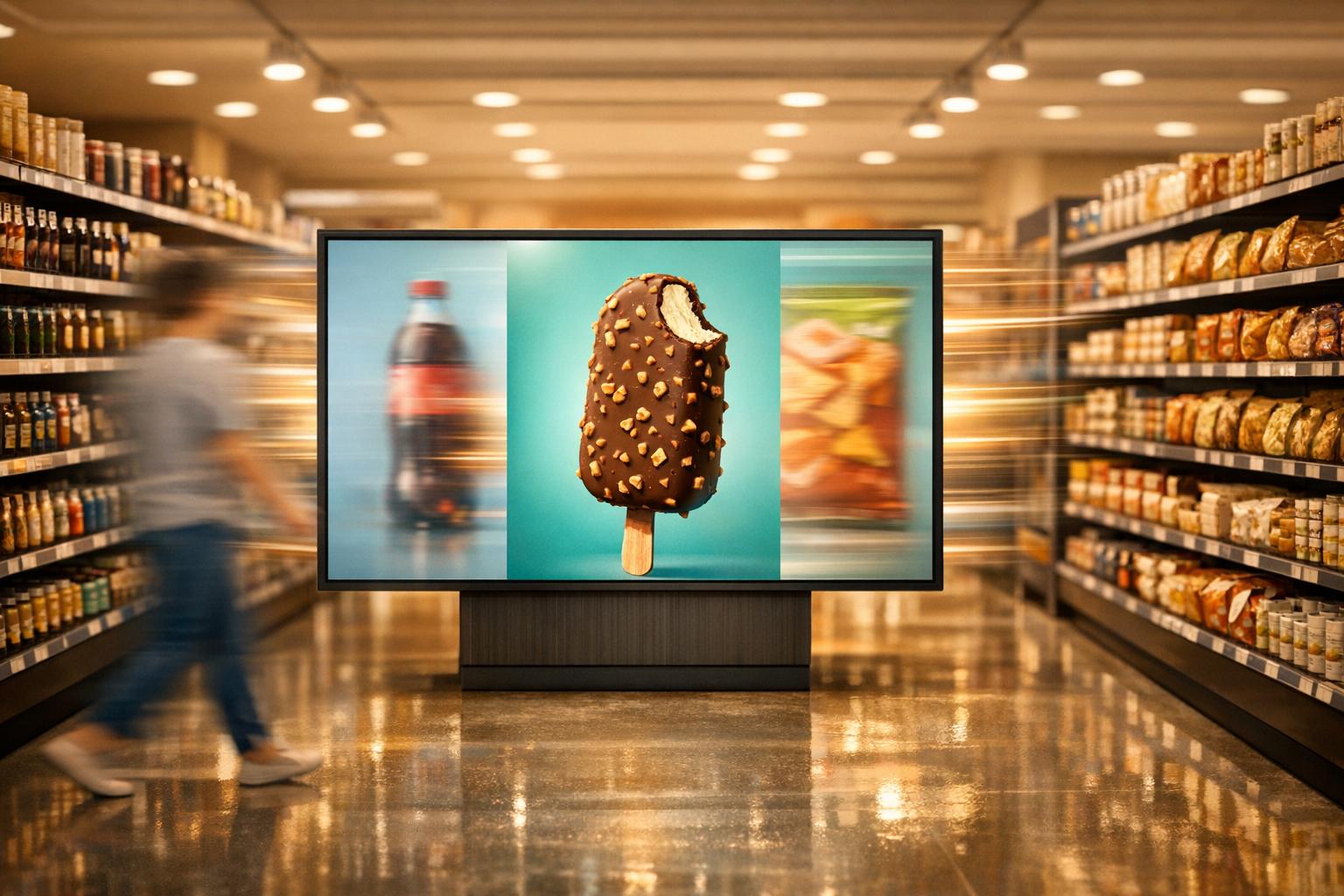
How RTB Transforms In-Store Advertising
Real-time bidding (RTB) is changing how in-store digital screens are used for advertising. Instead of pre-set prices, it lets brands bid for ad slots in milliseconds, tailoring ads to specific moments, locations, or even shoppers. By 2026, more than 90% of global digital display ad spend will use programmatic methods like RTB, making it a key player in Australia's growing $3 billion retail media market.
Here’s what RTB offers:
- Dynamic pricing: Pay for only the most relevant ad slots.
- Precise targeting: Use data like shopper behaviour, time of day, or even weather.
- Real-time adjustments: Update campaigns instantly based on performance or stock levels.
While RTB offers flexibility and cost efficiency, it comes with challenges like technical setup, data privacy compliance, and measurement gaps. Retailers and brands can overcome these by integrating RTB with tools that ensure streamlined management and accurate reporting.
RTB is turning in-store screens into powerful advertising tools, helping brands connect with shoppers at the right time and place.
Why Real-Time Bidding Is Retail Media's Next Frontier
sbb-itb-c231c83
How Real-Time Bidding Works in Retail
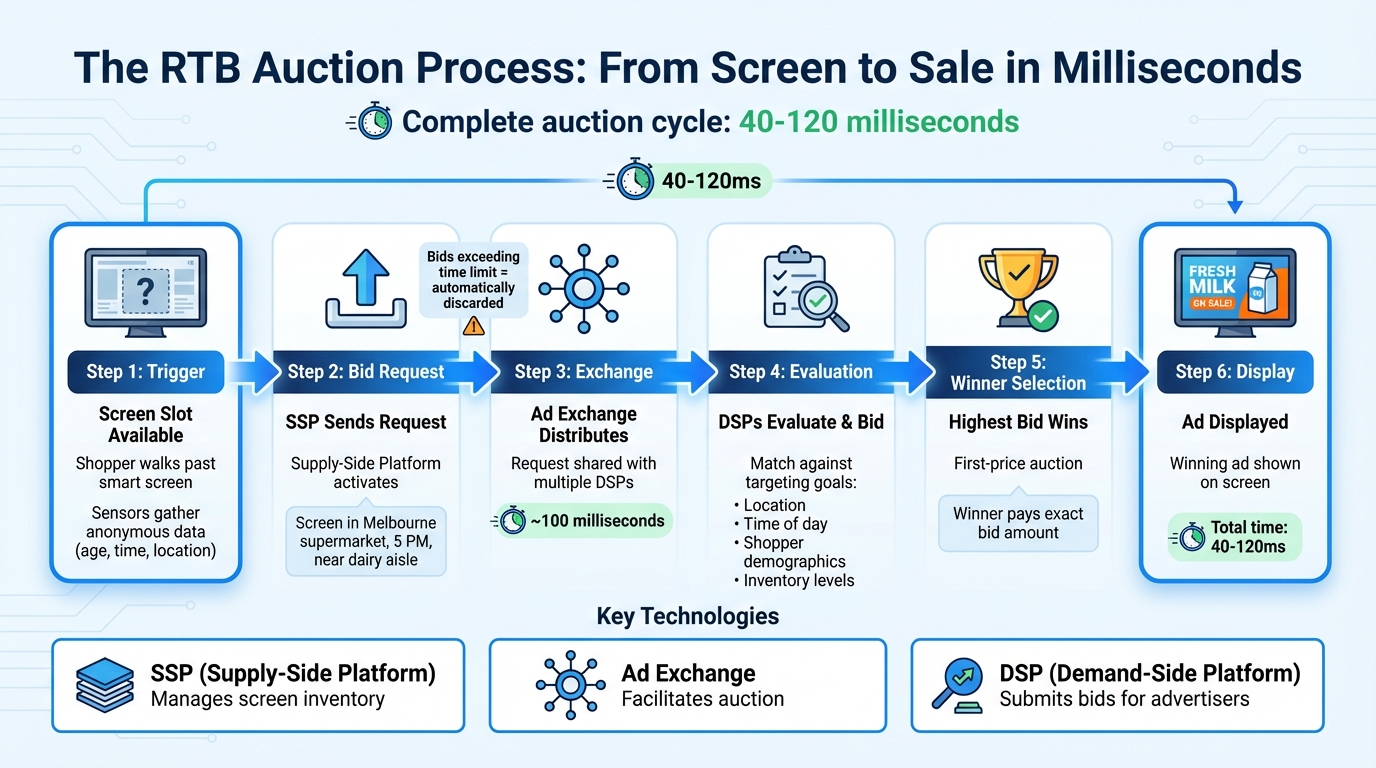
How Real-Time Bidding Works in Retail: The RTB Auction Process
Real-time bidding (RTB) transforms in-store digital screens into fast-paced advertising hubs, where ad spaces are bought and sold in just milliseconds. Imagine this: a shopper walks past a smart screen in a supermarket. Sensors gather anonymous data - like approximate age or the time of day - and trigger an instant auction for that ad slot. This entire process, from recognising the opportunity to displaying the ad, takes only 40–120 milliseconds.
Three key technologies power this process: the SSP (Supply-Side Platform), the DSP (Demand-Side Platform), and the Ad Exchange. Here's how it works: when a screen slot becomes available, the SSP sends a bid request to the Ad Exchange, complete with context - for example, "Screen in Melbourne supermarket, 5 PM, near dairy aisle." DSPs then evaluate this information against their campaign goals and decide whether to bid, all within roughly 100 milliseconds. This seamless tech integration drives the entire auction process.
The RTB Auction Process
The RTB auction follows a specific sequence. First, a screen slot triggers a bid request via the SSP. The Ad Exchange then shares this request with multiple DSPs. Each DSP assesses whether the impression aligns with its targeting goals - factors like location, time of day, or shopper demographics. If it’s a match, the DSP submits a bid. The Ad Exchange selects the highest bidder, and the winning ad is displayed on the screen within milliseconds.
Most exchanges now use first-price auctions, where the winning bidder pays exactly what they bid. Since speed is critical, any bids that exceed the time limit are automatically discarded. To avoid overpaying in these first-price auctions, DSPs often use bid shading techniques to estimate and bid just enough to win.
What makes RTB particularly effective is its use of real-time data. Retailers can integrate live information - like inventory levels, weather updates, or loyalty programme insights - directly into the bidding logic. This allows advertisers to adjust their bids on the fly, ensuring ads remain relevant. For example, they might bid higher for items that are in stock or reduce spending on out-of-stock products.
RTB vs Fixed-Price Ad Buying
RTB and fixed-price ad buying offer two very different approaches. Fixed-price methods rely on pre-negotiated agreements, where advertisers pay a set cost per thousand impressions (CPM) for guaranteed ad placements. In contrast, RTB dynamically assigns value to each impression based on real-time data and context.
Fixed-price deals are great for stability and securing premium placements, such as end-cap screens during major campaigns. However, RTB shines when flexibility is needed. For instance, advertisers can pause ads for out-of-stock items or increase bids during peak shopping hours.
Here’s a quick comparison:
| Feature | Real-Time Bidding (RTB) | Fixed-Price (Programmatic Direct) |
|---|---|---|
| Pricing | Dynamic (auction-based) | Fixed CPM |
| Inventory | Unreserved / non-guaranteed | Reserved / guaranteed |
| Speed | <100ms per auction | Negotiated in advance |
| Flexibility | High; adjust bids in real time | Low; terms set in advance |
| Best For | Scale, performance, retargeting | Premium placements, sponsorships |
Choosing between RTB and fixed-price buying depends on your campaign goals. RTB is ideal for advertisers looking for precise control, whether it’s to drive foot traffic or sell perishable goods. On the other hand, fixed-price deals are perfect when guaranteed visibility and brand safety are top priorities.
Main Benefits of RTB for In-Store Advertising
RTB brings three standout advantages to in-store advertising: dynamic pricing, precise audience targeting, and real-time campaign adjustments.
Lower Costs Through Dynamic Pricing
RTB evaluates each impression individually in just 40–120 milliseconds, ensuring you only pay for impressions that matter. Unlike flat-rate deals, which can lead to overspending, RTB dynamically determines the market value of each impression. This prevents the hefty premiums often tied to manual bulk buys. Modern first-price auctions use AI-driven bid shading to calculate the lowest bid necessary to win an impression, helping you avoid overpayment. As AI Digital explains, "First-price auctions reward smart bids, not high bids".
When RTB systems integrate with store inventory data, they can automatically pause ads for out-of-stock items or prioritise bidding for surplus or perishable goods. This ensures ad spend is directed toward products that are available and in need of promotion, avoiding wasted dollars.
"RTB prices each impression dynamically, which helps avoid overpaying for low-value inventory and concentrates spend on moments with higher conversion probability."
– Mary Gabrielyan, AI Digital
The shift to programmatic buying is accelerating. By 2026, over 90% of global digital display advertising is expected to run through programmatic channels. In 2024, programmatic ads accounted for 91.3% of all U.S. display ad spend, growing three times faster than non-programmatic methods. RTB’s ability to reallocate budgets in real time - from underperforming screens to high-traffic, high-conversion placements - further maximises cost efficiency.
This focus on cost-effectiveness pairs seamlessly with RTB’s precision in audience targeting.
Precise Audience Targeting
RTB leverages first-party data - like purchase history and real-time intent - to target shoppers more accurately than traditional methods. Instead of relying on broad audience segments, RTB allows bidding on specific impressions that align with your targeting goals, whether by demographics, location, or time of day. Environmental and contextual triggers refine this further; for instance, campaigns can adapt to local weather, promoting ice cream when temperatures hit 25°C or highlighting umbrellas during sudden rain.
"Avocados go from being cricket balls to balls of mush within 24 hours. Digital in-store assets are ideal for promoting when your avocados are ripe to help move them out the door."
– Ben Allman, Head of Sales, Broadsign
The impact is clear. L'Oréal achieved a 50.7% increase in average dollar sales when using front-of-store digital screens compared to other in-store media. Similarly, another FMCG brand saw a 74% sales boost in stores featuring digital promotions. This precise targeting is especially effective given that around 90% of consumers still prefer shopping in physical stores over online options.
Real-Time Campaign Adjustments
RTB’s flexibility doesn’t stop at pricing and targeting - it also allows for swift adjustments during campaigns. Unlike traditional advertising, where creatives and messaging are fixed once launched, RTB enables real-time updates based on performance feedback. Retailers can tweak budget pacing, engagement strategies, or conversion goals mid-campaign to optimise results. For instance, if a campaign hits its conversion targets early, bidding strategies can shift to focus on click-through rates instead.
In-store digital signage can also reflect real-time changes, such as updated product pricing, new imagery, or stock availability. AI algorithms process billions of data points in milliseconds, evaluating user intent and contextual signals. This rapid analysis, combined with synchronised data-sharing across the RTB ecosystem, can increase impression value by up to 19%.
This speed and adaptability transform in-store advertising into a dynamic, performance-driven tool that evolves with real-world conditions as they happen.
Expanding Campaign Reach with Programmatic RTB
RTB's ability to deliver cost-effective and precise targeting is helping brands extend their campaign reach like never before. By integrating in-store screens with programmatic systems, brands can now tap into premium ad placements across thousands of locations - all without the manual work that traditional ad buying demands.
Accessing High-Traffic In-Store Placements
Programmatic RTB turns physical screens into digital ad spaces that advertisers can purchase through the same demand-side platforms (DSPs) they use for mobile and web ads. Thanks to OpenRTB protocols, this system allows brands to bid in real time for in-store placements, targeting specific zones based on shopper behaviour and how long they linger in different areas.
The scale is impressive. By late 2024, Walmart Connect had brought approximately 160,000 in-store screens online across more than 4,600 locations. These include placements on self-checkout screens and digital endcaps, all available for programmatic buying. This means brands can connect with shoppers at the most critical moment - the point of purchase. After all, around 80% of purchase decisions are made in-store.
Retailers can categorise screens to maximise engagement: entrances for brand takeovers, aisles for showcasing products, and checkouts for encouraging impulse buys. The financial benefits are hard to ignore, with ad sale profit margins ranging from 50% to 90%, compared to the slim 2% to 4% margins typical of traditional product sales. This access to premium placements makes it easier for advertisers to scale campaigns across multiple locations.
Scaling Campaigns Across Multiple Locations
With automated, centralised tools, advertisers can take isolated successes and scale them into nationwide campaigns. There's no need to manually negotiate insertion orders for every location. Instead, campaigns can be deployed across thousands of screens at once using a single platform. Platforms like Adflux CMS (https://adflux.digital) allow real-time updates to content, aligning in-store ads with broader marketing strategies and showcasing the flexibility of RTB.
The impact of this scalability is clear. For example, The Lotteries Corporation in Australia expanded its digital reach to 4,000 sites using cloud-based systems. By delivering creative assets via the internet, they optimised sales for jackpot days, often selling 50% of tickets in the final 24 hours through real-time updates on digital signage.
The programmatic digital out-of-home (DOOH) advertising market is expected to grow from roughly $900 million in 2023 to over $6 billion by 2030, with an annual growth rate exceeding 31%. Jonathan Franco, Global Head of Retail Media at Broadsign, summarises the opportunity perfectly:
"The OOH market has taught us that success isn't just about having screens in impactful locations; it's about playing the right content in the right place at the right time".
How to Implement RTB in Retail Environments
Start by reviewing your current manual advertising processes to spot areas where programmatic RTB could make a difference. This initial step helps establish a clear starting point and ensures you choose the right technology. Select a demand-side platform (DSP) that aligns with your business needs to tap into global programmatic channels by 2026. From there, define your targeting methods and bidding strategies to make the most of RTB's data-driven capabilities.
Setting Up Targeting Parameters
Create audience segments based on real-time shopping behaviours and demographic data. Tailor your bidding strategy to match your campaign goals. For instance, if you're introducing a new product, focus on maximising reach. On the other hand, if conversions are your priority, target high-intent shoppers. Use Dynamic Creative Optimisation (DCO) to adapt ad creatives automatically based on where a shopper is in their buying journey. Frequency capping is another useful tool, as it prevents ad fatigue by limiting how often a shopper sees the same ad.
James Allison, Director of Market Development EMEA at Advertima Vision AG, highlights the importance of relevance:
"Ad relevance is crucial... smart digital signage powered by Advertima Audience AI addresses target audience segments in real-time with only the most suitable ads".
Once your audience segments are clearly defined, incorporate first-party data to refine your targeting further.
Using First-Party Data
Tap into loyalty programmes, CRM systems, and purchase history to build detailed audience segments. Unifying this data into a single identity layer provides a complete view of each customer.
You can also incorporate inventory-based bidding to optimise your RTB approach. For example, if a product is running low on stock, you could reduce ad spend for it. Conversely, items with surplus inventory or higher profit margins might warrant increased bids. A practical example comes from Tesco in the UK, which partnered with Dunnhumby in November 2024 to use till receipt data. They adjusted ad frequency for tinned tuna, increasing ads during late mornings and early afternoons on weekdays to target local workers shopping for lunch.
With these data strategies in place, it’s crucial to maintain brand integrity throughout the RTB process.
Maintaining Brand Safety and Control
Safeguard your brand by using pre-bid filters, frequency capping, allowlists, and dynamic price floors.
Platforms like Adflux CMS (https://adflux.digital) provide centralised control over your digital screens, ensuring consistent messaging across multiple locations. This level of oversight is especially critical when managing thousands of screens while maintaining strong governance.
Shift your focus from superficial metrics like click-through rates to more impactful ones, such as Return on Ad Spend (ROAS), incrementality, and sales uplift. For example, in November 2024, Sam Hegg, Head of Strategy and Planning at Coles 360, shared details of a campaign for an FMCG brand launching a new product. The campaign achieved a 74% sales increase in stores where digital screen promotions ran, compared to a control group. These closed-loop measurements highlight RTB’s effectiveness.
The Australian retail media market is projected to hit $3 billion by 2027, with 98% of Australian marketers planning to maintain or increase their retail media investments by 2026. By adopting these strategies, you not only protect your brand but also strengthen RTB’s role in driving in-store advertising success, positioning your business to capitalise on this growing market.
Benefits and Challenges of RTB in In-Store Advertising
RTB offers a mix of cost-effective targeting and fresh revenue opportunities, but it also comes with its fair share of technical, privacy, and standardisation challenges. While the benefits like dynamic pricing and precise targeting stand out, the hurdles demand just as much attention.
Main Benefits of RTB
One standout advantage of RTB is cost efficiency. With RTB, advertisers can bid on individual impressions, ensuring that budgets are spent on high-value placements. By linking ads to inventory data, businesses can promote surplus stock or pause campaigns for out-of-stock items, minimising wasted spend.
Another key benefit is precise targeting and real-time optimisation. RTB enables campaigns to dynamically adjust creative content based on factors like the weather, time of day, or customer behaviour. Brands like L'Oréal have seen noticeable sales increases by leveraging these capabilities in RTB-powered digital screen campaigns.
RTB also opens doors to diversified revenue streams. It attracts advertisers outside traditional categories, helping retailers monetise underused in-store networks.
But these advantages come with challenges that can’t be ignored.
Common Implementation Challenges
Technical complexity is a major obstacle. Integrating digital signage software with point-of-sale and inventory systems requires a solid infrastructure. RTB’s fast 40–120 millisecond auction cycles also demand a geo-distributed, high-performance setup - any delay can result in missed bids.
Data privacy and compliance add another layer of difficulty. Regulations like GDPR and CCPA dictate how sensitive data, such as device IDs and location information, is handled during auctions. Ensuring compliance across all intermediaries in the supply chain introduces legal risks and requires constant oversight.
Measurement and standardisation gaps make tracking ROI a challenge. Retail Media Networks (RMNs) often operate with their own platforms and reporting frameworks. Leah Sallen, Managing Director of Commerce Media at VML, describes this issue as:
"a little bit of a black box, where you maybe necessarily don't know how much you're spending versus a competitor".
In 2025’s first quarter, only 41% of programmatic budgets delivered "effective ad impressions", though this was an improvement from 36% in 2023.
Lastly, no guaranteed placements can complicate planning. RTB relies entirely on auction dynamics, so there’s no certainty of winning the impressions you want. This makes a hybrid approach - combining RTB for scale with direct deals for premium spots - a smarter strategy.
Benefits vs Challenges Comparison
| Aspect | RTB Benefit | Challenges |
|---|---|---|
| Pricing | Dynamic pricing; reduced spend on low-value placements | Risk of lower CPMs for retailers; requires expertise |
| Efficiency | Automated buying; centralised multi-location management | Fragmentation across RMN platforms and policies |
| Targeting | Real-time triggers (e.g., weather, inventory) | Limited data sharing due to "walled gardens" |
| Measurement | Multi-touch attribution and incrementality testing | Siloed reporting; lack of universal standards |
| Creative | Adaptive messaging via Dynamic Creative Optimisation (DCO) | Requires simple, high-impact designs for quick engagement |
To make RTB work in retail settings, it’s critical to address these challenges head-on. Tools like Adflux CMS (https://adflux.digital) can help by offering features like centralised control, programmatic SSP integration, and proof-of-play reporting. These solutions ensure compliance and scalability, allowing retailers to tap into RTB’s potential effectively. With Australia's retail media market forecasted to hit $3 billion by 2027, balancing the benefits and challenges of RTB could be the key to staying competitive in this growing space.
Conclusion
RTB has revolutionised in-store advertising, moving it from static, fixed-price displays to a dynamic, data-driven system. With impression-level bidding and real-time optimisation, advertisers can fine-tune costs, target shoppers with pinpoint accuracy, and expand campaigns across multiple locations. The auction-based model ensures ad budgets are spent on placements that matter most, while retailers maximise the value of their digital screen networks by inviting competition for ad slots. Examples like L'Oréal's 76.8% sales boost with Coles 360 and an FMCG brand's 74% jump during launches highlight RTB's power to drive in-store purchases.
Even today, with around 90% of Australians continuing to shop in physical stores, the potential for RTB in retail environments is immense. The technology allows for creative flexibility, such as promoting excess inventory or pausing ads for out-of-stock items, all while fitting seamlessly into broader omnichannel strategies.
Looking ahead, the path to success involves tackling challenges like technical complexities, adhering to data privacy laws, and establishing consistent measurement standards. Platforms like Adflux CMS (https://adflux.digital) simplify the process with features including programmatic SSP integration, centralised management, and proof-of-play reporting. These tools equip retailers and advertisers to overcome RTB's hurdles while improving cost efficiency and targeting accuracy.
RTB is reshaping how in-store advertising works, turning physical retail spaces into responsive, data-driven channels that deliver measurable outcomes. By leveraging dynamic pricing and real-time insights, RTB transforms retail environments into highly targeted advertising platforms that adapt to real-world conditions on the fly.
FAQs
What data can RTB use on in-store screens without identifying shoppers?
RTB can make use of aggregated and anonymised data displayed on in-store screens, including contextual details, location, and device type. This approach safeguards the privacy of individual shoppers while still allowing for precise ad targeting and improved campaign performance.
How do retailers prove sales uplift from RTB in-store campaigns?
Retailers are seeing a boost in sales through RTB (real-time bidding) in-store campaigns, thanks to in-store attribution methods. These techniques link advertising efforts directly to store sales, offering actionable insights while maintaining privacy standards. Metrics like aisle-level sales growth and upselling rates give a clear picture of campaign success. With this data, retailers can evaluate the impact of their campaigns and fine-tune strategies for better results in the future.
When should I use RTB versus a fixed-price in-store media buy?
Real-Time Bidding (RTB) is perfect for campaigns that thrive on real-time adjustments, precise audience targeting, and the ability to adapt to factors like shopper behaviour, weather changes, or even the time of day. This approach leverages dynamic, data-driven decisions to boost engagement and drive sales effectively.
On the other hand, fixed-price buys are ideal when the focus is on budget certainty, maintaining brand safety, and ensuring consistent exposure. This method works well for campaigns with predictable messaging or those that don't require constant updates, offering a straightforward and dependable solution.
Adflux Editorial
Retail media, programmatic DOOH, and digital signage insights for Australian retailers.
Ready to build your retail media network?
Talk to the Adflux team about how the platform can work for your screens.