
Proof-of-Play Reporting Checklist for Shopping Centres
A practical checklist for accurate proof-of-play in shopping centres covering setup, AI monitoring, verification and AU-formatted reporting.
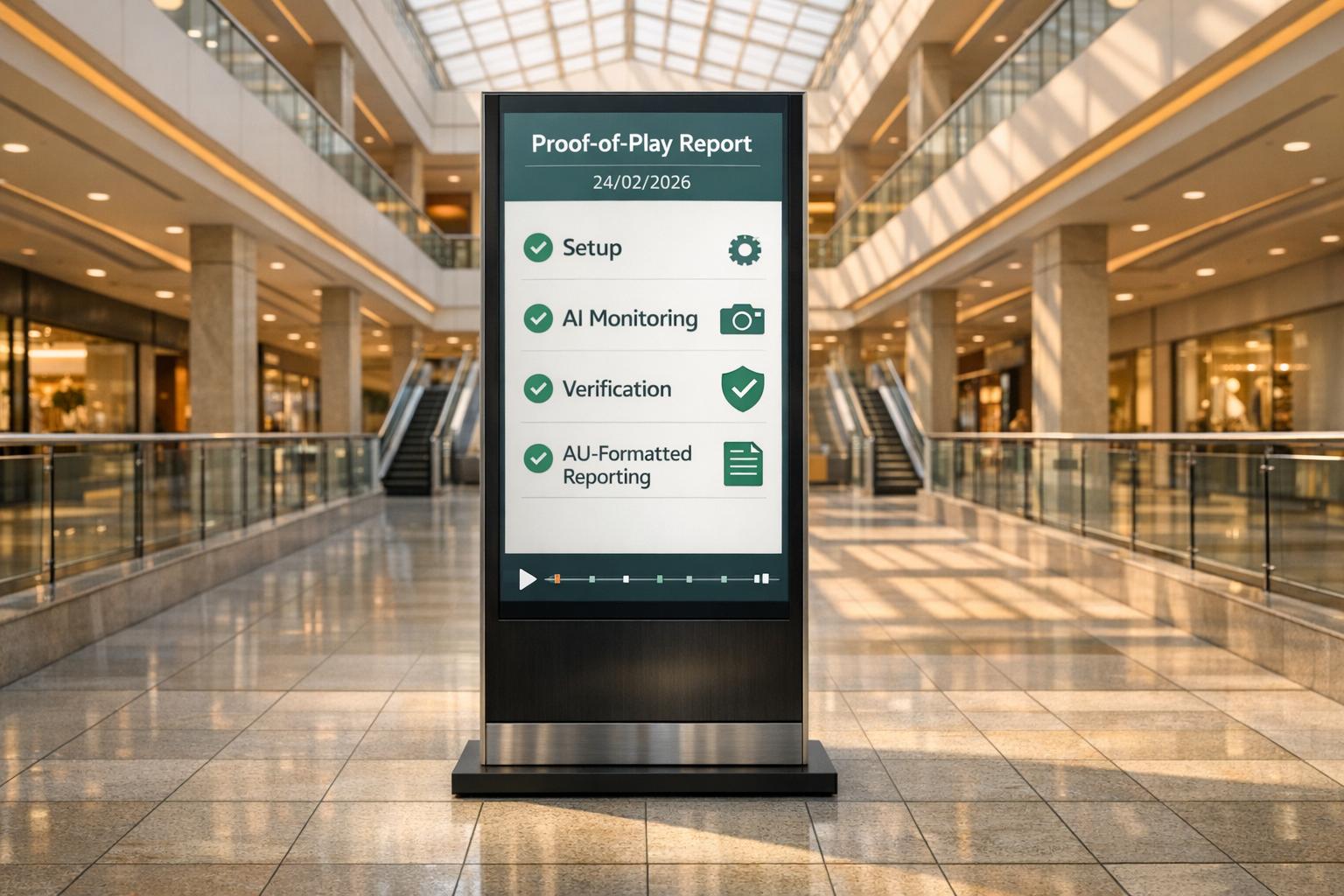
Proof-of-Play Reporting Checklist for Shopping Centres
Proof-of-play reporting ensures digital ads in shopping centres are displayed as scheduled, providing transparency for advertisers. This process tracks when, where, and how often ads play, helping centres avoid disputes, optimise campaigns, and demonstrate ROI. Adflux CMS, a tool designed for retail media networks in Australia, simplifies this with features like automated playback logs, AI-driven analytics, and remote monitoring.
Here’s a quick summary of the key steps:
- Pre-Deployment Setup: Verify hardware compatibility, configure content scheduling, enable remote monitoring, and integrate programmatic SSPs for automated ad delivery.
- Campaign Monitoring: Tag and schedule ads, use AI vision analytics for audience insights, monitor real-time playback, and log data for detailed performance analysis.
- Verification: Cross-check automated logs, validate with video evidence, ensure brand safety compliance, and confirm audience metrics.
- Reporting & Optimisation: Generate AU-specific reports, review performance data, audit for compliance, and securely archive data for advertisers.
Pre-Deployment Setup Checklist
Before rolling out proof-of-play reporting, shopping centres need to ensure their technical setup is rock solid. This involves checking that all hardware, scheduling systems, and monitoring tools are correctly configured. These steps are crucial for capturing accurate data from day one and setting the stage for smooth campaign execution.
Verify Hardware Compatibility
Adflux CMS works seamlessly with a wide range of hardware, making it compatible with most shopping centre digital signage systems. Whether you're using an external media player or a System-on-a-Chip (SoC) built into the display, the system is designed to integrate easily. To ensure optimal performance:
- Confirm screens support H.264 video formats like MP4, MOV, AVI, and WebM, as well as HTML5 for dynamic content.
- Install anti-glare and high-brightness screens in areas with direct sunlight, like entrances or windows.
- Use PCAP (Projected Capacitive) touch technology for interactive kiosks to enhance durability.
- Ensure connectivity options include LAN, WiFi, and 4G, with USB backup for offline updates.
- Choose hardware with remote management features like reboots, volume control, and power settings.
Configure Content Scheduling
Adflux CMS simplifies content scheduling, allowing you to plan campaigns weeks or even months in advance. Instead of updating content daily, group related materials into playlists and assign them to specific screen groups with just a few clicks. To maximise efficiency:
- Align content schedules with the shopping centre's trading hours so screens display relevant content during business times and switch to internal branding or turn off after hours.
- Use priority settings for programmatic campaigns, ensuring high-priority promotions or emergency alerts override standard loops.
- Add tags like "Food Court" or "NSW-Sydney" to enable precise targeting for advertisers.
"The Adflux CMS allows you to schedule digital signage content in advance... users can then set-and-forget their digital signage content, and they don't have to allocate time each day to deal with content updates."
– Adflux Australia
Enable Remote Monitoring
Remote monitoring is key to verifying proof-of-play across multiple locations. Adflux CMS provides a centralised dashboard that lets you check the status of all screens from any web browser. Features include:
- Viewing the "last image displayed" on each screen and checking if devices are online or offline.
- Grouping screens into categories like "Entrances" or "Food Court" for easier management across large networks.
- Using wired LAN connections where possible to minimise signal dropouts and maintain consistent reporting data.
- Testing all content and schedules on a demo device to ensure reporting logs capture data accurately.
Integrate Programmatic SSP
By connecting Adflux CMS with programmatic Supply-Side Platforms (SSPs), shopping centres can tap into real-time bidding and automate campaign delivery. This integration allows advertisers to purchase screen placements based on audience demographics, location, and timing that align with their campaign objectives. To enhance this functionality:
- Use the Adflux API to link external data sources, such as inventory databases, ensuring ads only feature products currently in stock.
- Keep your reporting infrastructure active to verify real-time ad delivery and ensure billing accuracy.
This setup not only streamlines ad placement but also strengthens proof-of-play reporting, giving advertisers confidence in the reliability of the system.
sbb-itb-c231c83
Campaign Execution Monitoring Checklist
When your campaigns are live, the next step is to monitor their performance in real-time. This ensures that ads are running as planned and reaching the right audience. It's all about verifying that your setup is working as intended and addressing any issues before they disrupt campaign delivery or erode advertiser trust. Here’s how to keep everything on track.
Tag and Schedule Ads
Adflux CMS uses tagging to organise screens based on factors like region, zone, or demographic profile. Consistent naming conventions - such as "Australia - NSW - Sydney - Shopping Centre - Food Court" - make it easier for advertisers and teams to locate and manage inventory. Group your campaign assets into playlists and assign them to the appropriate screen groups. Once tagging and scheduling are complete, you can move on to analysing engagement metrics in real-time.
Deploy AI Vision Analytics
Adflux CMS includes AI-powered vision analytics to measure audience engagement while adhering to Australian privacy laws. These tools estimate the age and gender of individuals near the screens, allowing the system to trigger content tailored to specific audience profiles. Additionally, metrics like Opportunity to See (OTS) and Gaze-Through Rate (GTR) help gauge how many people actively engage with the content instead of just passing by.
Here are some key stats to consider:
- Digital displays attract 400% more views compared to static signage.
- 68% of consumers are more inclined to buy from brands that effectively use digital signage to showcase promotions.
You can even link these engagement metrics to Point of Sale (POS) data to calculate campaign ROI and identify which creative assets perform best in different zones. After reviewing audience analytics, the next step is to ensure the ads are playing as expected.
Monitor Real-Time Playbacks
The Adflux CMS dashboard offers remote monitoring to confirm screens are online and displaying content correctly. The "last image displayed" feature provides a real-time snapshot of each screen, making it easier to identify playback issues like black screens or frozen content before they disrupt the campaign.
Set up automated alerts to notify you of unreachable screens or playback interruptions. Track screen uptime alongside asset playback to confirm that hardware is functioning during scheduled hours. Cross-check proof-of-play logs with your content schedule to spot discrepancies, such as missed ads due to connection problems or incorrect loop settings. Using standardised naming conventions can also help you quickly identify and resolve issues.
Log Sub-Campaign Data
Breaking down campaign performance into smaller segments - like ads displayed in specific areas such as Entrances or Food Courts - provides more detailed insights for advertisers. Use Ad Set IDs within the platform to monitor delivery status and troubleshoot issues at a granular level. This approach allows you to track performance trends by location, time of day, or audience demographic, leading to more precise campaign adjustments.
Adflux CMS automatically logs the time, duration, and frequency of each ad play, creating a reliable record for proof-of-play verification. The platform also uses asset fingerprinting to ensure content remains intact during delivery. For campaigns tied to inventory levels, you can integrate the CMS with your stock database via API to ensure ads only run for products that are in stock. This reduces errors and ensures accuracy in advertiser reporting, while also providing actionable insights for improving future campaigns.
Proof-of-Play Verification Checklist
Once your campaigns are live and actively monitored, the next step is to ensure everything ran as promised. Turning raw data into reliable evidence for advertisers is key to maintaining trust. Verification ensures accountability across your retail media network. Here's a checklist to help you verify log accuracy, visual confirmation, brand safety, and audience metrics.
Capture Automated Logs
Adflux CMS automatically generates detailed reports that track each ad's start time, duration, and status. These logs include essential details like asset names, device information, play counts, and the specific screens used. You can customise the report's time range and group data by creative, media type, or location.
Keep in mind that dashboards may have a reporting delay of up to one hour. To simplify integration with billing systems and maintain a consistent audit trail, set up automated .csv exports.
Validate with Video Evidence
Automated logs are helpful, but a visual cross-check adds an extra layer of credibility. Adflux CMS captures the "last image displayed" on each screen, offering a way to confirm that logged playback matches what was actually shown.
AI-powered sensors further enhance this process by detecting when content physically appears on a display, providing solid proof of audience exposure. By comparing these visual captures to your scheduled playlists, you can confirm that ads were shown as planned - at the correct time, in the right location, and for the intended duration. This step also helps identify issues like connectivity problems, power outages, or playback errors.
Check Brand Safety Compliance
Ensuring that every ad complies with brand safety guidelines is a critical part of the verification process. Adflux CMS includes centralised tools for managing content across your shopping centre network, ensuring alignment with marketing strategies and compliance standards. Regularly review brand safety settings to confirm that ads meet industry guidelines and avoid being displayed alongside inappropriate or conflicting content.
To maintain control, use the platform's multi-user permissions to assign different access levels, ensuring only authorised team members can approve or edit content. Conducting regular audits of your brand safety protocols helps ensure consistency across all screens and zones.
Confirm Audience Metrics
Audience metrics complete the proof-of-play picture, offering insights into campaign performance. Adflux CMS tracks key indicators like Exposures (total play count), Exposure Time (total duration in hours, minutes, and seconds), and Reach (the number of unique screens or locations where the content was displayed).
For a more comprehensive view, combine playback logs with in-store analytics, such as foot traffic, dwell time, and demographics. The platform’s AI vision analytics can estimate audience age and gender while adhering to Australian privacy laws, allowing you to link play logs with real-time audience data. This combination of playback verification and audience insights provides advertisers with a complete understanding of their campaign's impact, reinforcing data-driven accountability and transparency in your reporting.
Reporting and Campaign Optimisation Checklist
Once verification is done, the next step is turning proof-of-play data into reports that advertisers can rely on. This process involves presenting verified data in a way that highlights performance trends and lays the groundwork for refining future campaigns. Here's how to approach reporting and optimisation effectively.
Export AU-Formatted Reports
Australian advertisers expect reports tailored to local standards. Adflux CMS makes it easy to generate proof-of-play reports using AU$ currency, comma thousand separators (e.g., 10,000), and period decimals (e.g., 0.99). These reports should include key metrics such as impressions, reach, engagement, and conversion rates to give a full picture of campaign performance. For multi-site shopping centres, use standardised naming conventions to make it clear where content was displayed, ensuring advertisers can easily interpret regional data. Automating .csv exports can streamline billing processes and ensure audit trails are intact.
Review Performance Data
Leverage Adflux CMS analytics to evaluate campaign effectiveness and identify areas for improvement. Focus on metrics like impressions (total views), engagement rates (e.g., QR code scans, touch-screen interactions), and dwell time (how long audiences engaged with the content). For example, in November, a restaurant owner named Bob used proof-of-play tracking at half his locations and compared playback logs with sales data. This revealed a 100% increase in sales for the promoted dishes compared to the previous month. Similarly, a Melbourne-based fashion retailer found that screens near checkout counters drove the most engagement, leading to a resource shift that boosted average sales per customer by 20%. These examples highlight how performance data can guide content placement and creative strategies. After identifying trends, verifying data accuracy ensures campaigns remain accountable and trustworthy.
Audit for Compliance
Accountability goes beyond playback logs. Regularly review multi-user permission logs to track who scheduled or modified content, ensuring only authorised personnel have access. Check screen connectivity and content accuracy frequently to maintain advertiser confidence. Combining proof-of-play data with Point of Sale (POS) metrics can provide a clearer view of campaign ROI and its impact on stock levels. These thorough compliance checks are key to building a secure and reliable foundation for campaign data.
Archive for Advertiser Delivery
Strong data monitoring and capture systems make archiving seamless, providing advertisers with real-time access to campaign performance. Securely store reports and enable access via API integrations. Adflux CMS supports credentialed access to proof-of-play logs, allowing automated retrieval and sharing of campaign data. Overnight syncing of inventory and playback ensures records stay current, giving advertisers accurate, up-to-date insights. Self-service portals can further simplify access to campaign reports, reducing administrative overhead while strengthening relationships by delivering the information advertisers need, when they need it.
Common Pitfalls and Solutions
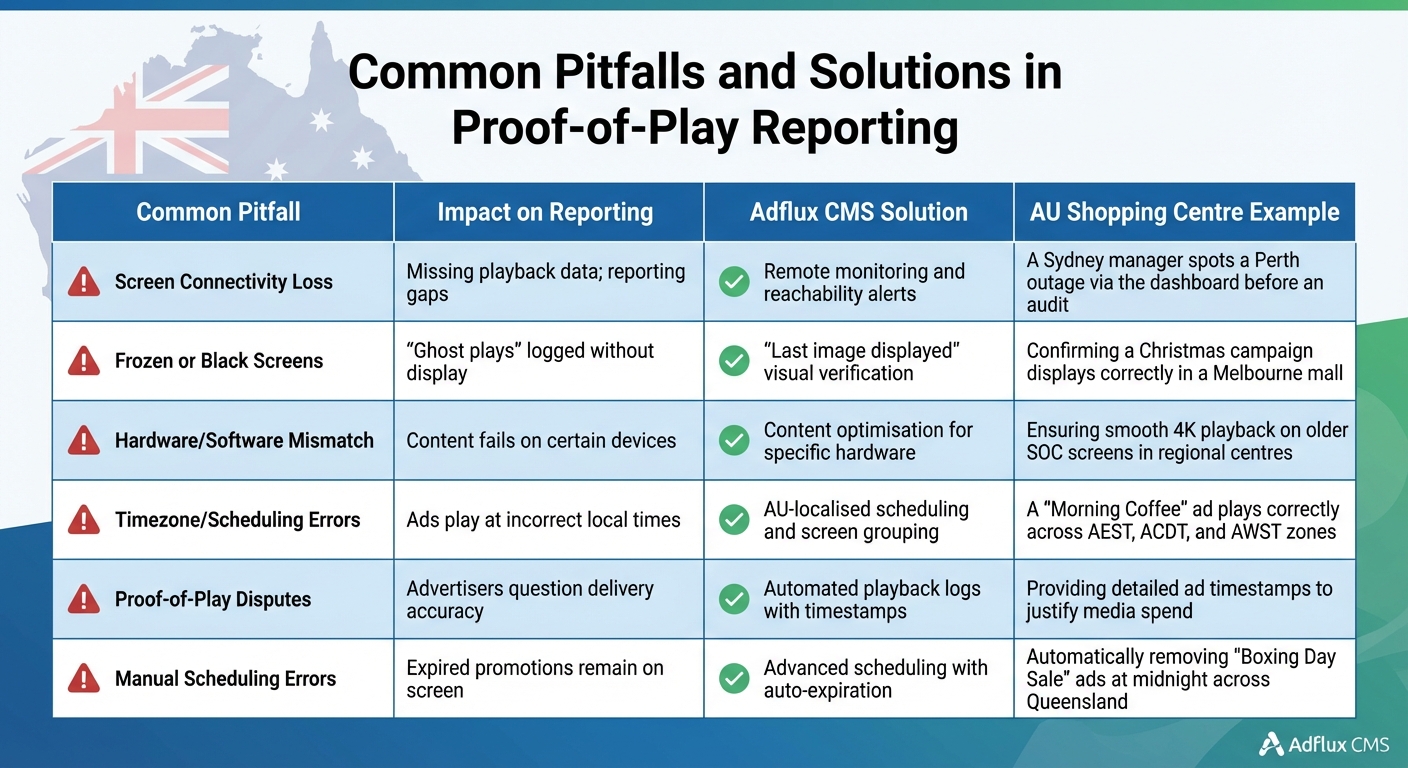
Common Proof-of-Play Reporting Pitfalls and Solutions for Shopping Centres
Even with reliable systems, proof-of-play reporting can face challenges that impact accuracy and advertiser trust. Addressing these issues is key to keeping campaigns running smoothly across Australian shopping centre networks. Below is a breakdown of common pitfalls and how Adflux CMS solves them in this context.
One of the most frequent problems is connectivity issues. Screens can lose connection due to network outages, especially in regional areas where infrastructure may be less dependable. Adflux CMS tackles this with remote monitoring and real-time reachability alerts, allowing teams to identify and address connectivity problems without costly site visits.
Another challenge is timezone mismatches, which can cause ads to play at the wrong local times. For example, a "Lunch Special" ad might run during off-hours in certain locations. Adflux CMS solves this with AU-localised scheduling and regional screen grouping, ensuring ads like "Lunch Special" trigger at 12:00 PM in Brisbane (AEST) and Perth (AWST), maintaining consistency across time zones.
Visual playback failures are another issue. A screen may appear "online" in logs but display a frozen or black image. Adflux CMS includes a "last image displayed" feature, enabling remote visual checks to ensure content is playing as intended.
| Common Pitfall | Impact on Reporting | Adflux CMS Solution | AU Shopping Centre Example |
|---|---|---|---|
| Screen Connectivity Loss | Missing playback data; reporting gaps | Remote monitoring and reachability alerts | A Sydney manager spots a Perth outage via the dashboard before an audit. |
| Frozen or Black Screens | "Ghost plays" logged without display | "Last image displayed" visual verification | Confirming a Christmas campaign displays correctly in a Melbourne mall. |
| Hardware/Software Mismatch | Content fails on certain devices | Content optimisation for specific hardware | Ensuring smooth 4K playback on older SOC screens in regional centres. |
| Timezone/Scheduling Errors | Ads play at incorrect local times | AU-localised scheduling and screen grouping | A "Morning Coffee" ad plays correctly across AEST, ACDT, and AWST zones. |
| Proof-of-Play Disputes | Advertisers question delivery accuracy | Automated playback logs with timestamps | Providing detailed ad timestamps to justify media spend. |
| Manual Scheduling Errors | Expired promotions remain on screen | Advanced scheduling with auto-expiration | Automatically removing "Boxing Day Sale" ads at midnight across Queensland. |
Hardware-specific issues also require attention. For instance, hardware incompatibility can prevent content from playing properly if it's not formatted for the display. Adflux CMS ensures smooth playback by optimising content for the specific hardware in use, whether it's 4K video on modern screens or standard content on older SOC displays. Automated playback reports further streamline proof-of-delivery processes, reducing manual workload and ensuring reliability.
Conclusion
Proof-of-play reporting isn't just a technical requirement for shopping centres - it’s the backbone of building trust with advertisers and ensuring campaigns deliver on their promises. Without reliable playback data, shopping centres risk losing credibility and missing opportunities to fine-tune their campaigns. With Australia's retail media market expected to hit $3 billion by 2027, those who prioritise robust proof-of-play systems now will be better equipped to capitalise on this growth. The checklist outlined above provides a clear roadmap for achieving this.
Platforms like Adflux CMS tackle the challenges of proof-of-play with precision. Features such as real-time monitoring, AI-driven analytics, and automated compliance tracking deliver the granular data advertisers need to see the value of their investment. For instance, in August 2022, independent verification showed only a 5% dispersion when matching player logs - highlighting the accuracy achievable with advanced CMS tools.
The benefits of effective proof-of-play systems are undeniable. Take Wolt Ads as an example. In 2024, they introduced SKU-level attribution across 29 markets, directly linking ad spend to product sales. The results? A 32% jump in revenue and a 4x Return on Ad Spend (ROAS) for their brand partners.
"That end-to-end experience, along with the results, proves that this truly delivers value for our partners." – Catalina Salazar, Head of Wolt Ads
For Australian shopping centres, adopting these practices means moving beyond basic ad delivery to offering transparent, data-backed accountability that advertisers increasingly demand. With 41% of advertisers feeling that Retail Media Networks lag behind other channels in measurement capabilities, centres that implement proof-of-play reporting can stand out. Adflux CMS, with its AU-specific features like localised scheduling and automated reporting, bridges this gap while reducing manual effort.
Investing in proof-of-play infrastructure is more than just a technical upgrade - it’s a strategic move. It strengthens advertiser relationships, improves campaign effectiveness, and opens the door to premium ad rates through verified performance. Shopping centres that embrace these practices position themselves as trusted, forward-thinking media partners ready to thrive in Australia's expanding retail media landscape.
FAQs
What counts as acceptable proof-of-play evidence for advertisers?
Acceptable proof-of-play evidence involves verified documentation that confirms when, where, and how long digital content was displayed. Examples of such evidence include:
- Playback logs: These logs track the exact times content was shown.
- Delivery statistics: Data summarising the performance and reach of the content.
- Detailed asset and screen reports: Comprehensive reports generated by digital signage software or third-party verification tools.
These records are essential for maintaining transparency and accountability in digital advertising campaigns, ensuring advertisers and stakeholders can trust the reported results.
How can we handle missing plays caused by screen dropouts?
To tackle missed plays caused by screen dropouts, it's essential to use verification tools that track ad display data and pinpoint any gaps. Make it a habit to review proof-of-play reports frequently, as these can help you identify dropouts and address issues like scheduling conflicts, connectivity problems, or hardware malfunctions. Additionally, real-time monitoring tools can be a game-changer - these notify you instantly when dropouts occur, allowing for quick fixes to ensure your ads are delivered consistently and reliably.
How do we report audience metrics without breaching Australian privacy laws?
To handle audience metrics in line with Australian privacy laws, it's essential to follow IAB Australia’s Retail Media Measurement Principles. This means using data that is aggregated and anonymised, ensuring you have consent when it's necessary, and sticking to strict privacy and security guidelines. Focus on maintaining transparency, delivering accurate results, and staying compliant. This way, you can respect consumer privacy while still providing trustworthy and actionable data.
Adflux Editorial
Retail media, programmatic DOOH, and digital signage insights for Australian retailers.
Ready to build your retail media network?
Talk to the Adflux team about how the platform can work for your screens.