
Programmatic Advertising and Data Privacy Compliance
Australian retail media must combine clear consent and strong anonymisation to comply with privacy laws while keeping ad performance.

Programmatic Advertising and Data Privacy Compliance
Retail media networks in Australia are navigating a tough landscape. On one hand, programmatic advertising is making ad placements faster and more precise by using customer data. On the other, stricter privacy laws like the Privacy Act 1988 and Australian Privacy Principles (APPs) are raising compliance costs and risks.
Here’s what’s happening:
- Customer data like IP addresses and hashed emails is now classified as personal information if it can identify individuals.
- Non-compliance fines are steep - up to AU$50 million or 30% of adjusted turnover.
- Costs of compliance could reach AU$1 billion annually for businesses.
To stay ahead, businesses are adopting two key strategies:
- Consent-based models: Require clear, explicit user consent for data collection, boosting transparency but adding operational challenges.
- Anonymisation techniques: Strip personal identifiers from data, allowing broader targeting but increasing technical complexity and regulatory scrutiny.
The takeaway? Balancing trust, compliance, and performance is critical. Tools like Adflux CMS can help streamline governance and ensure privacy-first advertising without sacrificing results.
Programmatic Advertising in a Privacy-First World: Solutions & Strategies
sbb-itb-c231c83
1. Consent-Based Models
Consent-based models require users to explicitly agree before any data is collected. Instead of relying on vague privacy policies or pre-ticked boxes, this approach ensures that data collection is "voluntary, informed, current, specific and unambiguous". By moving away from "consent bundling" – where users are asked to approve multiple actions like marketing analytics and third-party sharing in one go – individuals gain more control over how their data is used.
User Trust
Being transparent about data collection builds trust. On the other hand, deceptive practices like "dark patterns" or unclear consent processes can damage a brand’s reputation and reduce conversions. Clear and detailed consent requests help establish long-term trust by explaining exactly how data will be used.
Scalability
For mid-sized organisations, adopting consent-based models can take 12–18 months. This involves redesigning data flows, updating vendor agreements, and modifying tracking technologies. Businesses will need to create live inventories of all pixels, tags, and SDKs, while optimising server-side tagging and APIs to collect only the data necessary for specific purposes.
Implementation Cost
Switching to consent-based models requires significant internal changes. Staff need training on privacy protocols, and dedicated data governance roles must be established. Businesses also need to purge outdated data, as keeping unnecessary information increases the risk of non-compliance. Vendor contracts must be updated to include provisions like audit rights, breach notifications, and clear restrictions on data re-use.
Enforcement Risk
Regulators in Australia are already using the Australian Privacy Principles to crack down on "covert tracking" that lacks proper notice, as it violates fair and transparent collection standards. Peter Leonard, Chair of ADMA's Regulatory and Advocacy Working Group, explains:
"Legal responsibility follows the data, not the contract".
This means that if a third-party pixel collects data improperly, the brand using it is still responsible – even if the tracking was set up by an agency or adtech vendor.
The proposed "fair and reasonable" test reinforces that businesses cannot justify unfair practices by simply obtaining consent. Retailers must ensure their opt-out processes are as simple as opting in, eliminate pre-ticked boxes, and avoid requiring users to call customer service or fill out surveys to withdraw consent.
For retail media networks looking to maintain compliance while staying efficient, tools like Adflux CMS (https://adflux.digital) can centralise data governance and simplify the transition to consent-based systems.
The next section will explore anonymisation techniques that work alongside these consent-based strategies.
2. Anonymisation Techniques
Anonymisation techniques provide a way to meet compliance requirements, but they come with their own set of hurdles. True anonymisation ensures that individual links to data are permanently severed, while pseudonymisation keeps a key that allows data to be reconnected. Under Australian law, methods like SHA-256 hashing are generally seen as pseudonymisation. If a lookup table exists, the data is still classified as personal information.
User Trust
Pseudonymisation carries the risk of reversibility, which can undermine user trust. A practical guideline, often referred to as the "Grandmother Test", suggests that if someone can be identified in a report based on the combination of available data points, the data isn't anonymised enough. To address this, methods like aggregation thresholds - only reporting on groups with at least 10–20 users - can help protect privacy while also strengthening brand reputation. However, these measures often lead to operational and cost challenges, making effective anonymisation a tricky balance to strike.
Implementation Cost
Aside from trust concerns, implementing proper anonymisation can be expensive and complex. Redesigning systems to anonymise data correctly takes time and resources. For instance, tools like GA4’s data redaction feature automatically strip out email addresses and other identifiers from URL query parameters before processing. Setting up such systems requires heavy investment in Privacy Impact Assessments, team training, and regular audits.
There’s also a trade-off to consider: overly cautious redaction can unintentionally remove critical identifiers, which may result in lower conversion tracking accuracy and flawed measurement data.
Another challenge is the delay caused by external dependencies. Using third-party data onboarders to anonymise audience data can slow down campaigns by one to two weeks. Belinda Lloyd, Senior Technical Account Manager at Amperity, highlights this issue:
"The process of transferring and anonymising audience data through a third-party intermediary can take one to two weeks or longer. Campaigns lose agility, network managers lose visibility, and advertisers lose confidence".
Enforcement Risk
Even when anonymisation is outsourced, the legal responsibility stays with the business. Handing over the task to an agency or vendor doesn’t shift liability. Like consent-based models, enforcement remains strict, making robust data governance essential. Under the updated tiered penalty system, administrative breaches can incur fines of $330,000, while infringement notices can cost up to $66,000.
To minimise risks, businesses are encouraged to audit all pixels and tags quarterly, ensuring that no legacy tracking or unapproved data-sharing arrangements are overlooked. For retail media networks juggling complex programmatic setups, platforms like Adflux CMS (https://adflux.digital) can centralise governance and ensure consistent application of anonymisation protocols across campaigns.
Comparing Compliance Strategies
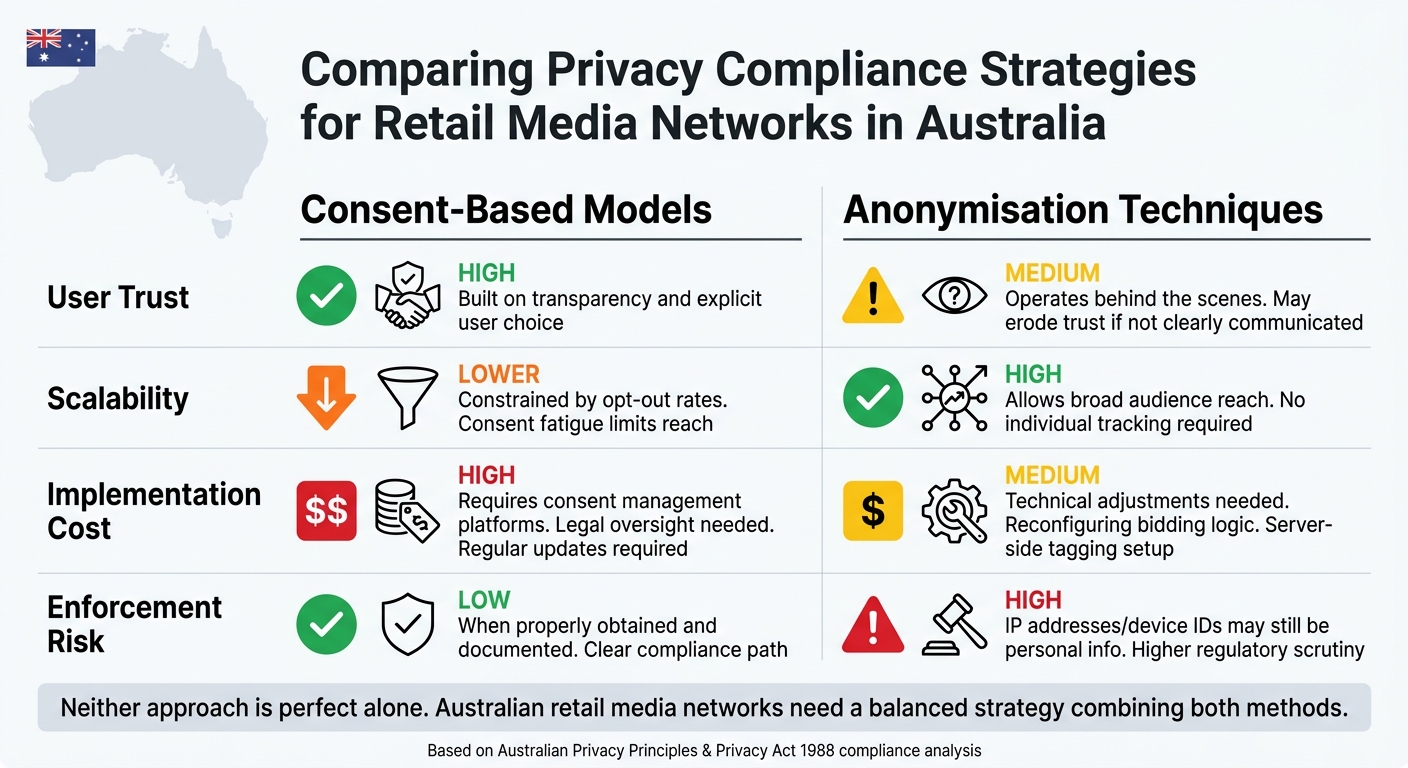
Consent-Based vs Anonymisation Compliance Strategies for Retail Media Networks
Retail media networks face a challenging decision when choosing between consent-based models and anonymisation techniques. These approaches must be evaluated across four key areas: user trust, scalability, implementation cost, and enforcement risk. Neither option is flawless, and each comes with its own set of trade-offs that can impact campaign performance and legal compliance.
To better understand these differences, the table below offers a side-by-side comparison of the two strategies:
| Feature | Consent-Based Models | Anonymisation Techniques |
|---|---|---|
| User Trust | High – built on transparency and explicit user choice. | Medium – operates behind the scenes, which may erode trust if not clearly communicated. |
| Scalability | Lower – constrained by opt-out rates and consent fatigue. | High – allows for broad audience reach without tracking individuals. |
| Implementation Cost | High – requires consent management platforms, legal oversight, and regular updates. | Medium – involves technical adjustments like reconfiguring bidding logic and server-side tagging. |
| Enforcement Risk | Low – when explicit consent is properly obtained and documented. | High – even "anonymous" data like IP addresses or device IDs can be classified as personal information. |
This comparison makes it clear: relying solely on explicit consent is not enough. With emerging reforms, retail media networks must limit data collection to what is strictly necessary for a well-defined purpose.
For networks operating within complex programmatic environments, tools like Adflux CMS offer a practical solution. Its privacy-first features include anonymised bidding that uses contextual and cohort-based targeting to make split-second bid decisions without relying on individual identifiers. Additionally, its AI-powered vision analytics assess shopper engagement through in-store digital screens while adhering to data minimisation principles. By processing engagement data locally, this system builds trust without compromising performance. These capabilities make Adflux CMS a valuable asset for balancing regulatory requirements with campaign effectiveness.
Privacy-focused setups like these also deliver measurable benefits. For example, they can enhance conversion API match rates and filter out low-value events, leading to stronger long-term brand performance. In Q1 2025, advertisers allocated 41% of their programmatic budgets to "effective" impressions that met quality standards, up from 36% in 2023. This 7.9-percentage-point improvement in ad spend efficiency highlights how better data governance and stricter controls not only reduce risk but also boost campaign outcomes.
Conclusion
Australian retail media networks face a clear challenge: balancing trust and scale while navigating privacy regulations. The solution? Integrating consent-based models with anonymisation techniques. Each has its strengths - consent fosters trust but limits reach, while anonymisation expands scale but may attract regulatory attention. A balanced strategy leverages first-party data from loyalty programs and POS systems, strengthened by tools like data clean rooms and explicit consent for sensitive targeting.
"Privacy and security should not be seen as opposing forces... narrow approaches undermine progress." – Carly Kind, Australian Privacy Commissioner
Retailers must take an active role in managing their adtech ecosystems, from pixels and SDKs to third-party vendors. Accountability doesn’t end when external agencies or platforms are involved. With regulations constantly evolving, proactive governance is no longer optional - it’s essential.
The numbers speak volumes: in 2025, 70% of Australian advertisers increased their retail media spend, with 77% collaborating with three or more networks. Advertisers are shifting budgets away from opaque third-party models, favouring networks that deliver transparent data practices and closed-loop attribution. Platforms like Adflux CMS exemplify this trend, offering anonymised bidding and AI-driven analytics that process data locally, ensuring both compliance and performance.
As Australian consumers place privacy just behind quality and price when making purchasing decisions, networks that embrace data minimisation, transparency, and easy opt-out options will stand out. Compliance is no longer just a regulatory requirement - it’s a chance to gain a competitive edge. The real question isn’t whether compliance is necessary, but how to turn it into a driver of success.
FAQs
Do I need consent for programmatic ads if I only use hashed emails or IP addresses?
Yes, consent is typically required for programmatic ads, even if you're using hashed emails or IP addresses. Privacy laws demand that individuals give clear and informed consent before their personal data is processed - whether that data is anonymised, encrypted, or hashed. Following these regulations isn't just about staying on the right side of the law; it's also about maintaining transparency and trust with your audience.
What’s the practical difference between anonymisation and pseudonymisation in Australia?
In Australia, pseudonymisation involves substituting direct identifiers with codes, which can later be reconnected to the original data using a separate key. Despite this process, the data remains classified as personal information under GDPR. Anonymisation, by contrast, permanently removes all identifiers, ensuring the data cannot be linked back to individuals. Once anonymised, the data falls outside the scope of GDPR. Understanding this difference is essential for adhering to privacy laws.
How can I audit pixels, tags and SDKs to reduce Privacy Act compliance risk?
To stay on top of Privacy Act compliance, it’s crucial to regularly audit your pixels, tags, and SDKs. A 'set-and-forget' mindset can lead to unnecessary risks. Instead, make sure every tracking tool you use is necessary, documented, and compliant with privacy regulations.
Here are some key steps to follow:
- Limit Data Collection: Ensure your tools collect only the data you actually need. Anything beyond that increases compliance risks.
- Consent Mechanisms: Verify that proper consent is obtained before collecting any data. This includes clear and transparent mechanisms for users to opt in or out.
- Privacy Notices: Regularly update your privacy notices to reflect any changes in your data collection practices.
- Review Personal Information Handling: Pay special attention to how personal information - like IP addresses, device details, and activity logs - is managed. These require careful handling to meet privacy obligations.
Routine reviews are essential to ensure your tracking tools align with current regulations and best practices. Taking these steps will help you stay compliant and protect user privacy.
Adflux Editorial
Retail media, programmatic DOOH, and digital signage insights for Australian retailers.
Ready to build your retail media network?
Talk to the Adflux team about how the platform can work for your screens.