
AI in Retail Media: Personalising Content at Scale
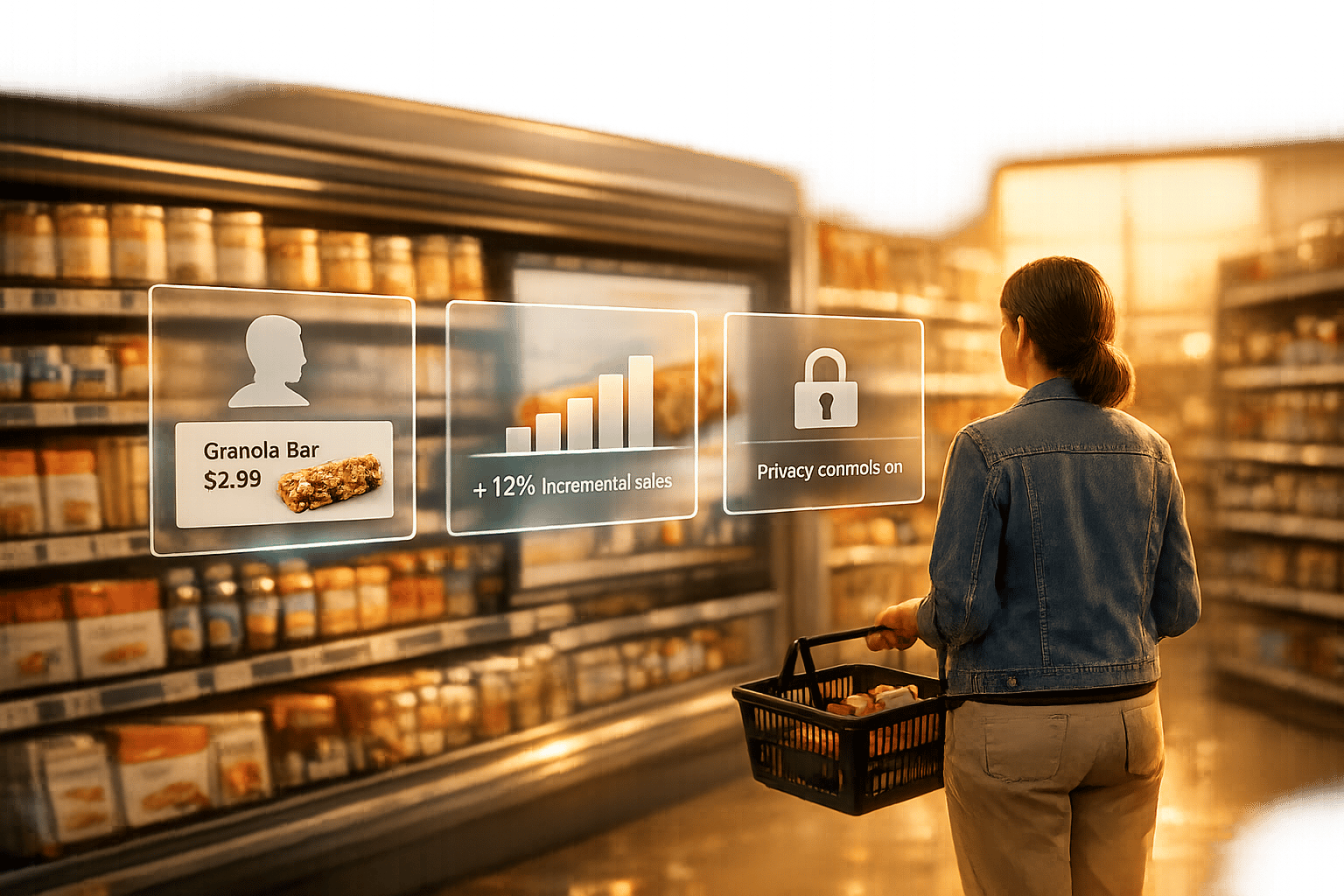
AI turns first‑party retail data into real‑time personalised ads and in‑store experiences while measuring true incremental sales under clear privacy controls.
AI in Retail Media: Personalising Content at Scale
AI is transforming retail media by enabling real-time personalisation and dynamic content creation. With the retail media market projected to reach $105 billion by 2027 in the US, retailers are leveraging first-party data, AI-driven insights, and generative AI to deliver tailored shopper experiences. Key advancements include:
- Dynamic Audiences: AI creates self-updating shopper profiles based on real-time behaviours like searches, purchases, and browsing.
- Customised Ads: Generative AI assembles ad components (headlines, images, offers) instantly to match shopper intent.
- Real-Time Adjustments: AI adapts campaigns based on factors like stock levels, weather, and time of day.
- Closed-Loop Measurement: Retailers can directly link ad impressions to sales, optimising campaigns for incremental growth.
- In-Store Media: AI personalises digital screens, audio messages, and checkout displays in physical stores.
With loyalty programs and CRM systems providing reliable first-party data, AI offers a scalable way to meet rising consumer expectations. However, privacy compliance and transparent governance remain critical for maintaining trust. Retailers embracing these technologies report increased revenue, improved ROI, and more precise targeting. AI is reshaping how brands connect with shoppers across digital and physical channels.
AI in Retail Media: Key Statistics and Impact Metrics 2024-2028
Personalization and efficiency: AI revolutionizing Retail Media Networks
sbb-itb-c231c83
How AI Powers Personalisation in Retail Media
AI has transformed the way retailers target their audiences, shifting from static methods to dynamic, ever-evolving systems. Instead of relying on rigid demographic categories, AI creates "living audiences" that adapt with every user interaction - whether it's a click, search, or purchase. For instance, a late-night shopper browsing nappies might receive a completely different ad than someone exploring premium skincare products at midday, even if both fall into similar demographic groups.
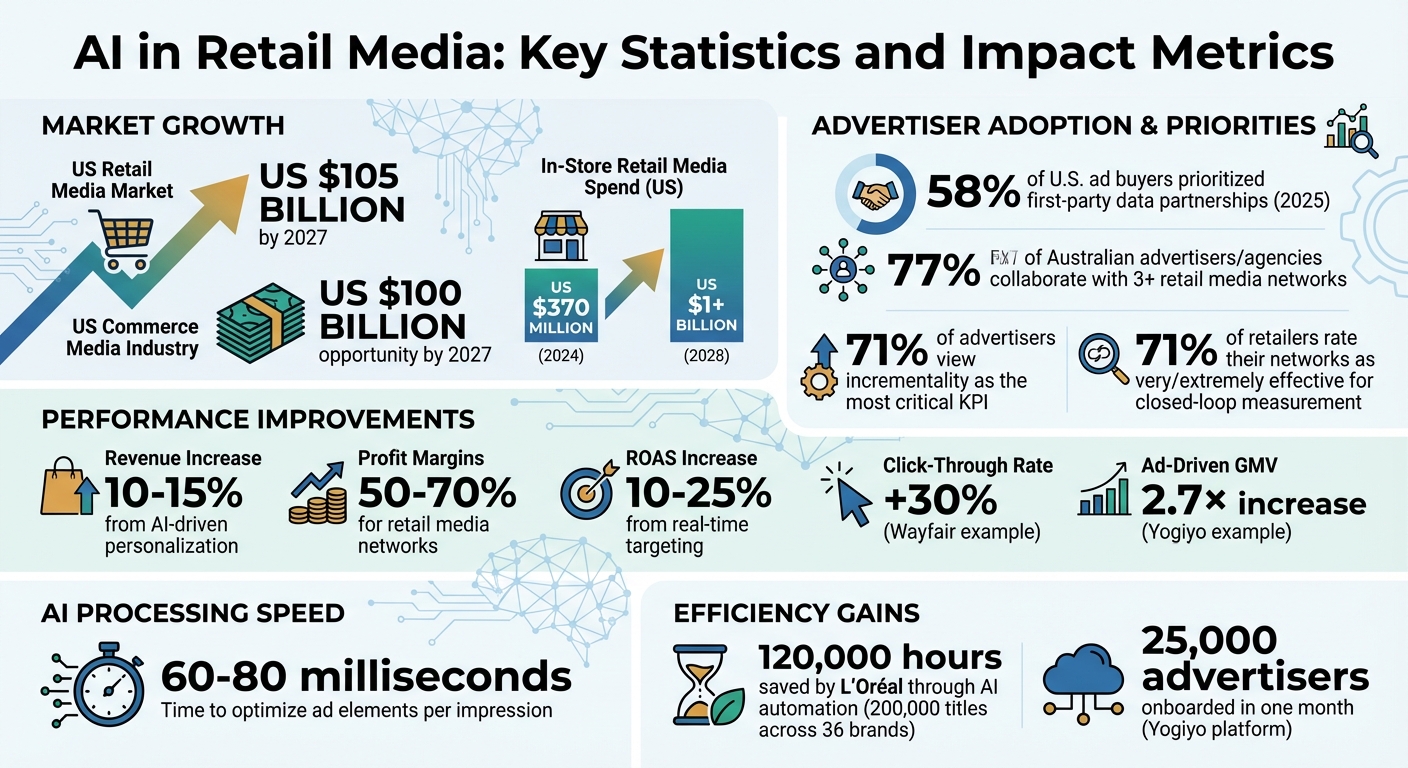
This transformation is driven by a sophisticated stack of AI models working together. Propensity models predict the likelihood of a purchase, while uplift models determine whether an ad will influence behaviour. Price elasticity models help identify the best discount thresholds, and ranking algorithms optimise ad elements - like headlines, images, and offers - for each individual impression, all within a fraction of a second (60 to 80 milliseconds). This synergy enables a level of personalisation that was previously unattainable.
From Broad Segments to Individual Targeting
Traditional retail advertising often relied on pre-defined audience groups that were updated monthly. This meant a shopper who bought their first tin of formula could still be targeted with nappy ads weeks later. AI has upended this approach by using product and shopper embeddings. Instead of simple keyword matching, these systems detect deeper connections. For example, a customer who buys organic baby food and eco-friendly cleaning products might later receive ads for other sustainable items.
A real-world example of AI's impact is L'Oréal's use of SiteCore's generative AI in March 2025. By automating metadata tagging for 200,000 titles across 36 brands and 500 websites, they saved 120,000 hours of manual work while improving SEO. This highlights how AI not only enables personalisation but also streamlines tasks that would have required extensive human input.
Dynamic Content Creation and Real-Time Adaptation
Generative AI has taken personalisation a step further by enabling dynamic content creation. Instead of serving static banners, AI systems use Dynamic Creative Optimisation (DCO) to instantly generate tailored content. These systems create variations of copy, images, and product detail pages, which are then tested using multi-armed bandit algorithms. The best-performing combinations are automatically selected based on metrics like conversion rates or incremental profit.
Wayfair, a retailer managing 14 million products for 22 million customers, adopted an AI-driven onsite ad solution to handle this complexity. By analysing product relationships and user intent in real time, they achieved a 30% increase in click-through rates.
This adaptability extends to physical stores as well. In-store retail media spend in the US is expected to grow from $370 million in 2024 to over $1 billion by 2028. AI-powered systems personalise in-store experiences by adjusting endcap screens, audio messages, and checkout displays based on factors like store layout, time of day, weather, and product availability. For example, a suburban supermarket on a rainy Saturday might promote comfort foods. Platforms like Adflux CMS allow retailers to manage these AI-driven insights seamlessly, delivering a personalised experience across all digital touchpoints.
Context and Intent Analysis for Better Targeting
AI goes beyond basic targeting by analysing shopper intent. Instead of just asking, "What did they buy?" AI considers, "Why are they shopping right now?" By processing unstructured data - such as customer service transcripts, social media engagement, and browsing patterns - AI creates more comprehensive customer profiles. Transformer models fill in gaps in incomplete shopper histories, predicting intent even when data is limited.
An example of this precision is Yogiyo, a South Korean food delivery platform. They shifted from a time-based ad model to an AI-driven system that processes real-time user events and restaurant locations. In just one month, they onboarded 25,000 advertisers and increased their ad-driven gross merchandise value by 2.7×. This kind of real-time targeting has helped retailers achieve a 10% to 25% increase in return on ad spend, as the system continuously adjusts ads, offers, and placements based on current data rather than outdated information.
First-Party Data in AI Personalisation
First-party data powers AI-driven retail media by connecting verified shopping behaviours to individual customers. When retailers gather details like SKU-level transactions, search histories, basket contents, and loyalty information, AI can go beyond general demographic assumptions to truly understand consumer habits. In 2025, 58% of U.S. ad buyers prioritised partnerships involving first-party data. Christopher Good from EverWorker highlights this advantage:
Retail media networks are the fastest path to AI personalisation because they pair robust first‑party identity with SKU‑level outcomes you can optimise in near real time.
This data creates "living audiences" that evolve with every interaction. Instead of relying on monthly updates, AI models can continuously adjust based on factors like recency, purchase frequency, spending patterns, brand preferences, likelihood of churn, and sensitivity to price changes. In Australia, where 77% of advertisers and agencies now collaborate with three or more retail media networks, this kind of responsiveness has become the standard. Using first-party data is key to crafting the dynamic, personalised strategies that define today’s retail media landscape.
Retailer data is particularly reliable because it’s deterministic. Unlike third-party cookies, which are becoming less effective, loyalty IDs, hashed emails, and phone numbers provide durable identity graphs that connect online browsing to in-store purchases. This unified identity framework supports closed-loop measurement, linking ad exposure directly to sales. Industry research shows that 71% of retailers find their networks very or extremely effective at achieving this type of measurement. This solid data foundation allows for deeper insights, often derived from loyalty programs and CRM databases.
Loyalty Programs and CRM Data
Loyalty programs now play a crucial role in creating persistent identifiers that merge online and offline interactions. When customers swipe their loyalty cards or log into apps, they generate identifiers that link various touchpoints - like website visits, app sessions, emails, and in-store purchases. This integration gives AI the ability to develop detailed customer profiles that go far beyond basic demographic data.
Data collected from loyalty programs and CRM systems - such as purchase frequency, basket size, favourite categories, brand-switching tendencies, and responses to past promotions - enables AI to predict behaviours like churn risk or price sensitivity. These insights help determine which product image, headline, or offer will resonate most with each individual. AI can then adjust messaging in real time to match changing customer needs. These comprehensive profiles also allow AI systems to react instantly to external changes.
Real-Time Adjustments Based on External Factors
AI personalisation thrives on its ability to adapt to external factors that influence shopping habits. By integrating real-time signals - such as weather, stock levels, and store locations - AI can adjust offers on the fly. This level of contextual awareness transforms static campaigns into dynamic experiences that respond to the world around them.
For instance, if a product runs out of stock, AI can automatically pause its ads or highlight alternative items or nearby stores with available inventory. This not only prevents customer frustration but also helps maintain brand trust. Similarly, when weather conditions shift, AI can tailor promotions accordingly. A hot day might trigger ads for barbecue supplies and cold drinks, while a cold snap could prompt offers for comfort foods and hot beverages. Nearby shoppers might even receive "buy online, pick up in store" messages with real-time inventory updates.
Such agility is made possible by a strong Customer Data Platform (CDP) with sub-second activation capabilities. This infrastructure allows AI to deliver personalised updates across multiple channels - whether it’s website banners, in-store digital screens, or email campaigns. Tools like Adflux CMS help retailers coordinate these AI-driven adjustments across their digital and audio networks, ensuring that personalisation remains consistent whether customers are shopping online or visiting a store.
Measuring and Optimising AI-Driven Campaigns
Tracking and refining AI-driven campaigns is just as important as launching them. To truly understand the impact of AI personalisation, you have to look deeper than basic metrics. For instance, traditional ROAS (Return on Ad Spend) can often give an inflated sense of success by capturing shoppers who were already planning to buy. As Jordan Gisch from CommerceIQ explains:
ROAS doesn't help you understand how much of your ad spend is driving incremental growth for your business.
This underscores the importance of isolating sales that are genuinely driven by ads. Incremental ROAS (iROAS) has become a key metric for this purpose. By filtering out factors like organic demand, seasonal trends, and pricing changes, iROAS reveals the true impact of campaigns. In fact, 71% of advertisers now see incrementality as the most critical KPI for retail media investments. This focus helps identify campaigns that generate real growth.
SKU-Level Attribution and ROI Tracking
AI-powered tools are now capable of tracking campaign performance down to individual product SKUs. This means brands can link specific ad exposures directly to purchase outcomes. Platforms like Amazon Marketing Cloud make this possible by using clean room environments to analyse aggregated, privacy-safe data. With machine learning, these platforms can calculate the likelihood of conversion for each touchpoint.
There are some impressive examples of this approach in action:
- PepsiCo achieved over 80% new-to-brand ROAS by leveraging Kenshoo Skai's test-and-learn optimisation.
- Sauer Brands saw a 113% year-over-year ROAS increase through disciplined campaign refinement.
- A Brazilian retailer experienced a 104% revenue boost using targeted keyword harvesting.
For physical stores, AI systems employ technologies like computer vision and edge computing to link shopper behaviour - such as gazing at a display - to specific SKU purchases at checkout. Tools like Adflux CMS also provide proof-of-play reporting and AI-powered vision analytics, enabling retailers to track engagement across digital screens and audio networks while remaining privacy-compliant.
These insights feed into closed-loop systems, which integrate first-party data to measure the true incrementality of campaigns.
Closed-Loop Systems for Incrementality Measurement
Just as with content personalisation, measuring value in real time is essential. Closed-loop attribution connects media spend directly to consumer actions by integrating first-party data from loyalty programmes and CRM systems with retail media platforms. This approach allows brands to track the entire customer journey - from ad exposure to conversion - and determine whether campaigns are driving new demand or simply capturing existing intent.
AI plays a big role in incrementality testing by comparing test and control groups to isolate a campaign's true impact. As Kenshoo Skai notes:
Incrementality testing isolates true impact by separating ad driven outcomes from seasonality, pricing shifts, competitive moves, and organic demand.
Some real-world examples highlight the power of this approach:
- Panasonic used digital shelf intelligence and real-time signals in 2025/2026 to reallocate spend during high-impact moments, nearly doubling total sales and achieving an 83% lift in new-to-brand revenue.
- A leading beverage company implemented dynamic dayparting on Amazon, adjusting bids based on hourly conversion patterns, which led to a 31% revenue increase across multiple product lines.
- A home appliance brand combined advertising investments with real-time retail signals like Buy Box ownership and inventory levels, resulting in 34% revenue growth without increasing budgets.
Automated incrementality testing takes this a step further by providing real-time optimisation signals. AI can then adjust budgets and creative assets on the fly. This "always-on" approach replaces one-off manual studies with continuous machine-learning models that refine performance as new data becomes available. For retailers juggling campaigns across multiple channels, this level of automation ensures that every dollar spent contributes to measurable, incremental growth - delivering the kind of dynamic personalisation at scale that has been discussed throughout this article.
Governance and Transparency in AI Personalisation
As AI increasingly handles complex tasks in retail media, effective governance becomes more critical for managing thousands of campaigns. Retailers need frameworks that safeguard customer privacy, comply with regulations, and maintain brand trust - all while preserving the agility that makes AI-driven personalisation so effective. At the core of this framework lies robust privacy controls.
Privacy and Data Compliance
Australian retailers face stringent privacy regulations when implementing AI-driven personalisation. Under the Privacy Act 1988, the Australian Privacy Principles (APPs) require retailers to only collect data that is necessary (APP 3) and to use it solely for its intended purpose (APP 6). For instance, loyalty programme data gathered to track purchase history cannot be repurposed for unrelated targeting without obtaining new consent.
Additionally, the Australian Consumer Law prohibits misleading or deceptive practices (Sections 18 and 29), ensuring that AI-generated product claims are accurate. Similarly, the Spam Act 2003 mandates explicit opt-in consent for email and SMS campaigns, along with clear sender identification and an easy-to-use unsubscribe option.
A "privacy by design" approach is now essential. This involves practices like logging the specific data signals behind each ad impression, automating the removal of personally identifiable information, and creating consent-aware models that adjust when users opt out. For AI tools processing data overseas, retailers must ensure compliance with Australian privacy standards.
Louis Martin, General Manager of Privacy and Customer Trust at Wesfarmers OneDigital, emphasises:
Privacy is an opportunity. Done well, it can help grow customer trust.
Legal compliance is just the beginning - transparent and ethical practices are key to maintaining stakeholder trust.
Building Trust with Stakeholders
Compliance alone isn’t enough; transparency is vital for earning trust. Many retailers are adopting clean room environments - secure platforms where brands and retailers can collaborate on audience matching and performance measurement without exposing raw customer data. This trend aligns with the growing importance of first-party data partnerships, with 58% of U.S. ad buyers prioritising such collaborations - a pattern mirrored in Australian retail media.
Audit trails are another way to build trust, as they document data origins, processing steps, and the logic behind AI-driven decisions. Automated fairness checks, which evaluate AI performance across protected attributes, help identify and mitigate bias before it can harm brand reputation.
Tools like Adflux CMS support transparency with features such as proof-of-play reporting and AI-powered vision analytics. These allow retailers to track engagement across digital screens while maintaining privacy compliance. Furthermore, the shift toward controlled automation - where AI manages campaigns but humans retain the ability to override decisions - ensures accountability without sacrificing efficiency.
The Association for Data-driven Marketing and Advertising (ADMA) reinforces this point:
Transparency, data minimisation, and express consent are no longer optional. These practices are the cornerstones of trust. The brands that demonstrate compliance with these privacy constructs effectively will stand out in an era of algorithmic opacity.
With 71% of retailers already rating their networks as highly effective for closed-loop measurement, those that combine strong performance with transparent governance are well positioned to attract substantial brand investment. Governance and transparency ensure that every aspect of AI-driven personalisation remains accountable and effective.
Conclusion
AI is reshaping retail media by turning first-party data into real-time, personalised messages across various touchpoints. This transformation is delivering impressive results, such as revenue increases of 10–15% and profit margins of 50–70%, as the US commerce media industry approaches a projected $100 billion opportunity by 2027.
This shift represents a move from static campaigns to agile, data-driven strategies. With tools like self-updating audiences, dynamic creative, and closed-loop measurement, retailers can now prove incrementality down to the SKU level. Advertising, once reliant on guesswork, has become a precise, data-driven profit engine, directly linking first-party identity to measurable outcomes in near real time.
Physical stores are also becoming a key focus, with spending expected to more than double. Platforms like Adflux CMS play a pivotal role in this growth. Adflux CMS enables retailers to automate content creation, manage digital campaigns, and monetise inventory effectively. Features such as AI-powered vision analytics, proof-of-play reporting, and real-time content adaptation keep campaigns relevant while ensuring compliance with privacy regulations.
To thrive in this evolving space, retailers must embrace governed autonomy. This means allowing AI to manage orchestration while teams concentrate on strategy and maintaining brand equity. By combining robust first-party data systems with transparent governance frameworks, retailers can secure the brand investment needed for growth. The future of retail media lies in delivering the right message to the right shopper at the right time - and AI makes this possible on a large scale, all while upholding privacy and data governance standards.
FAQs
What data do retailers need to personalise retail media with AI?
Retailers rely on a variety of first-party data to effectively tailor retail media with AI. This data includes search behaviour, browsing habits, purchase history, loyalty program activity, and location information. Together, these elements help create detailed customer profiles and audience segments.
With these insights, AI can provide targeted, real-time content across multiple channels, such as on-site platforms, mobile apps, and external media. This approach not only enhances conversion rates but also increases basket sizes and boosts customer lifetime value. It's an effective way for retailers to adapt to the fading reliance on third-party cookies.
How do you prove AI-driven ads deliver incremental sales (not just ROAS)?
To demonstrate the real impact of AI-driven ads on sales, it's essential to go deeper than just relying on ROAS (Return on Ad Spend). Methods like controlled experiments, holdout groups, and uplift modelling are key tools for isolating how much of the sales growth can be directly attributed to these ads.
Recent case studies and industry insights back up these approaches, showing how AI can deliver measurable results that drive genuine sales growth. These techniques provide a clearer picture of the incremental value AI-powered advertising can bring.
How can in-store screens and audio be personalised without breaching privacy?
In-store screens and audio systems can now adapt their content using anonymous data and AI technologies that are aware of their surroundings - all without needing personal information. These systems rely on signals such as audience demographics (like age groups), external factors (such as weather or nearby events), and point-of-sale (POS) data to adjust content on the fly. By working with aggregated, anonymised data, retailers can create relevant and engaging experiences without compromising consumer privacy or dealing with the hassle of storing sensitive data.
Adflux Editorial
Retail media, programmatic DOOH, and digital signage insights for Australian retailers.
Ready to build your retail media network?
Talk to the Adflux team about how the platform can work for your screens.