
Omnichannel Segmentation for In-Store Digital Screens
AI-driven omnichannel segmentation turns in-store screens into privacy-safe, real-time ad channels that boost engagement and sales.
Omnichannel Segmentation for In-Store Digital Screens
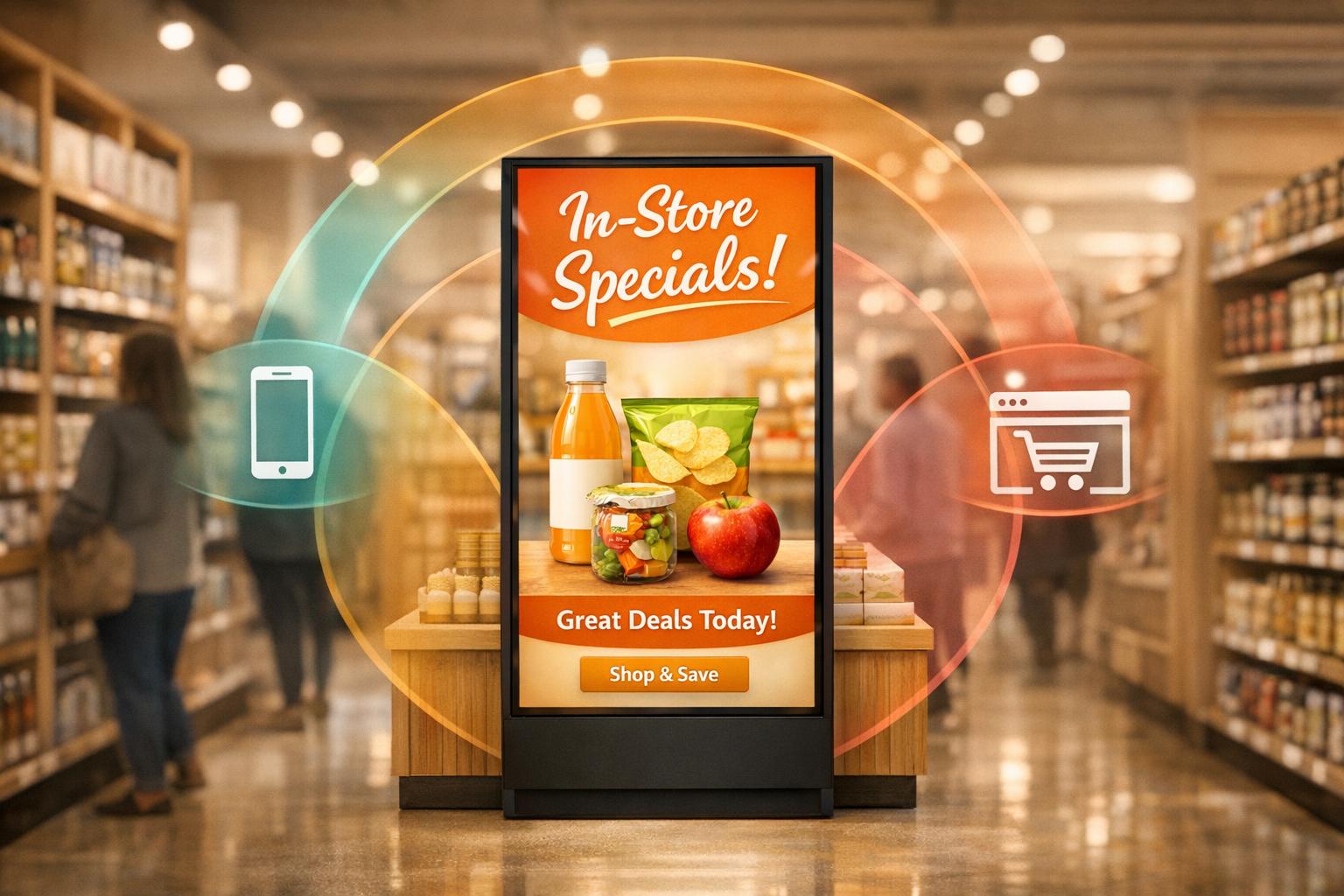
Omnichannel segmentation transforms in-store digital screens from static displays into dynamic, data-driven tools for personalised advertising. By combining online and in-store shopper data, retailers can deliver targeted, real-time content that aligns with customer preferences and behaviours. Here's what you need to know:
- Personalised Messaging: AI and real-time data tailor ads to shopper demographics and behaviours, such as age, gender, or browsing history.
- Privacy-Compliant Data: Edge-based AI ensures data is anonymised and processed locally to respect privacy.
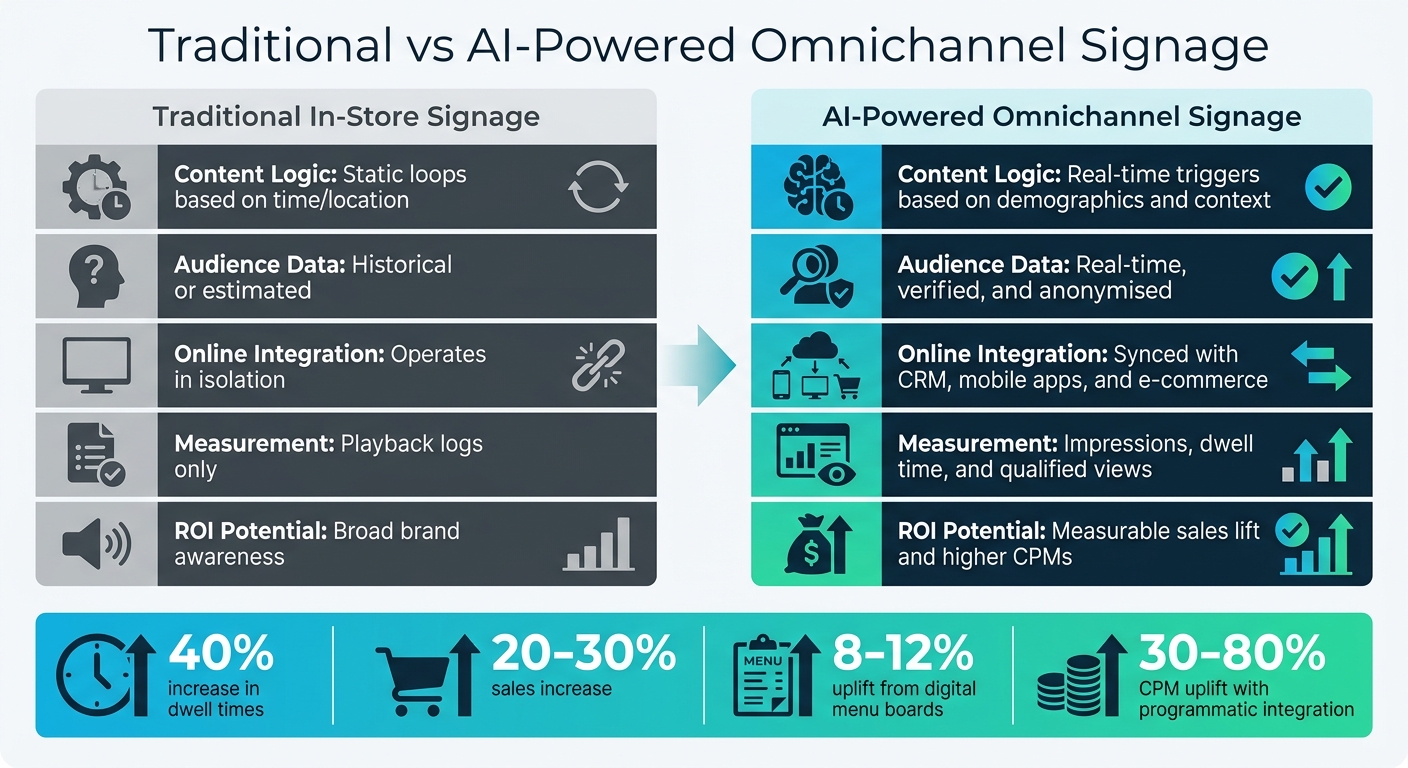
- Improved Engagement: Targeted ads increase dwell times by up to 40% and boost sales by 20–30%.
- Programmatic Integration: Real-time bidding platforms like Adflux SSP connect screens with global advertisers, driving higher revenue.
- Measurable Results: Metrics like impressions, dwell time, and transaction matching provide clear insights into ad performance.
Retailers who integrate these strategies can bridge the gap between digital and physical shopping, ensuring consistent, meaningful customer experiences while maximising ad revenue and campaign efficiency.
How In-Store Retail Media is Transforming with Personalized Digital Signage
sbb-itb-c231c83
What Is Omnichannel Audience Segmentation
Traditional vs AI-Powered Omnichannel Digital Signage Comparison
Omnichannel audience segmentation uses real-time data and AI to understand shopper demographics and behaviours, delivering content tailored to their entire digital and physical shopping journey. Instead of treating in-store screens as standalone billboards, this approach turns them into precise media channels, similar to online advertising.
This technique bridges the gap between online and offline shopping. For instance, if someone browses gluten-free products on a retailer's app, the system can instantly display related promotions on in-store screens when that shopper enters the store. This is powered by real-time data processing: sensors collect anonymised shopper data, match it to predefined segments, and trigger ads that are relevant in the moment. Integration with CRM and loyalty systems further ensures that the content reflects the shopper's digital history.
This shift moves retailers away from location-based advertising - where ads play simply because a screen is in a specific spot - to audience-based media that targets specific demographics or behaviours. Noura Assem, Marketing Automation Engineer at intouch.com, explains:
"The core idea of audience segmentation is simple: if you try to speak to everyone, you end up connecting with no one. True connection begins when you understand who you're talking to and what they actually care about".
The result is a data-driven transformation of physical stores into digital platforms, offering the targeting precision and analytical tools typically associated with online advertising. This seamless integration between online and offline experiences sets the stage for AI-driven shopper profiling.
How AI Enables Shopper Profiling
AI brings a new level of precision to in-store advertising by analysing shopper attributes in real time. As customers approach, edge-based AI technology processes anonymised visual cues - such as age, gender, and group size - and immediately triggers ads tailored to those attributes. Importantly, no personal images or identifiers are stored; only aggregated data is used to match customers to predefined segments.
This approach shifts the focus from reactive to predictive segmentation. Instead of relying solely on past purchases, AI considers a range of subtle signals - like browsing history, cart contents, and even external factors like weather or queue length - to anticipate what a shopper might want next. For example, if someone lingers in the dairy section on a chilly morning, an ad for hot chocolate or soup might appear on a nearby screen.
The ability to respond instantly enables real-time targeting, ensuring the most relevant ad is displayed while the shopper is still in the store. AI also creates unified customer profiles by combining data from POS systems, loyalty programs, and e-commerce platforms with in-store sensor data. For example, a shopper who left an online cart abandoned might see a discount or reminder for that very product when they visit the physical store. These unified profiles drive personalised messaging that boosts both engagement and sales. In fact, advanced AI-driven digital signage has been shown to increase dwell times by up to 40% and double audience attention compared to generic ads.
Benefits of Omnichannel Segmentation
Omnichannel segmentation, powered by AI, delivers clear advantages. By refining targeting, it not only enhances the shopping experience but also leads to measurable revenue growth. Targeted in-store content has been shown to increase sales by 20–30%, with digital menu boards achieving an uplift of 8–12%.
For customers, this precision translates into more relevant and personalised experiences. A survey found that 81% of consumers prefer brands that deliver tailored messaging. When shoppers encounter consistent, meaningful content both online and in-store, they feel understood, not overwhelmed, by irrelevant ads. This strengthens trust and increases the likelihood of making a purchase.
From a retailer's perspective, omnichannel segmentation significantly improves marketing ROI. Targeted campaigns account for 77% of marketing ROI, highlighting the inefficiency of generic advertising. This approach not only enhances customer experience but also boosts profitability. By reaching the right audience with fewer ad plays, retailers can sell unused inventory to other advertisers, further increasing profit margins.
| Factor | Traditional In-Store Signage | AI-Powered Omnichannel Signage |
|---|---|---|
| Content Logic | Static loops based on time/location | Real-time triggers based on demographics and context |
| Audience Data | Historical or estimated | Real-time, verified, and anonymised |
| Online Integration | Operates in isolation | Synced with CRM, mobile apps, and e-commerce |
| Measurement | Playback logs only | Impressions, dwell time, and qualified views |
| ROI Potential | Broad brand awareness | Measurable sales lift and higher CPMs |
Additionally, omnichannel segmentation provides real-time data insights that can inform broader strategies. Metrics like dwell time, impressions, and conversion rates allow retailers to A/B test content and refine their targeting over time. This feedback loop transforms in-store screens from static displays into dynamic tools that directly contribute to revenue growth.
How to Capture Shopper Data for Segmentation
Gathering shopper data in-store requires a careful balance: you want precise insights, but you also need to respect privacy and comply with Australian data protection laws. The aim is to turn in-store shoppers into detailed digital profiles while keeping their personal information secure. Many retailers now use edge-based AI to process data locally, ensuring sensitive visual information never leaves the store.
Interestingly, since 2023, the cost of sensor-based kits has dropped by over 70%. This makes advanced data collection tools accessible even to smaller retailers.
Privacy-First Data Collection
The key to ethical data collection lies in edge computing. This method processes information directly on in-store devices instead of sending it to cloud servers. It ensures no personally identifiable information (PII) is captured, stored, or shared. As datmedia explains:
"All analytics are designed with privacy in mind - no personally identifiable information (PII) is captured; data is aggregated and anonymised for compliance".
Privacy-first systems focus on group-level data, such as age ranges, gender, and group size, rather than identifying individual shoppers. This approach aligns with Australian privacy laws by keeping the data anonymous right from the start. Retailers can also enhance this strategy by using opt-in tools like QR codes or interactive screens. These let shoppers voluntarily engage and share their preferences.
With privacy safeguards in place, retailers can unlock even more insights through AI-driven analytics.
AI-Powered Vision Analytics
AI-powered vision analytics is changing the way retailers understand customer behaviour. These systems use sensors to track key metrics like audience presence, dwell time, and attention spans in real time - all without compromising privacy. For example, Adflux CMS integrates vision analytics into its content management system, combining viewer data with proof-of-play logs to give a complete picture of campaign performance.
This technology enables automated profiling based on anonymised demographics like age and gender. It also monitors behavioural patterns, such as foot traffic and how shoppers move through the store. By analysing these patterns, retailers can better understand how different customer groups interact with their space.
Iman Nahvi, Co-Founder and CEO of Advertima, highlights the value of this approach:
"Only computer vision can deliver the quantity and quality of data signals to understand the full spectrum of shoppers and their behaviour in-store".
To make the most of these tools, ensure sensors are placed strategically, with proper sightlines to cover the most relevant areas.
How to Activate Audience Segments on In-Store Digital Screens
Delivering ads to the right audience at the right moment is now possible with real-time activation on in-store digital screens. Instead of relying on assumptions, modern systems use real-time data to display ads tailored to the audience standing in front of the screen. This process builds on earlier segmentation insights, ensuring your messaging is both timely and relevant.
Dynamic Content Scheduling
Dynamic scheduling takes advantage of real-time data like foot traffic, visitor volume, and customer flow to align content with shopper behaviour. By using these insights, retailers can automatically display ads that resonate with specific audience segments. For example, sensor data can track footfall patterns, allowing systems like Adflux CMS to deliver highly targeted content. This approach not only enhances engagement but can increase customer interaction by up to 30%.
Adflux CMS integrates sensor data with proof-of-play logs, giving retailers a clear view of which segments are seeing specific ads. The system processes this information instantly, ensuring the right ad is displayed for the audience in real time. Businesses using automated footfall analytics have reported up to 20% higher efficiency in content scheduling compared to manual methods.
To optimise results, it's crucial to match content length and frequency with dwell time data. For instance, if sensors show that a segment typically spends only a few seconds in front of a screen, shorter, punchier ads will be more effective. Regularly reviewing and adjusting your schedule based on updated foot traffic data ensures that your strategy remains effective.
The growing demand for these technologies is reflected in the footfall analytics market, which is expected to reach $1.5 billion by 2026.
Programmatic SSP Integration
Programmatic Supply-Side Platforms (SSPs) are transforming the way in-store ad inventory is managed. These systems connect in-store screens with global Demand-Side Platforms (DSPs), enabling automated real-time bidding (RTB) for ad slots. This allows for precise targeting based on first-party audience data.
Adflux SSP, for example, links to over 35 DSPs, including major players like The Trade Desk and Google DV360. This integration increases competition for ad slots, improving fill rates. With an auction response time of under 50ms, ads are selected and delivered almost instantly, tailored to the current audience segment. This programmatic approach can lead to a 30–80% CPM uplift compared to traditional models.
Adflux explains the benefits clearly:
"Adflux SSP delivers maximum monetisation through neutral, multi-DSP RTB auctions... For retailers who want to retain control of their CMS while maximising programmatic yield, Adflux SSP is the clear choice".
By using programmatic budgets across both in-store screens and online platforms, retailers can create seamless omnichannel campaigns, ensuring consistent messaging across all touchpoints.
Traditional Scheduling vs AI-Activated Segmentation
The shift from traditional scheduling to AI-driven segmentation is a game-changer. While traditional methods rely on static data and fixed ad loops, AI-activated segmentation uses real-time insights to dynamically adjust content based on the audience present.
| Feature | Traditional Scheduling | AI-Activated Segmentation |
|---|---|---|
| Targeting Precision | Broad (Location/Time-of-day) | Granular (Real-time demographics/Behaviour) |
| Content Selection | Static Loop / Manual | Dynamic / Data-driven |
| Buying Model | Direct / Loop-based | Programmatic RTB / Impression-based |
| Revenue Impact | Standard CPMs | 30–80% CPM uplift |
As Iman Nahvi, Co-Founder and CEO of Advertima, highlights:
"The AI cannot passively wait for a trigger - it must be active at all times, analysing the environment well before the targeted ad spot begins".
A practical example of this technology in action is Majid Al Futtaim's Precision Media initiative, launched in 2024 across Carrefour UAE stores. By deploying sensor-based systems, they enabled real-time audience segmentation, activation, and measurement across their in-store screens.
To fully utilise AI-activated segmentation, retailers should map screen zones to key shopper moments. For instance, screens at entrances can feature brand takeovers, while checkout screens can display loyalty program messages. Linking these screens to programmatic SSPs opens up access to global demand, while predictive AI can anticipate the audience composition for upcoming ad slots, ensuring maximum relevance.
How to Measure and Optimise Segmentation Performance
Retailers are increasingly treating in-store screens as dynamic digital media channels. They rely on tools like proof-of-play reporting, audience-based metrics, and closed-loop measurement to assess performance and make improvements.
Key Metrics for Success
The focus has shifted from traditional loop-based scheduling to metrics that highlight viewer engagement. These include total impressions, exposure frequency, dwell time, and Share-of-Voice. By linking screen exposure to transaction and loyalty data, retailers can achieve closed-loop attribution, providing a clear picture of how ads drive results.
Jonathan Franco, Global Head of Retail Media at Broadsign, explains:
"The OOH market has taught us that success isn't just about having screens in impactful locations; it's about playing the right content in the right place at the right time".
The table below outlines how measurement evolves across various retail media strategies:
| Metric Category | Online-Only Strategy | In-Store-Only (Legacy) | Omnichannel (AI-Activated) |
|---|---|---|---|
| Primary Metric | Click-through rate (CTR) | Loop frequency / Airtime | Real-time impressions |
| Audience Data | Deterministic (Cookies/IDs) | Historical foot traffic | Real-time AI-predicted segments |
| Engagement | Viewability / Scroll depth | None (Passive) | Dwell time and View time |
| Attribution | Last-click / Multi-touch | General store sales lift | Closed-loop transaction matching |
| Optimisation | Real-time bidding (RTB) | Manual schedule updates | AI-driven spot-by-spot activation |
Modern systems distinguish between total impressions and viewable impressions, offering more precise insights. Unlike online ads, which typically reach one person at a time, in-store screens operate on a "1-to-some" model, where a single ad can generate multiple impressions simultaneously.
Proof-of-Play Reporting and Optimisation
Metrics like proof-of-play (PoP) reporting provide accountability and actionable insights. When paired with real-time audience data, PoP logs enable immediate adjustments to campaigns. Platforms like Adflux CMS integrate PoP data with impressions and dwell times, creating performance analytics that align with online media standards.
Adflux CMS also uses real-time polling and remote screenshot capture to verify that screens display the correct content for each segment. This data supports campaign rebalancing, where budgets or impressions are dynamically shifted between screens or locations to achieve campaign goals. For instance, if specific screens consistently perform better with a target audience, the system can allocate more impressions to those spots.
To ensure long-term success, integrate digital signage into your broader retail media reporting from the start. This prevents data silos and allows for seamless optimisation. Predictive AI can further enhance targeting by analysing shopper movement patterns. Instead of merely counting passers-by, it forecasts who will remain in view for the duration of a 10-second ad.
Despite the rise of e-commerce, 80% of retail purchases still happen in physical stores. This makes in-store measurement a critical component for understanding campaign effectiveness. A continuous feedback loop sharpens segment targeting and boosts overall performance.
Conclusion
Omnichannel segmentation transforms static retail screens into highly targeted media channels, thanks to the power of AI-driven analytics and real-time targeting. By merging online and in-store shopper data, retailers can send tailored messages to the right audience at the perfect moment - bridging the gap between digital and physical environments.
This evolution from location-based to audience-based selling not only boosts campaign efficiency but also allows retailers to achieve higher CPMs. With retail media budgets expected to exceed $230 billion by 2027 and around 80% of grocery shoppers still choosing in-store shopping, the opportunity to monetise physical retail spaces is immense. Real-time targeting further enhances efficiency by minimising ad waste, optimising inventory use, and delivering measurable returns on ad spend.
Platforms like Adflux CMS bring these advancements into focus. Through programmatic SSP integration with over 35 DSPs, AI-powered vision analytics for live audience profiling, and detailed proof-of-play reporting, retailers gain tools that rival online media capabilities. Its unbiased, neutral design ensures retailers maintain control while maximising returns via real-time bidding mediation.
To succeed, retailers must move beyond manual playlist management and adopt automated, rule-based content strategies. Start small with impactful audience segments, integrate real-time data, and continuously refine the approach through measurement. With over 80% of purchase decisions made in-store, leveraging omnichannel segmentation ensures that every screen delivers meaningful engagement and value.
FAQs
What data is needed to start omnichannel segmentation on in-store screens?
To implement omnichannel segmentation on in-store screens, start by collecting data about your customers - who they are, how they behave, and what they prefer. This includes first-party data like purchase history, loyalty program participation, in-store interactions, and online activities that connect to their in-store behaviour.
Having a unified customer view and a reliable data infrastructure is critical. By organising details like demographics, shopping habits, and engagement patterns, you can craft tailored and meaningful content for your in-store digital screens.
How can I personalise ads in real time without collecting personal information?
You can customise ads in real time by using AI-driven audience segmentation and contextual targeting - all without needing personal data. Instead of relying on identifiable information, this method taps into non-identifiable data like:
- Location insights: Understanding where users are helps tailor ads to their immediate surroundings.
- Behavioural patterns: Analysing general trends in how people interact with content or products.
- Contextual cues: Matching ads to the environment or situation, such as weather or time of day.
For example, in-store digital screens can use AI-powered vision analytics to assess the shopping environment and deliver ads that feel relevant to the moment. This approach not only respects privacy but also boosts engagement by making the content more meaningful to the audience.
How do I prove in-store screen ads drove sales?
To show that in-store screen ads are boosting sales, focus on tracking important metrics such as sales lift, conversion rates, and customer engagement. Use analytics tools to compare sales figures from before and after running your campaigns. Additionally, monitor data like impressions, dwell time, or even coupon redemptions to gauge effectiveness.
For a more detailed understanding, consider A/B testing to compare outcomes between stores with and without the ads. You can also use camera analytics to link shopper behaviour, like interactions with the screens, directly to sales performance. When presenting your findings, highlight the increase in sales and engagement to clearly showcase the impact of your ads.
Adflux Editorial
Retail media, programmatic DOOH, and digital signage insights for Australian retailers.
Ready to build your retail media network?
Talk to the Adflux team about how the platform can work for your screens.