
How Programmatic Ads Optimise In-Store Campaigns
Use real-time bidding, AI and live store data to run inventory-aware digital ads on screens that drive measurable in-store sales.
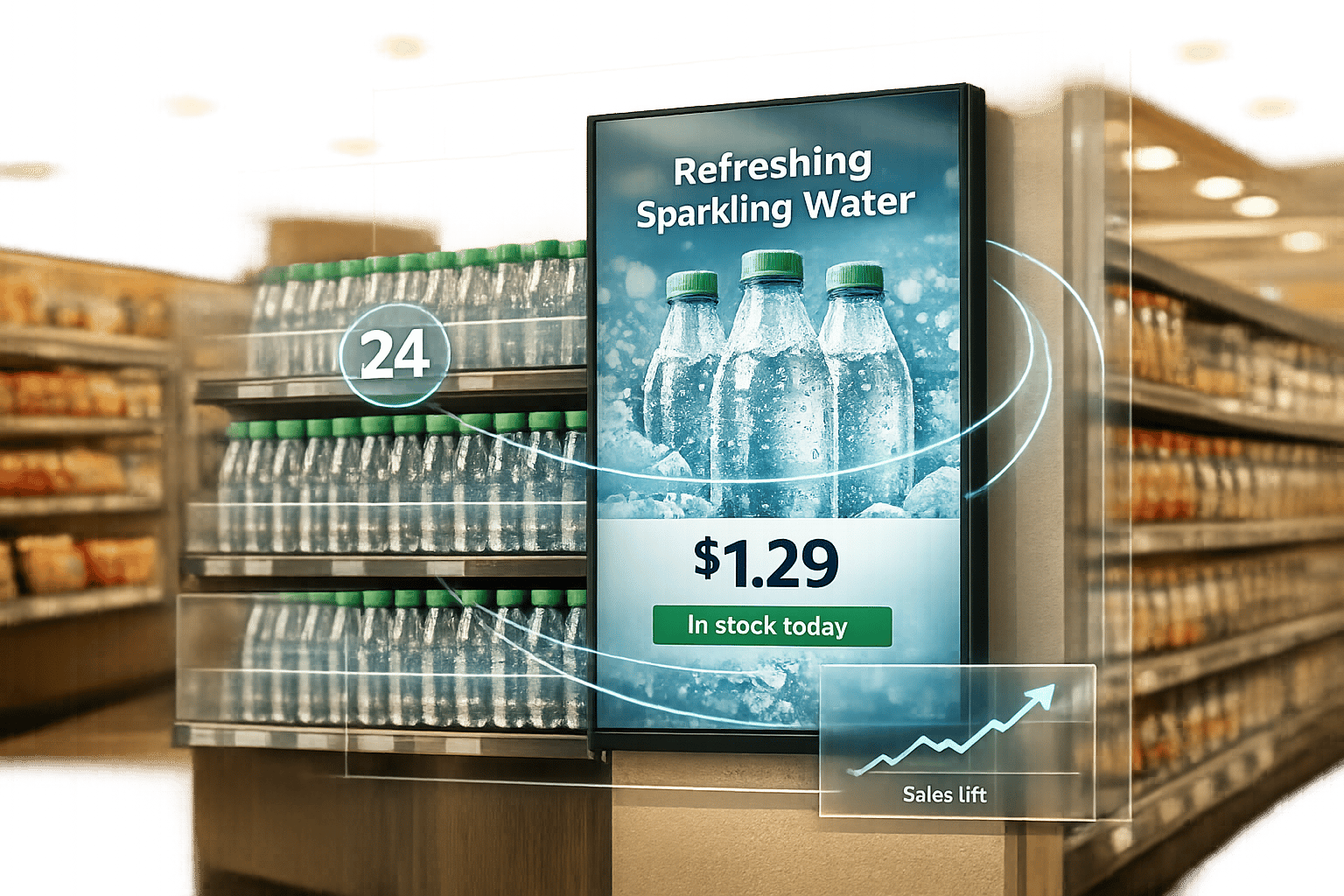
How Programmatic Ads Optimise In-Store Campaigns
Programmatic advertising is transforming in-store marketing by automating ad placements using real-time bidding, AI, and live data. Retailers can now display ads on digital screens that adjust dynamically based on factors like inventory levels, weather, or store traffic. For example, ads can promote products during peak demand or pause for out-of-stock items. This approach has proven effective, with campaigns like L'Oréal's 2024 initiative delivering a 50.7% sales increase compared to traditional methods.
Key takeaways:
- Dynamic Ads: Automatically adapt to store conditions (e.g., stock levels, shopper behaviour).
- Advanced Tools: Platforms like Adflux CMS connect in-store screens to global ad networks, enabling real-time bidding and AI-driven analytics.
- Proven Results: Programmatic campaigns have shown sales uplifts of up to 74% in some cases.
- Data-Driven Targeting: Combines in-store analytics with first-party data for precise audience segmentation.
This guide outlines how to set clear objectives, use data effectively, select bidding strategies, and integrate tools like Adflux CMS to optimise in-store campaigns. By leveraging programmatic technology, retailers can maximise ad performance and drive measurable sales growth.
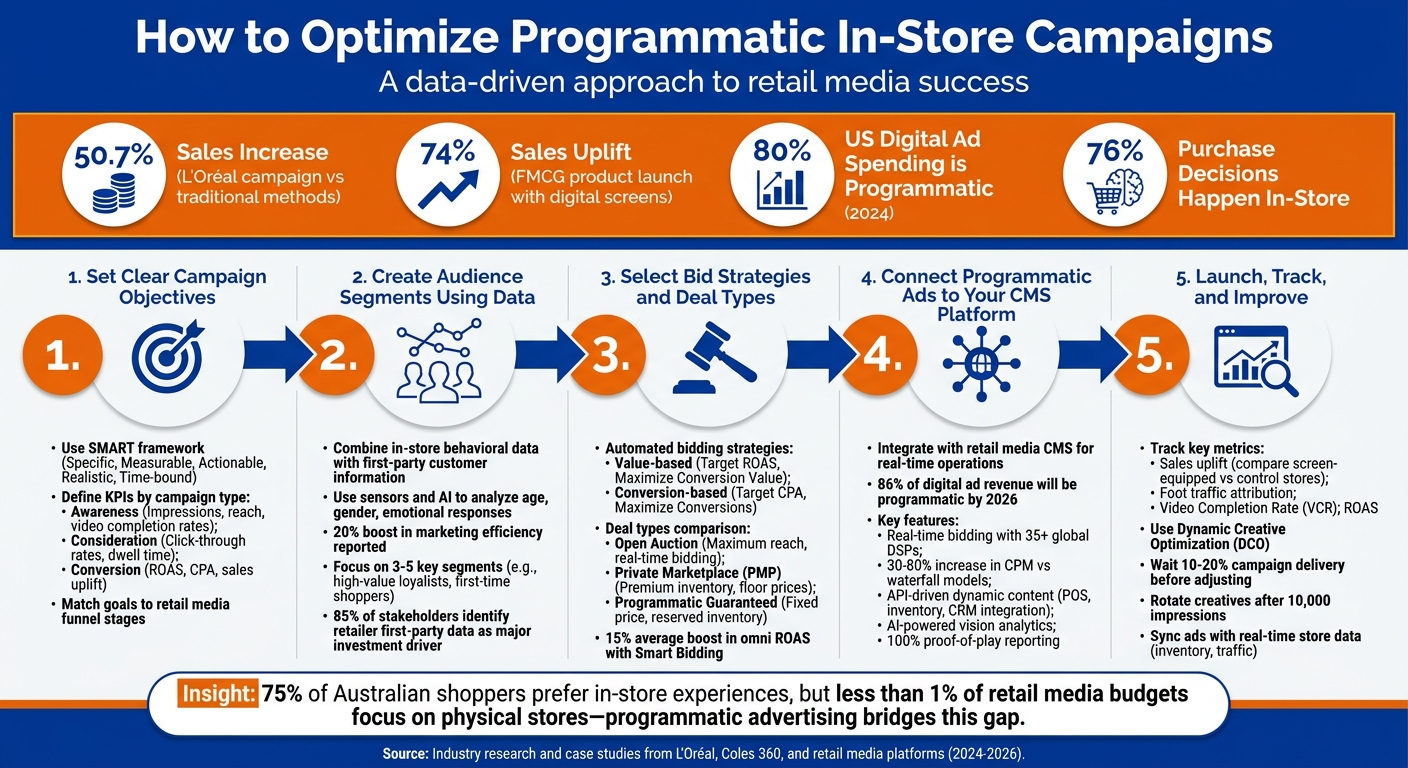
5-Step Process to Optimize Programmatic In-Store Ad Campaigns
James Avery, of Kevel, on Programmatic Advertising for Retail Media
sbb-itb-c231c83
What Is Programmatic Advertising for In-Store Campaigns?
Programmatic advertising uses digital technology, artificial intelligence, and real-time bidding to automate the process of buying ad space. Instead of relying on pre-set ad loops, it enables live bidding on in-store screens, helping to deliver the right message to the right shopper at the perfect moment.
How Programmatic Advertising Works
To make the most of programmatic ads in retail, it’s important to understand how they work. The entire process happens in milliseconds. Digital screens placed in key areas - like entrances, aisles, endcaps, or checkout zones - are connected to demand-side platforms (DSPs) via supply-side platforms (SSPs) using OpenRTB standards. When specific conditions are met, an automated auction is triggered. The winning ad is then displayed instantly, following the targeting and campaign rules.
This system is very different from traditional advertising, which relies on fixed pricing and static schedules. Programmatic ads use dynamic pricing, adjusting based on demand. In 2024, programmatic advertising made up 80% of all digital ad spending in the US. Moreover, 60% of US advertisers planned to increase their investment in this area. This fast-paced, flexible approach is transforming in-store ad campaigns.
Using Programmatic Ads In-Store
In-store programmatic campaigns are displayed on digital screens and can also play over in-store audio networks. These ads adapt in real time using live store signals. For instance, they can pause promotions for out-of-stock items, advertise umbrellas during a rainy day, or change messaging during busy shopping periods. Integration with a content management system (CMS) ensures operational updates can override ads when necessary.
A standout example occurred in November 2024, when L'Oréal partnered with Coles for a campaign on digital screens at the front of stores. Led by Zoe Berends, National Business Manager at L'Oréal, the campaign achieved impressive results: a 50.7% increase in average dollar sales compared to weeks with non-digital media, and a 76.8% increase compared to weeks without any in-store media. Berends highlighted the importance of in-store advertising:
"The vast selection of in‑store touch points to speak to shoppers during their shopper mission are highly valuable for brands such as L'Oréal to drive our presence and visibility in store at that point of purchase".
Step 1: Set Clear Campaign Objectives
Before diving into any programmatic campaign, it’s crucial to establish clear objectives. These goals should tie directly to your broader business ambitions, whether that’s breaking into a new market, boosting customer lifetime value, or driving immediate sales.
A helpful way to structure your goals is by using the SMART framework - they should be Specific, Measurable, Actionable, Realistic, and Time-bound.
Define Your Key Performance Indicators (KPIs)
Once your objectives are in place, the next step is to identify measurable KPIs that reflect your campaign’s success. These metrics should go beyond surface-level data and provide real insights into the value of your in-store audience. For instance, tracking foot traffic alone won’t help if only a small percentage of visitors actually make purchases.
Here’s how to focus your KPIs based on campaign type:
- Awareness campaigns: Monitor impressions, reach, and video completion rates.
- Consideration campaigns: Look at click-through rates, website traffic, and dwell time.
- Conversion campaigns: Measure return on ad spend (ROAS), cost per acquisition (CPA), and in-store sales uplift.
For example, in November 2024, Coles 360 executed a campaign for an FMCG brand launching a new product. Led by Sam Hegg, Head of Strategy and Planning, the campaign utilised digital screens for promotions. The result? A 74% sales uplift in participating stores compared to a control group where no digital promotions were used.
Match Campaign Goals to Retail Media Stages
The success of programmatic campaigns lies in tailoring them to where shoppers are in their journey. Here’s how to align your efforts with the retail media funnel:
- Awareness campaigns: Build brand recognition with high-reach placements, such as digital ads near store entrances.
- Consideration campaigns: Engage shoppers mid-aisle with tools like product comparisons or reviews.
- Conversion campaigns: Encourage action at checkout with timely offers or product recommendations.
Understanding this shopper journey helps you allocate your budget wisely. For instance, with 75% of Australian consumers preferring in-store shopping to physically experience products, your strategy should maximise those key point-of-purchase opportunities. Historical data can also guide your expectations - if past campaigns achieved a 50% sales uplift, that figure can serve as a benchmark for future efforts.
Step 2: Create Audience Segments Using Data
To run a successful campaign, you need to know your audience inside out. By segmenting shoppers based on behaviour, demographics, and context, you can deliver tailored ads that speak directly to their needs. This kind of precision matters, especially since 76% of purchase decisions happen in-store. Targeting the right person at the right time can make all the difference in boosting engagement and driving results.
The secret lies in blending in-store behavioural data with first-party customer information. This combination not only sharpens your targeting but also keeps you compliant with privacy laws like Australia's Privacy Act.
Use In-Store Data for Targeting
In-store analytics offer a treasure trove of insights into shopper behaviour. Advanced sensors and AI can quickly analyse attributes like age range, gender, and even emotional responses as shoppers pass by digital screens. This data is then matched to predefined audience segments, ensuring that the ads displayed are spot-on.
Here’s a practical example: A male shopper walks by a personal care section. The system detects this and serves an ad for men’s grooming products. Metrics like dwell time (how long someone looks at a screen) and eye movements help distinguish between casual glances and genuine interest. Retailers using this approach have reported a 20% boost in marketing efficiency.
"In-store shoppers are pivotal for grocery and FMCG advertisers, but traditional digital signage in physical stores hasn't been able to compete with online retail media's targeting and campaign measurement capabilities." - James Allison, Director Market Development EMEA, Advertima Vision AG
To get started, focus on three to five key audience segments. These could include groups like “high-value loyalists,” “first-time shoppers,” or “lapsed customers.” Keep it simple - over-segmenting can make your campaigns harder to manage and dilute your message.
Add First-Party Data for Privacy-Compliant Targeting
Pairing in-store sensor data with first-party customer data gives you a full picture of shopper behaviour. First-party data - collected directly through loyalty programs, POS systems, apps, or e-commerce platforms - is both more precise and privacy-friendly than third-party alternatives.
The best way to manage this data is by using a Customer Data Platform (CDP). A CDP consolidates information from different sources into a unified profile. This allows you to connect online interactions with in-store visits, enabling highly targeted campaigns.
For instance, if a shopper abandons their online cart, you can retarget them with a tailored offer when they visit your store. Imagine displaying that offer on a digital screen near the product they were considering. With cart abandonment rates exceeding 70% in 2023, this strategy can help recover lost sales.
Start small with progressive profiling. For example, collect an email address for a digital receipt, then gradually gather preferences through quizzes or preference centres. Another effective method is using guest Wi-Fi portals, which can capture contact details and link them to visit data like dwell time and frequency.
Transparency is key. Always use clear privacy statements to explain how the data will be used. When activating data for programmatic platforms, rely on hashed, consented identifiers to protect customer privacy. This builds trust while keeping you compliant with privacy regulations.
With 85% of buy-side stakeholders identifying retailer first-party data as a major driver of retail media investment, having a solid data strategy isn’t just a good idea - it’s a competitive necessity.
Once you’ve built strong audience segments, you’ll be ready to select bid strategies that align with each group’s needs.
Step 3: Select Bid Strategies and Deal Types
Once you've outlined your audience segments, the next step is to decide on your bid strategy and inventory access. These choices can significantly influence your campaign's ROI. For instance, advertisers using omnichannel Smart Bidding with store conversions have reported a 15% average boost in omni ROAS at a similar cost.
Your bid strategy determines how much you're willing to pay for ad impressions, while your deal type decides the inventory you can access and its priority. When both elements align, your ads are more likely to reach the right shoppers at the perfect moment - without wasting budget on ineffective placements.
Choosing the Right Bid Strategy
Automated bidding strategies leverage AI to adjust bids in real-time, considering factors like device, location, and time. This is especially useful for in-store campaigns where both online and offline behaviours - like store visits - impact performance.
- Value-based strategies (e.g., Target ROAS, Maximise Conversion Value) are great for campaigns focused on high-value purchases, such as premium product promotions.
- Conversion-based strategies (e.g., Target CPA, Maximise Conversions) work well for increasing foot traffic or transactional frequency, such as during a weekend sale.
For instance, if you're running a weekend sale to drive store visits, Target CPA can help maximise foot traffic within budget. On the other hand, if you're promoting high-end products, Target ROAS ensures you bid more aggressively on shoppers likely to make larger purchases.
To optimise automated bidding:
- Use a one-week conversion window instead of the default 30 days. This allows the algorithm to quickly adapt to recent behavioural changes.
- Ensure your test campaigns have at least 30% budget headroom and an impression share below 75%. This gives the system room to explore new offline demand.
- If dynamic store sales reporting isn't available, set an average conversion value in your platform to guide the algorithm.
Once your bid strategy is in place, it's time to evaluate deal types for inventory access.
Comparing Programmatic Deal Types
Programmatic deals offer varying levels of control, pricing, and inventory options. The right choice depends on your campaign goals and the level of certainty you want for ad placements.
- Open Auctions: These are open to all advertisers and use real-time bidding. They are cost-effective and ideal for campaigns focused on broad reach rather than precise placement. Programmatic advertising accounted for over 90% of U.S. digital display ad spend in 2024.
-
Private Marketplaces (PMPs): These invite-only auctions provide access to premium inventory at a floor price, offering enhanced brand safety. For example, the Nova Retail Network introduced programmatic in-store audio in March 2026 through a partnership with Magnite, enabling brands to access exclusive retail environments.
"The Nova Retail Network represents a highly engaging environment where brands can connect with shoppers in real time, and we look forward to being able to deliver greater flexibility, efficiency and scale for our advertising partners." - Nicole Bence, Chief Commercial Officer, NOVA Entertainment
- Programmatic Guaranteed: This option reserves inventory at a fixed price with guaranteed delivery, similar to traditional direct buying but with automated execution. It's perfect for high-stakes events like Black Friday or Boxing Day sales.
Here’s a quick comparison of the three deal types:
| Deal Type | Access Level | Pricing Model | Inventory | Best For |
|---|---|---|---|---|
| Open Auction | All buyers | Real-time bidding | Non-reserved | Maximum reach and cost efficiency |
| Private Marketplace (PMP) | Invite-only | Floor prices | Non-reserved | Premium inventory with added brand safety |
| Programmatic Guaranteed | One-to-one | Fixed price | Reserved | High-impact events needing guaranteed delivery |
For most in-store campaigns, starting with PMPs ensures access to quality inventory, while incorporating open auctions can help broaden your reach. Save Programmatic Guaranteed for major retail events where delivery certainty justifies the higher cost. With 72% of Australian audio buyers purchasing programmatically in 2025, the trend toward automated buying in physical retail spaces is accelerating.
Step 4: Connect Programmatic Ads to Your CMS Platform
Once you've selected your bid strategies and deal types, the next step is to link your programmatic ads to a retail media CMS. This connection shifts your campaign management from manual processes to automated, real-time operations. It builds on the audience targeting and bidding strategies you've already set up, streamlining the entire process.
A retail media CMS acts as a hub for monetisation, measurement, and delivery across your screen network. This integration is crucial for managing campaigns in real time, using data to make informed decisions. Considering that by 2026, programmatic ads are projected to make up 86% of all digital advertising revenue, integrating with a CMS is no longer optional - it's essential for staying ahead.
How Adflux CMS Supports Programmatic Campaigns
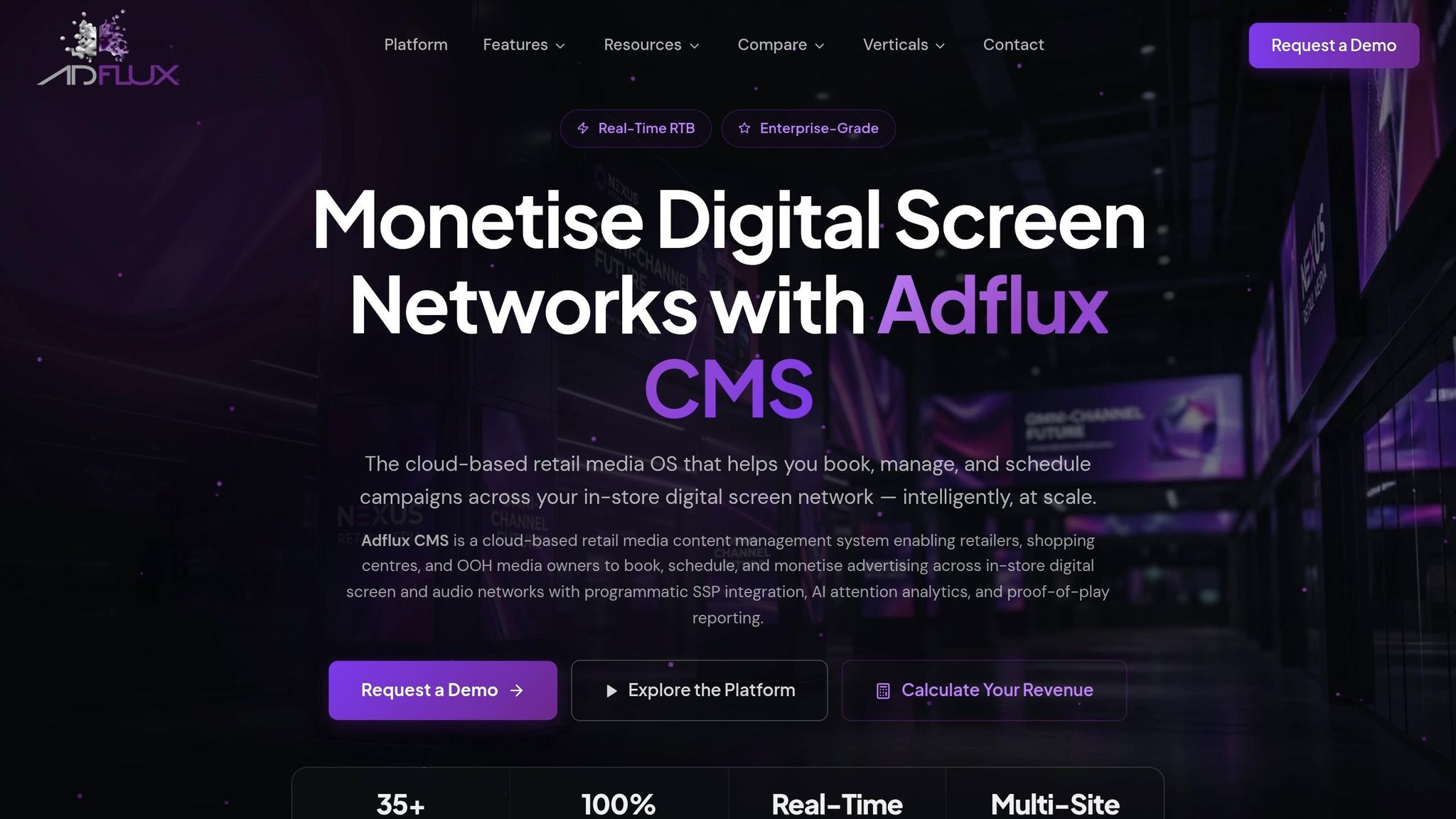
Adflux CMS is purpose-built for retail media, unlike generic digital signage tools. It connects seamlessly with over 35 programmatic DSPs worldwide, enabling real-time bidding to optimise pricing. This approach can lead to a 30–80% increase in CPM compared to older waterfall auction models.
The platform's slot-based engine ensures that reserved inventory is prioritised automatically, whether by advertiser or category. It also adapts programmatic ads to fit various screen formats - like ultra-bright LCDs or transparent LED film - without requiring manual adjustments. This flexibility allows for dynamic, in-store adjustments in real time, as discussed earlier.
Adflux CMS also prioritises brand safety and governance. Features include private marketplace activation, advertiser whitelisting, and creative approval workflows. If needed, a real-time "kill-switch" allows for immediate intervention at the CMS level. Additionally, the platform provides 100% proof-of-play reporting, verified at both the screen and campaign levels.
"Adflux CMS is the operating system of your entire screen network - purpose-built for enterprise digital signage and retail media, not adapted from generic content management tools." – Adflux CMS
Use Real-Time Features to Improve Performance
Real-time functionality sets successful campaigns apart. Adflux CMS offers API-driven dynamic content that integrates with systems like Point of Sale, inventory databases, and CRM platforms. For example, ads for out-of-stock products can be automatically removed, while overstocked items can be highlighted, ensuring ad spend is used effectively.
The platform’s AI-powered vision analytics enhances campaign performance through privacy-first audience tracking, measuring dwell time and attention at the device level. By using computer vision technology, it tailors content based on viewer demographics and behaviour, boosting engagement while maintaining privacy.
For retailers managing both visual and audio touchpoints, Adflux supports real-time scheduling of in-store audio ads. These can be tailored to specific times, events, or locations. The centralised dashboard includes six live KPI cards, tracking metrics like Active Campaigns, Ad Plays Today, and Average Opportunity to See, along with trend indicators. These insights help you schedule high-priority programmatic content during peak traffic times, ensuring every impression counts. Real-time data like this allows you to continuously adjust and enhance your campaign strategies.
Step 5: Launch, Track, and Improve Your Campaigns
Once your campaigns are live, the real work begins. Tracking performance and making ongoing adjustments are essential for achieving measurable results. With your CMS integration and bidding strategies in place, focus on monitoring metrics that align directly with your campaign goals and deliver meaningful outcomes.
Track These Key Metrics
One of the most important metrics to monitor is sales uplift. This involves comparing revenue from stores equipped with digital screens to either a control group or periods without media. Past campaigns have shown that front-of-store digital screens can significantly boost average sales compared to other in-store media formats or times when no media was present.
Another key metric is foot traffic attribution, which measures how many shoppers visit your store after viewing a programmatic ad. Using tools like GPS, beacon technology, and bidstream analysis, you can track these visits. However, it's not just about total visits - incrementality testing helps separate ad-driven visits from organic foot traffic, proving the effectiveness of your campaign spend.
"Capturing the shoppers at the right time, when they're in the right frame of mind to consider our products and within their purchase mindset, is critical for us." – Zoe Berends, National Business Manager, L'Oréal
For video content, keep an eye on the Video Completion Rate (VCR) to measure engagement and viewability to ensure your ads are actually being seen. Additionally, ROAS (Return on Ad Spend) helps you calculate the financial return on your investment. These metrics provide the insights needed to make informed adjustments as your campaign progresses.
Use Data to Improve Campaign Performance
Use the KPIs and audience data you’ve already established to guide improvements. However, avoid making changes too early - wait until 10–20% of the campaign has been delivered or at least a week has passed. Early adjustments can disrupt the learning phase and lead to inaccurate results.
Dynamic Creative Optimisation (DCO) is a powerful tool for refining your campaign. It allows you to test different creative elements - headlines, visuals, and calls-to-action - by automatically adapting them based on real-time engagement data. For example, if carousel ads outperform static images, you can reallocate your budget mid-campaign. To combat ad fatigue, rotate creatives regularly, ensuring each one reaches at least 10,000 impressions before being replaced.
For retail campaigns, syncing your programmatic ads with real-time store data can be a game-changer. For instance, campaigns can pause automatically when stock levels are low or ramp up promotions for surplus or perishable items. A compelling example: in 2024, an FMCG brand launching a new product through Coles 360 achieved a 74% sales increase in stores with digital screen promotions compared to stores without ads.
"Digital in-store assets are ideal for promoting when your avocados are ripe to help move them out the door." – Ben Allman, Head of Sales, Broadsign
Fine-tune your bidding and targeting strategies by aligning content with shopper habits. Use time-of-day targeting to display relevant products when they’re most likely to resonate - for example, promoting morning skincare serums during early hours and nighttime routines later in the day. Adjust bids dynamically, increasing them during peak shopping times and reducing spend on underperforming segments. To optimise further, create allow lists for high-performing domains or screens and block lists to exclude placements that don’t meet expectations. These continuous refinements ensure every dollar works harder for you.
Conclusion
Programmatic advertising has reshaped in-store campaigns, turning them into dynamic, real-time systems. By automating ad placement, targeting customers at the point of purchase, and incorporating live data on inventory and performance, retailers can achieve results that traditional methods simply can't match. This approach has already delivered impressive improvements in both sales and efficiency.
The key to success lies in following a strategic approach: setting clear KPIs, leveraging detailed audience data, choosing effective bidding strategies, integrating your CMS, and fine-tuning campaigns based on real-time insights. Each step works together to create a continuous cycle of improvement.
Technology plays a critical role in amplifying these efforts. For example, Adflux CMS simplifies the process by combining screen management, programmatic SSP integration, vision analytics, and strong governance tools. With access to over 35 global DSPs and real-time bidding capabilities, retailers can monetise unsold inventory automatically while maintaining control over brand safety and content priorities.
Although 75% of Australian shoppers prefer in-store experiences, less than 1% of retail media budgets currently focus on physical stores. Programmatic advertising bridges this gap by transforming every screen into a measurable and adaptable media asset. This combination of strategy and technology creates new opportunities for measurable growth.
FAQs
What do I need to run programmatic ads on in-store screens?
To display programmatic ads on in-store screens, you'll need a digital signage platform that supports this type of advertising. This platform lets you manage, schedule, and adjust campaigns remotely, making it easier to keep your content fresh and relevant.
You'll also need a demand-side platform (DSP). This tool automates ad placements through targeting and real-time bidding, ensuring your ads reach the right audience at the right time. When combined, these tools streamline creative delivery, simplify campaign management, and provide analytics to help you measure the success of your in-store advertising efforts.
How is in-store programmatic ads performance measured?
Performance is tracked using metrics such as total impressions served and click-through rate (CTR), which measure how often ads are viewed and engaged with. More advanced approaches now include AI-powered analytics that monitor factors like foot traffic, dwell times, and shopper interactions. These tools go a step further by connecting digital impressions to in-store sales, offering valuable insights into how digital signage and in-store campaigns influence consumer behaviour and drive sales outcomes.
How do I use real-time stock data without wasting ad spend?
Don't let your ad spend go to waste. Programmatic advertising lets you fine-tune campaigns using real-time stock data, ensuring your ads only appear when products are available.
By aligning your ad targeting and bidding with live inventory updates, you avoid promoting out-of-stock items. Plus, automation and analytics tools enable you to adjust bids dynamically based on stock levels. This way, your budget is focused on in-stock items, helping you get the most out of your advertising spend and boosting your return on investment (ROI).
Adflux Editorial
Retail media, programmatic DOOH, and digital signage insights for Australian retailers.
Ready to build your retail media network?
Talk to the Adflux team about how the platform can work for your screens.