
Future of Real-Time Audio Ad Bidding
Programmatic real‑time audio bidding uses AI personalisation, dynamic ad insertion and first‑party data to target podcast and streaming listeners and drive measurable retail ROI.
Future of Real-Time Audio Ad Bidding
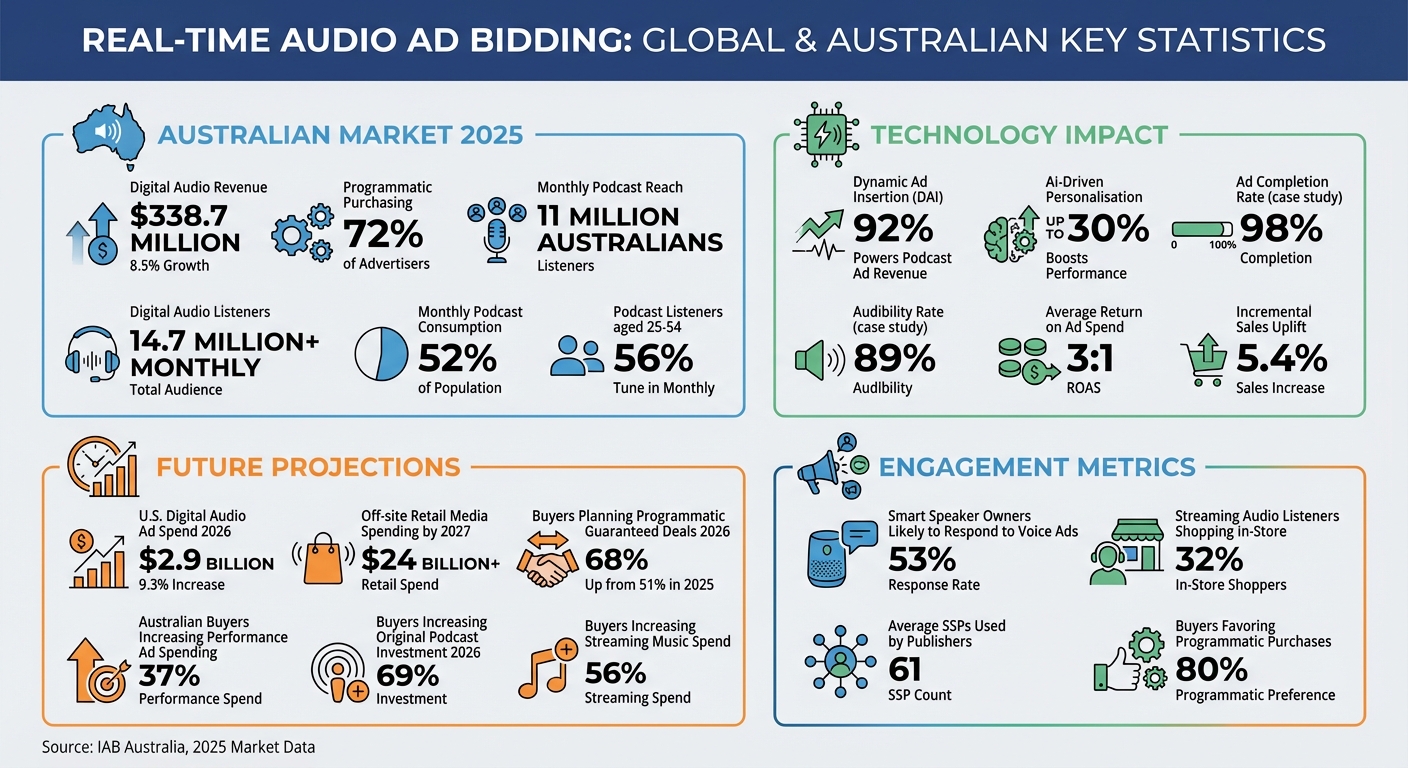
Real-time audio ad bidding is reshaping how retailers engage with audiences, especially through podcasts, streaming music, and digital radio. This programmatic approach uses automated auctions to deliver ads in milliseconds, driven by real-time listener data. In 2025, digital audio revenue in Australia grew by 8.5% to $338.7 million, with 72% of advertisers purchasing programmatically. Podcasts, a key growth driver, now reach 11 million Australians monthly.
Key takeaways:
- Dynamic Ad Insertion (DAI) powers 92% of podcast ad revenue.
- AI-driven personalisation boosts ad performance by up to 30%.
- Interactive formats like voice-activated ads are increasing engagement.
- Retailers integrate first-party data to target audiences during "off-site" moments.
- Platforms like Adflux CMS simplify campaign management and revenue generation.
With programmatic tools improving, audio ad spend is set to grow further, making it an integral part of retail media networks.
Real-Time Audio Ad Bidding Statistics and Market Growth 2025-2026
Market Analysis: Current State and Future Projections
Global and Australian Market Trends
Digital audio advertising keeps climbing, though its growth rate has slowed from the explosive 16-20% increases of past years. In Australia, digital audio revenue hit $338.7 million in 2025, reflecting steady progress.
Podcasting has taken the lead as the key driver of growth, contributing 77% of revenue growth in the U.S. market during 2025. Back home, podcast ad spending in Australia surpassed $150 million in 2025, following a 24.3% rise by late 2024. Podcasts now reach 11 million Australians monthly, with 56% of those aged 25-54 tuning in at least once a month.
Advertisers are also leaning into performance-driven strategies. 37% of Australian buyers plan to increase spending on performance advertising, compared to 27% for brand-focused campaigns. This shift highlights growing trust in audio's ability to deliver measurable results beyond brand awareness. Programmatic buying is now the go-to method, with 72% of Australian advertisers purchasing audio programmatically in 2025. Interest in programmatic guaranteed deals is also climbing: 68% of buyers plan to use them for streaming audio in 2026, up from 51% in 2025.
These trends show audio is carving out a solid role in the broader digital advertising ecosystem, setting the stage for continued growth in ad spend.
Audio Ad Spend Growth Forecasts
The outlook for audio ad spending remains strong. In the U.S., digital audio ad spend is projected to reach $2.9 billion in 2026, up 9.3% from $2.6 billion in 2025. Podcasts are expected to account for 35% of all digital audio spending by 2026, solidifying their role as the backbone of the format's commercial success.
In Australia, confidence in podcasting is clear: 69% of audio ad buyers plan to increase investment in original content podcasts in 2026, while 56% aim to boost spending on streaming music. Despite its reach, digital audio remains under-monetised. In the U.S., for example, it accounts for just 2% of media spend, even though 58% of adults consume it. Sean Wright, Chief Insights and Analytics Officer at Guideline, emphasised this untapped potential:
"There's no reason in my mind that that [digital audio] can't be 5% of marketing plans given the sheer amount of consumption. In the U.S. alone, that could mean an additional $3 billion roughly".
Australia shows similar promise, with 14.7 million Australians listening to digital audio monthly by the end of 2025, and 52% of the population consuming podcasts monthly. Budget shifts are already happening - $87 million moved from TV to digital audio in the U.S. during 2025. As real-time bidding becomes more refined and programmatic tools improve, digital audio is poised to capture a larger chunk of retail media spending.
sbb-itb-c231c83
Technology Driving Real-Time Audio Ad Bidding
Programmatic Audio Infrastructure
New technologies are reshaping how retail ads are delivered, focusing on precision and adaptability. Programmatic infrastructure has replaced outdated manual systems with Real-Time Bidding (RTB), enabling transactions to occur in milliseconds. Publishers now use Supply-Side Platforms (SSPs) to manage ad inventory, control pricing, and ensure brand consistency. On the other side, Demand-Side Platforms (DSPs) allow advertisers to reach specific audiences efficiently.
The introduction of the OpenRTB 2.6 standard has streamlined the process further. This standard includes audio-specific features like format declarations, duration details, and "podding" rules for streaming media. Dynamic Ad Insertion (DAI) enhances ad relevance by allowing ads to be updated in real time, ensuring they align with current retail promotions.
However, the market remains fragmented, with publishers using an average of 61 SSPs. Dr Daniel Knapp, Chief Economist at IAB Europe, highlighted the potential benefits of reducing this fragmentation:
"Consolidating and strengthening these connections could help brands leverage richer first-party data and ensure greater efficiency in their ad spend".
With this programmatic framework in place, AI is taking things a step further by customising ads in real time.
AI-Powered Ad Personalisation
AI is revolutionising ad personalisation through Dynamic Creative Optimisation (DCO). This technology adjusts ad elements in real time based on listener-specific data like weather, time of day, and user behaviour. Smart bidding algorithms evaluate thousands of signals - such as device type, user intent, and context - within milliseconds to determine the best bid. This level of personalisation has been shown to boost audio ad performance by 15%–30%.
In 2024, the finance app Yuh ran a multi-campaign initiative using AdsWizz ShakeMe™ interactive audio technology. The campaign achieved a 92% listen-through rate and a 2.48% interaction rate, far exceeding benchmarks for non-interactive ads. AI is also being used to analyse voice patterns, uncovering listener sentiment and motivations. Meanwhile, machine-learning tools are transcribing and categorising podcast episodes, offering pre-bid suitability signals to ensure ads are matched with appropriate content.
Beyond personalisation, new interactive ad formats are making audio ads more engaging than ever.
Interactive Audio Ad Formats
Interactive formats are transforming how listeners engage with audio ads. Voice-activated ads, for example, encourage users to interact through smart devices with commands like "Alexa, add this to my cart". Over half (53%) of smart speaker owners say they are likely to respond to such ads.
Mobile listeners are also engaging with shake-to-action ads, which prompt actions like opening a map or downloading an app through physical gestures such as shaking or tapping their device. These formats are particularly effective for connecting with busy, on-the-go consumers. A notable example is Fuze Tea's 3D audio campaign on Spotify, which targeted "Chill" and "Yoga" playlist listeners. The campaign achieved a 3.5x increase in ad recall and a 1.8x boost in brand awareness.
Dynamic voice ads take interaction further by enabling real-time conversations. These ads can ask questions and respond instantly, such as sending a voucher via text. Bill Simmons, a podcaster at Spotify, remarked:
"There is going to be a way to use my voice for the ads... it opens up, from an advertising standpoint, all these different great possibilities for you".
Integrating Audio Ad Bidding with Retail Media Networks
Retail Media Network Integration Methods
Real-time audio ad bidding is changing the game for retail media, making it crucial to integrate off-site audio channels for broader audience reach. By tapping into first-party purchase and loyalty data, retailers can target audiences on platforms like Spotify, podcasts, and smart speakers. This approach extends their influence beyond their own websites. Using programmatic infrastructure, this data can be connected to DSPs (like The Trade Desk or Google DV360) to enable real-time bidding for audio ad inventory.
Advanced data matching and closed-loop measurement systems allow retailers to share exposure files and customer identifiers with audio platforms. This creates a direct connection between audio impressions and in-store or online purchases. A standout example is The Coca-Cola Company’s campaign with Dollar General Media Network and Pandora. By leveraging first-party shopper data, they targeted specific audiences, achieving impressive results: a 98% ad completion rate, 89% audibility rate, $6.57 return on ad spend, and 19 million impressions.
Adam Ross, Sales Director at SiriusXM Media, summed it up:
"The real value proposition for audio via a retail media network is to leverage our retail partners' robust audience data".
With seamless data integration as the foundation, advertisers are now turning to Supply Path Optimisation to further refine their campaigns.
Supply Path Optimisation for Audio Campaigns
Supply Path Optimisation (SPO) simplifies the connection between buyers and audio publishers by cutting out unnecessary intermediaries. This reduces inefficiencies often seen in fragmented programmatic ecosystems. Many media buyers are now shifting towards auction-based pricing, which offers more control compared to fixed retailer rates.
In fact, 80% of media buyers expect retail media to adopt the same automated buying methods used in other digital channels. This shift not only standardises processes but also makes it easier to include audio in omnichannel strategies managed through a single DSP. With off-site retail media spending forecasted to surpass $24 billion by 2027, audio campaigns are already proving their worth, showing a 5.4% average incremental sales uplift and a 3:1 return on ad spend.
Anthony Costanzo, Chief Analytics Officer at Mile Marker, captured the growing expectation in the industry:
"Media buyers are accustomed to auction-based and real-time buying methods from non-retail media now. There's that expectation they should be able to execute that in the retail media world as well".
Adflux CMS: Supporting Real-Time Audio Ad Bidding
Core Features for Audio Ad Bidding
Adflux CMS offers retail media networks the ability to engage in real-time audio ad bidding through programmatic marketplace integration. This feature connects audio-capable devices and digital signage displays with demand-side platforms, enabling participation in auction-based ad buying across digital channels.
With content scheduling and API integration, ad delivery aligns seamlessly with real-time inventory data. This ensures that audio promotions are only aired for products currently in stock, reflecting the industry's growing reliance on automated, data-driven advertising. Additionally, proof-of-play reporting provides detailed playback insights and remote monitoring, making sure ads are delivered as planned.
Retailers can further enhance their targeting strategies by using first-party shopper data or third-party audience segments. This allows them to trigger specific audio ads tailored to demographics, location, or time of day, bringing personalised advertising into the physical store environment.
Monetisation and Campaign Management
Beyond its audio bidding capabilities, Adflux CMS simplifies monetisation and campaign management. The platform supports a range of revenue models, including direct ad sales, self-service portals for brands and media agencies, and automated programmatic bidding. This flexibility allows retailers to adopt the approach that best fits their business needs and advertiser relationships.
For large retail organisations, enterprise governance features like multi-user support with custom permission levels make it easy to manage campaigns across multiple regions or store clusters. A centralised interface ensures consistent messaging across the network while allowing for localised adjustments. These tools transform the platform into a bridge between technology and revenue optimisation.
With retail media display ad spending on the rise, Adflux CMS offers competitive pricing. The Standard plan starts at $95 per screen per year (1GB storage and basic tracking), while the Premium plan costs $130 per screen per year (unlimited storage, advanced scheduling, proof-of-play reporting, and multi-user support). Prices are in AUD, excluding GST. By combining these features, Adflux CMS helps retailers maximise revenue opportunities and streamline their campaign management within the growing retail media landscape.
How to Build a Programmatic Audio Marketing Strategy
Conclusion
Real-time audio ad bidding is transforming retail media networks by offering a transparent and efficient advertising solution that reaches over 85% of Australians each month. With digital audio revenue projected to hit $338.7 million by 2025 and 72% of audio ad buyers already purchasing inventory programmatically, the shift from fixed-rate models to auction-based marketplaces is gaining strong momentum.
Technologies like programmatic infrastructure, AI-driven personalisation, and dynamic creative insertion enable highly contextual ads that capture attention - even in the hustle and bustle of retail spaces. Interestingly, 32% of streaming audio listeners actively engage with audio content while shopping in-store. As Steve Golding, Chair of the IAB Australia Audio Council, explains:
"As the channel scales within the media mix, advances in targeting, dynamic creative, and experimentation with content creators will make audio campaigns even more relevant, accountable, and effective".
Retailers can harness these advancements through platforms like Adflux CMS, which provide the tools needed to optimise real-time audio ad campaigns. Features such as programmatic SSP integration, proof-of-play reporting, first-party data targeting, and flexible revenue models allow retailers to transform their media networks into powerful advertising channels. These tools not only meet the demands of today’s media buyers but also boost efficiency and revenue.
Looking ahead, the success of retail media will rely heavily on automation and standardisation. With 80% of buyers favouring programmatic purchases and 68% planning guaranteed deals for streaming audio by 2026, the groundwork is in place for continued growth. Retailers that embrace centralised management systems and open bidding channels will position themselves as leaders in this evolving market.
FAQs
How does real-time audio ad bidding work?
Real-time audio ad bidding leverages programmatic advertising to facilitate the buying and selling of ad impressions through lightning-fast automated auctions. In just milliseconds, it analyses user data, context, and targeting criteria to pair ads with listeners on platforms like streaming services, podcasts, or digital radio. Advertisers place their bids through demand-side platforms (DSPs), and the highest bid secures the slot. This process allows for highly targeted, dynamically optimised, and scalable audio campaigns within retail media networks.
What data can retailers use to target audio ads off-site?
Retailers have a powerful tool at their disposal: first-party data. By leveraging shopper information collected from both online and in-store interactions, they can create off-site audio ads that feel more personal. Details like purchase history and browsing patterns help fine-tune audience targeting, ensuring the right message reaches the right people.
Adding to this, contextual signals - such as the time of day, a shopper's location, or the device they're using - boost the relevance of these ads even further. And with privacy-conscious solutions like clean rooms and identity resolution, retailers can maintain accurate targeting while safeguarding user privacy.
How can audio ads be measured back to sales?
Measuring the impact of audio ads on sales has become more precise thanks to advanced attribution models. These models track incremental reach and engagement, connecting ad exposure directly to consumer actions. Tools like cross-platform analytics, AI-driven insights, and proof-of-play reporting - features found in systems like Adflux CMS - make it possible to link ad impressions to both in-store and online sales. This ensures campaigns remain accountable and can be adjusted for better, measurable outcomes.
Adflux Editorial
Retail media, programmatic DOOH, and digital signage insights for Australian retailers.
Ready to build your retail media network?
Talk to the Adflux team about how the platform can work for your screens.