
First-Party Data Strategy for Retail Media Networks: A Practical Guide
First-party data is the foundation of a differentiated retail media network. This guide covers how retailers can collect, structure, activate, and protect their shopper data to build a high-value media business.
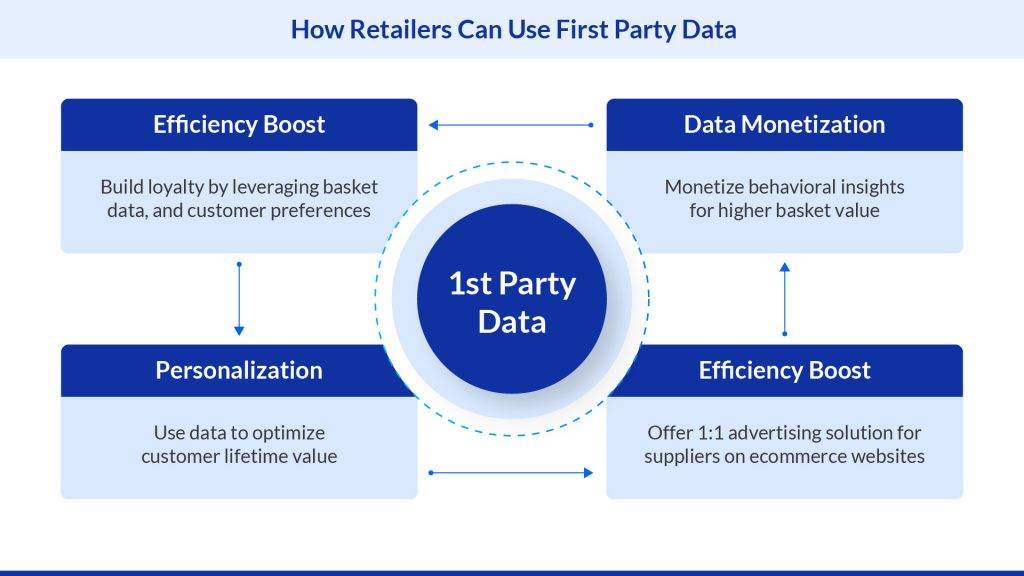
Why First-Party Data Is the Defining Asset of Retail Media
In a world where third-party cookies have been deprecated and privacy regulations have tightened, first-party data has become the most valuable asset in advertising. Retailers are uniquely positioned in this environment because they hold some of the richest first-party data available: detailed records of what their customers buy, how often they shop, which categories they prefer, and how their behaviour changes in response to promotions and price changes.
This data, when properly structured and activated, transforms a retailer's media network from a collection of screens into a precision targeting platform that commands premium advertising rates. The difference between an untargeted digital screen and a screen that can reach "shoppers who have purchased competitor brand X in the last 90 days" is not marginal, it is the difference between a $5 CPM and a $50 CPM.
Building the Data Foundation
The starting point for a first-party data strategy is the loyalty programme. A well-run loyalty programme that captures a high proportion of transactions provides the foundation for audience segmentation and closed-loop measurement. Retailers without a loyalty programme, or with low loyalty programme penetration, should consider this a priority investment before building a retail media network, because the data is what differentiates the network from generic digital out-of-home advertising.
Beyond loyalty data, retailers can enrich their first-party data with additional signals: in-store location data from Wi-Fi or Bluetooth beacons, app engagement data, website browsing behaviour, and customer service interactions. Each additional data source adds depth to the audience profiles and increases the targeting precision available to advertisers.
Audience Segmentation for Retail Media
Effective audience segmentation for retail media requires a balance between precision and scale. Segments that are too narrow may not have enough members to deliver meaningful impressions; segments that are too broad lose the targeting value that justifies premium CPMs. A practical approach is to build a hierarchy of segments, from broad category-level segments with large audiences to narrow behavioural segments with smaller but highly valuable audiences.
Common segment types for retail media include category buyers (shoppers who have purchased in a specific category in the last 30, 60, or 90 days), brand switchers (shoppers who have purchased competing brands but not the advertised brand), lapsed buyers (shoppers who previously purchased the advertised brand but have not done so recently), and high-value households (shoppers in the top quartile by spend). Each of these segments has a clear advertiser use case and can be priced accordingly.
Privacy-Safe Data Activation
Activating shopper data for advertising purposes requires careful attention to privacy regulations and shopper expectations. In Australia, the Privacy Act and the Australian Privacy Principles govern the collection and use of personal information, and retailers must ensure that their data practices comply with these requirements. The key principles are transparency (shoppers should know their data is being used for advertising), consent (shoppers should have the opportunity to opt out), and data minimisation (only the data necessary for the specific purpose should be used).
In practice, most retail media data activation uses anonymised and aggregated audience segments rather than individual shopper profiles. Advertisers receive information about the characteristics of the audience that saw their campaign, not the identities of individual shoppers. This approach preserves shopper privacy while still providing the targeting and measurement capabilities that advertisers value.
Closed-Loop Measurement: The Retail Media Superpower
The ability to measure the direct sales impact of advertising campaigns is the most powerful differentiator of retail media networks. Closed-loop measurement works by matching the anonymised profiles of shoppers who were exposed to a campaign with their subsequent purchase behaviour in the retailer's loyalty programme. By comparing the purchase rates of exposed shoppers with a matched control group that was not exposed, the retailer can calculate the incremental sales generated by the campaign.
This measurement capability allows retailers to provide advertisers with metrics that are directly comparable to the performance metrics they use for digital advertising: return on ad spend, cost per incremental purchase, and sales uplift percentage. These metrics build advertiser confidence and justify the premium CPMs that retail media networks command over traditional out-of-home advertising.
Adflux Editorial
Retail media, programmatic DOOH, and digital signage insights for Australian retailers.
Ready to build your retail media network?
Talk to the Adflux team about how the platform can work for your screens.