
How Consent Impacts Programmatic Revenue
User consent shapes programmatic ad revenue in Australia—impacting targeting, CMPs, server-side tracking and revenue recovery.

How Consent Impacts Programmatic Revenue
Consent directly affects programmatic advertising revenue. Businesses in Australia face tighter privacy laws, like the updated Australian Privacy Act, which requires user consent to be "voluntary, informed, current, specific, and unambiguous." Without proper consent, advertising revenue can drop significantly. For example, research shows:
- 250% higher ad performance when users provide consent.
- 40% revenue loss due to poorly configured consent systems.
- Revenue per thousand impressions (RPM) can fall from $2.00 (with consent) to $1.40 (unavailable consent) and $0.80 (refused consent).
Key takeaways for Australian businesses:
- Consent systems matter: Poorly managed consent impacts data accuracy and audience targeting, reducing revenue.
- First-party data is critical: Rely less on third-party cookies and focus on building trust with users.
- Use advanced tools: Consent Management Platforms (CMPs), Enhanced Conversions, and server-side tracking can recover up to 22% of lost revenue.
- Compliance is non-negotiable: Stricter laws demand transparency in data use and consent practices.
Balancing compliance with revenue strategies is essential to thrive in an increasingly regulated advertising landscape.
Safeguarding your advertising revenue with a Google-certified CMP.
sbb-itb-c231c83
How Consent Affects Programmatic Revenue
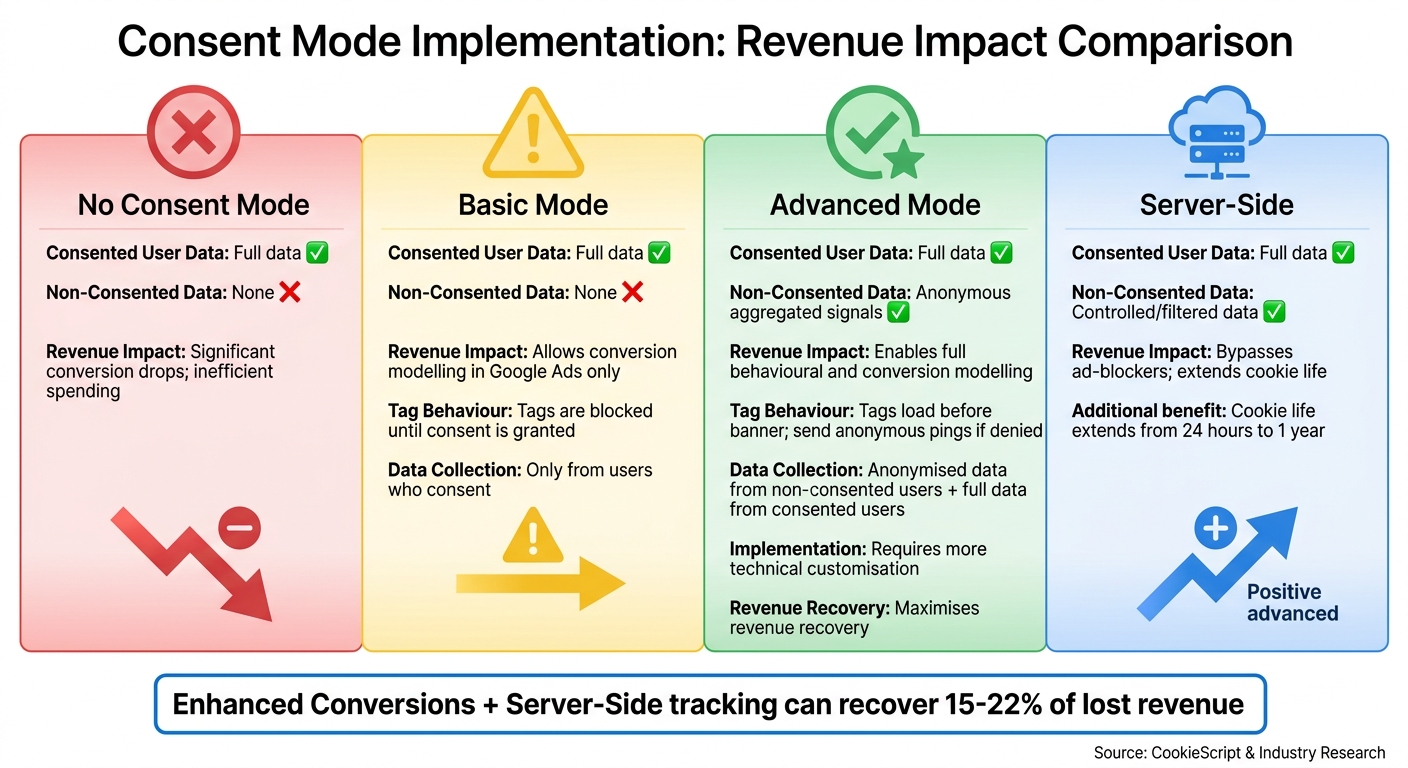
Consent Mode Implementation Types and Revenue Impact Comparison
Consent decisions play a crucial role in shaping programmatic revenue. When users grant consent, advertisers can access identifiers like cookies, local storage, and session storage, which are essential for precise tracking across platforms. On the other hand, when consent is denied, tracking capabilities become severely limited.
In a world without cookies, platforms must rely on aggregated signals instead of individual-level data. This shift impacts everything from building audiences to optimising campaigns. As CookieScript highlights:
"Without Consent Mode, Google Ads operates blindly, which is rarely profitable." – CookieScript
These limitations significantly reduce the accuracy of audience segmentation, making it harder for advertisers to reach their target audiences effectively.
Effects on Audience Targeting
When detailed consent signals are unavailable, remarketing lists shrink, and bidding algorithms are forced to work with incomplete data. This lack of precision in targeting can be particularly challenging for Australian businesses. Proposed reforms to the Privacy Act aim to ensure that consent is "voluntary, informed, current, specific, and unambiguous." This marks the end of bundled consent, where a single tick box covers multiple purposes. As ADMA cautions:
"The risk for businesses that do bundle consent is that, if there is a component that a customer does not agree to, you will likely not have valid consent, even under existing law." – ADMA
These changes not only complicate audience targeting but also introduce new hurdles for maintaining revenue streams.
Revenue Impact of Consent Requirements
The inability to target audiences effectively has a direct impact on revenue. Early data suggests that compliance rates hover around 40% before optimisation. Non-compliance leads to immediate revenue losses.
However, technical solutions can help mitigate some of these challenges. For instance, using Enhanced Conversions and Server-Side tracking in conjunction with consent management can recover 15–22% of lost data. Server-side tracking is particularly advantageous for Australian businesses, as it extends cookie life from 24 hours to one year and bypasses browser-based restrictions on client-side tracking.
| Implementation Type | Consented User Data | Non-Consented Data | Revenue Impact |
|---|---|---|---|
| No Consent Mode | Full data | None | Significant conversion drops; inefficient spending |
| Basic Mode | Full data | None | Allows conversion modelling in Google Ads only |
| Advanced Mode | Full data | Anonymous aggregated signals | Enables full behavioural and conversion modelling |
| Server-Side | Full data | Controlled/filtered data | Bypasses ad-blockers; extends cookie life |
This table illustrates why investing in robust consent solutions is essential for protecting revenue in an environment of increasingly strict privacy regulations.
Privacy Regulations and Compliance Requirements
Australian programmatic campaigns must navigate a maze of privacy regulations that dictate how consent is gathered, stored, and communicated to advertising platforms. Mastering these rules is crucial - not just for compliance but also for protecting revenue streams. These legal frameworks demand both technical precision and strategic planning.
Australian Privacy Act Requirements
Big changes are coming with the reform of the Australian Privacy Act, set to take effect in early 2026. The updated law will redefine consent, requiring it to be "voluntary, informed, current, specific, and unambiguous". This effectively ends the practice of bundled consent - where a single tick box covers multiple purposes, such as marketing analytics and third-party data sharing.
The reforms also introduce a "fair and reasonable" test for all data activities. According to the ADMA:
"Businesses won't be able to 'consent their way to compliance'. The idea behind this requirement is essentially to shift some of the legal responsibility for privacy that currently falls on consumers, onto businesses".
In other words, even with user consent, the fairness of the data practice itself will be scrutinised.
From December 2026, businesses will need to disclose how personal data is used in "substantially automated decisions", which includes programmatic bidding. Additionally, opting out must be as simple as opting in - no more subscription traps or complex withdrawal processes. Pre-ticked boxes will no longer meet the standard for voluntary consent.
Regulators are already stepping up enforcement. The OAIC and ACMA now see pixel tracking and third-party data flows as central compliance issues, not just technical details. Peter Leonard, Chair of ADMA's Regulatory and Advocacy Working Group, explains:
"The Privacy Commissioner has also made clear that organisations are expected to know how personal information is collected through digital marketing, where it goes, and who ultimately receives it".
While these local reforms tighten the screws on domestic practices, global privacy laws add another layer of complexity for Australian businesses.
Global Privacy Laws Affecting Australian Businesses
For Australian companies serving international markets, laws like the GDPR and the ePrivacy Directive bring additional challenges. These regulations require active, prior opt-in consent for non-essential cookies, including those used in programmatic advertising, for users in the EEA and UK. Without a valid Transparency and Consent (TC) string from a certified Consent Management Platform (CMP), businesses are limited to non-personalised ads, which typically generate far less revenue.
As of 1 March 2026, publishers using Google ad services in the EEA, UK, and Switzerland must adopt TCF v2.3 with a Google-certified CMP to serve personalised ads.
Enforcement is no joke. In September 2025, the French regulator CNIL fined Google €325 million and Shein €150 million for deploying advertising trackers before users interacted with a consent banner. In 2025 alone, the CNIL issued 83 sanctions, totalling €487 million, with cookie-related violations topping the list. Following European court rulings in May 2025, TC Strings are now legally recognised as personal data, requiring the same rigorous protections as other identifiers.
These developments underscore the importance of robust consent management systems - not just for compliance but also to maintain revenue in an increasingly regulated environment.
Balancing Compliance and Revenue Performance
Privacy compliance isn’t just about following regulations - it can also drive revenue by making the most of approved data. Australian businesses can safeguard programmatic revenue by focusing on first-party data strategies, using certified consent management platforms (CMPs), and applying conversion modelling to bridge gaps left by users who opt out of tracking. This delicate balance between adhering to privacy laws and maintaining revenue is central to today’s programmatic advertising strategies.
Building First-Party Data Strategies
The days of relying on third-party cookies are numbered. With Australia’s updated Privacy Act requiring businesses to adopt "fair and reasonable" data practices, collecting first-party data in a way that’s both ethical and transparent is more critical than ever. But this shift isn’t just about compliance - it’s about fostering trust, which leads to higher-quality user opt-ins.
As Chris Brinkworth, a Privacy Engineering Expert, puts it:
"If you don't have permission, you don't have trust".
Clear and open communication about what data you’re collecting, why you need it, and how it benefits users - whether through personalised offers, loyalty rewards, or an improved shopping experience - turns consent into an opportunity to build stronger connections.
Moving away from unclear data collection methods also ensures your business is better prepared for the future. Anna Samkova highlights this shift:
"Data privacy is no longer 'nice to have' – it's a business imperative".
To stay ahead, audit your data workflows to ensure they align with the "fair and reasonable" standard outlined in the updated regulations.
Implementing Consent Management Platforms
A certified CMP is a must-have for businesses aiming to balance data compliance with revenue goals. A Consent Management Platform automates privacy compliance and, when integrated with your advertising tools, ensures consent signals are sent to ad platforms in real time. This guarantees that tags only fire when user consent is granted, keeping programmatic operations efficient and compliant with both Australian and international privacy laws.
For companies with global audiences, using a Google-certified CMP that supports the IAB Transparency and Consent Framework (TCF) ensures consent strings are communicated accurately across the programmatic ecosystem. Even for businesses focused solely on Australian markets, this integration simplifies data handling.
To protect revenue, Advanced Consent Mode is far more effective than Basic Mode. While Basic Mode blocks all data collection for users who decline consent, Advanced Mode sends anonymous pings that allow conversion modelling to continue. This ensures smart bidding remains optimised even when direct user data isn’t available.
Pairing Enhanced Conversions with server-side tracking can recover an additional 15–22% in revenue. Without consent mode, Google Ads might underreport conversions, leading to higher cost-per-acquisition (CPA) and lower return on ad spend (ROAS).
| Feature | Basic Consent Mode | Advanced Consent Mode |
|---|---|---|
| Tag Behaviour | Tags are blocked until consent is granted. | Tags load before the banner; send anonymous pings if denied. |
| Data Collection | Only from users who consent. | Anonymised data from non-consented users + full data from consented users. |
| Revenue Impact | Limited modelling; lower recovery. | Enables conversion modelling; maximises revenue recovery. |
| Implementation | Easier to set up. | Requires more technical customisation. |
For retail media networks using programmatic SSP integrations, like those managed via Adflux CMS, a CMP that integrates with your content management system ensures consent signals flow smoothly through the entire ad tech stack. This approach maintains compliance while preserving campaign performance.
To address data gaps from non-consenting users, configure GA4 with blended reporting.
Case Study: Consent-First Implementation
Australian media networks can adopt these strategies to navigate local privacy regulations while protecting revenue streams. Although specific Australian examples are still emerging as the Privacy Act reforms take effect, lessons from the broader programmatic industry are clear. By late 2024, over 37% of U.S. browsers were operating without cookies. Advertisers who shifted to first-party data strategies maintained targeting precision through Private Marketplace (PMP) deals, which rely on first-party signals instead of third-party cookies.
While cookie-based buys are still common, forward-thinking advertisers are embracing SSP-level data curation. This method pre-matches inventory with custom audience segments, enabling precise targeting without third-party cookies.
As Sojern explains:
"Data curation allows for targeted strategies that align with diverse privacy standards, helping to build consumer trust and foster long-term relationships".
The takeaway for Australian retail media networks? Diversify your targeting methods. Use a mix of first-party data, AI-driven lookalike modelling, and contextual targeting to keep campaigns effective across different privacy frameworks. Streamlining data processing at the SSP level not only enhances compliance but also reduces the number of parties handling user data, lowering your advertising carbon footprint.
For businesses running digital screen and audio networks, server-side tracking through Google Tag Gateway can bypass ad-blockers and extend cookie life. This is especially important as browsers like Safari and Chrome tighten their restrictions. When combined with a certified CMP and Advanced Consent Mode, these strategies create a solid foundation for maintaining programmatic revenue while meeting Australia’s stricter privacy standards.
How Adflux CMS Supports Consent Management and Revenue

For Australian retail media networks managing digital screen and audio advertising, Adflux CMS offers the tools needed to meet consent requirements while protecting revenue streams. Its programmatic SSP integration ensures consent signals are seamlessly transmitted through the ad tech stack. This means critical metadata and compliance markers reach buyers within milliseconds during real-time bidding auctions, a necessity for adhering to Australia's strict consent regulations. By building on earlier strategies for consent management, Adflux CMS ensures revenue stays optimised in an increasingly privacy-focused environment.
The platform's privacy-focused analytics enable an advanced consent mode that adjusts tag behaviour dynamically. When consent is denied, its built-in system sends cookieless pings, allowing for conversion modelling without relying on cookies. This feature bridges data gaps while respecting user privacy - an essential capability, especially since Google Ads requires at least seven days of consent mode implementation before reporting any uplift from conversion modelling.
With enterprise-grade governance tools, Adflux CMS helps businesses maintain the auditable records required by Australian regulations. The platform handles complex frameworks like the Australian Privacy Act and global standards such as TCF 2.2. This is increasingly important under Australia's "fair and reasonable" test, which evaluates whether data practices are fair, even if consent has been obtained. These governance and technical features highlight the platform's ability to meet compliance needs while maintaining industry trust.
As OneTrust explains:
"When it comes to programmatic advertising, consent isn't just a requirement; it's the key to unprecedented revenue potential".
By combining SSP integration, advanced analytics, and strong governance, Adflux CMS transforms consent management into an avenue for precision and revenue growth.
In line with the growing emphasis on first-party data, Adflux CMS equips retail media networks to maintain competitive revenue while complying with Australia's stricter privacy standards. This approach is particularly relevant as programmatic advertising is forecast to account for nearly 90% of global display ad spend by 2025.
Conclusion
Consent management plays a crucial role in driving revenue for Australian retail media networks within the programmatic advertising space. The focus has shifted from merely meeting legal requirements to actively building trust with users. As FLLR Consulting aptly states:
"Your consent architecture is either building audience or eroding it".
By integrating Advanced Consent Mode, server-side tracking, and first-party data strategies, businesses can improve Enhanced Conversions and Server-Side GTM recovery rates by 15–22%. Additionally, organisations excelling in digital trust are 1.6 times more likely to achieve annual revenue and EBIT growth of at least 10%. These practices not only safeguard revenue streams but also address the challenges of evolving compliance requirements.
For Australian companies, adhering to the "fair and reasonable" test means ensuring data practices are genuinely equitable. This involves treating consent as both a compliance issue and a user experience priority. Essential steps include A/B testing preference centre language, using opt-in rates as a performance metric, and maintaining detailed audit trails.
Adflux CMS offers the technical tools needed to execute these strategies effectively. With features like seamless programmatic SSP integration and privacy-focused analytics, it supports cookieless tracking and conversion modelling. As programmatic advertising continues to expand, platforms that strike the right balance between compliance and revenue growth are poised to lead the next phase of retail media innovation.
Closing the trust gap by creating consent experiences that prioritise user respect while maintaining data integrity will be key to long-term success.
FAQs
How do I increase opt-in rates without hurting user experience?
To improve opt-in rates while keeping the user experience intact, focus on clear and transparent consent methods. Steer clear of manipulative tactics like hiding "reject" options or making "accept" buttons overly prominent. Instead, present balanced choices and clearly explain the advantages of data sharing in simple, honest terms. A well-designed, user-friendly cookie banner that prioritises clarity and respects user autonomy builds trust, encouraging users to opt in willingly while ensuring compliance.
What’s the best way to measure consent-related revenue loss in GA4 and Google Ads?
When it comes to tracking revenue loss tied to user consent in GA4 and Google Ads, conversion modelling and signal recovery are your go-to methods. Tools like Google Consent Mode v2 can help you estimate how much signal loss occurs due to users declining consent. Plus, they assist in regaining some of that lost performance, especially when it comes to ROAS (Return on Ad Spend). These approaches give you a clearer picture of how consent impacts your advertising results.
Do I need server-side tracking if I already use Advanced Consent Mode?
Absolutely, server-side tracking remains a strong recommendation. Why? It helps bypass ad-blockers, extends cookie lifespans, and can make a noticeable difference in attributed revenue. These advantages work hand-in-hand with Advanced Consent Mode, improving data accuracy and compliance while also fine-tuning programmatic revenue strategies.
Adflux Editorial
Retail media, programmatic DOOH, and digital signage insights for Australian retailers.
Ready to build your retail media network?
Talk to the Adflux team about how the platform can work for your screens.